Image courtesy of World Poker Tour
One question that I get often from small stakes players is how to play from the blinds facing several limpers. In this article, we’ll address several specific things you can do in these situations to improve your win rate in the situations.
Before we do that, however, there are a couple of questions you need to answer about the limpers in your specific games and their overall strategies, such as:
- Are they straightforward, limping in mostly with weak hands and trying to see cheap flops, or are they on the tricky side, calling with premium hands looking to trap? This distinction will heavily influence your preflop strategy.
- Are they calling stations? Do you expect them to fold to raises, or are they more a type of player who’ll call almost any raise with almost any two cards?
What you should also be aware of in these scenarios is that the first limper is usually your main concern. Subsequent limpers will rarely have strong starting hands, because they would have raised themselves with premium holdings, looking to isolate the original limper and play against them in position.
When you do decide to raise, you should be experimenting with different sizes to see what works best. Generally speaking, you’ll want to make your raises big enough to discourage players from calling.
A pot-sized raise is usually the minimum you should go with, and, in some specific lineups, you can even go with huge raises, knowing that your opponents have unprotected ranges and will never call if you make it something like 15 big blinds.
Playing from the Small Blind
When you’re in the small blind, your pot odds increase as more players limp in. You’ll only have to put in half a big blind to call and play for the pot that already has five, six, or seven big blinds in it.
Therefore, you should call with a fairly wide range of hands that can reasonably flop effective nut hands, i.e., pairs, suited hands, and decent connectors.
Despite getting the great odds, you should fold hands with significant reverse implied odds. These are largely off-suit hands like K5 or Q7. With these types of holdings, when you flop a top pair or even improve to trips, you’ll rarely be in good shape if a lot of money ends up going into the pot.
Your raising range should consist primarily of strong hands that you can play for value (99+, AJo+, ATs+, maybe KQ), and some bluffs. You are best off picking hands that block your opponents’ value holdings, such as Ax, Kx, and Qx of the off-suit variety.
If you get to the flop with multiple limpers, you should play pretty straightforwardly. More often than not, if you don’t connect with the flop, someone else will have, and these are not favorable situations to start bluffing.
Playing from the Big Blind
When you’re in the big blind and facing limpers, you have the option to check and see the free flop. This means that you’ll primarily want to raise with some of your best hands, and then a few bluffs (again, hands like Kx, Qx, and Jx).
When deciding how frequently you want to go for it with weak hands and how to size your bluffs, consider the players’ tendencies. If many of them are calling stations who just don’t like to fold before the flop, dial it down.
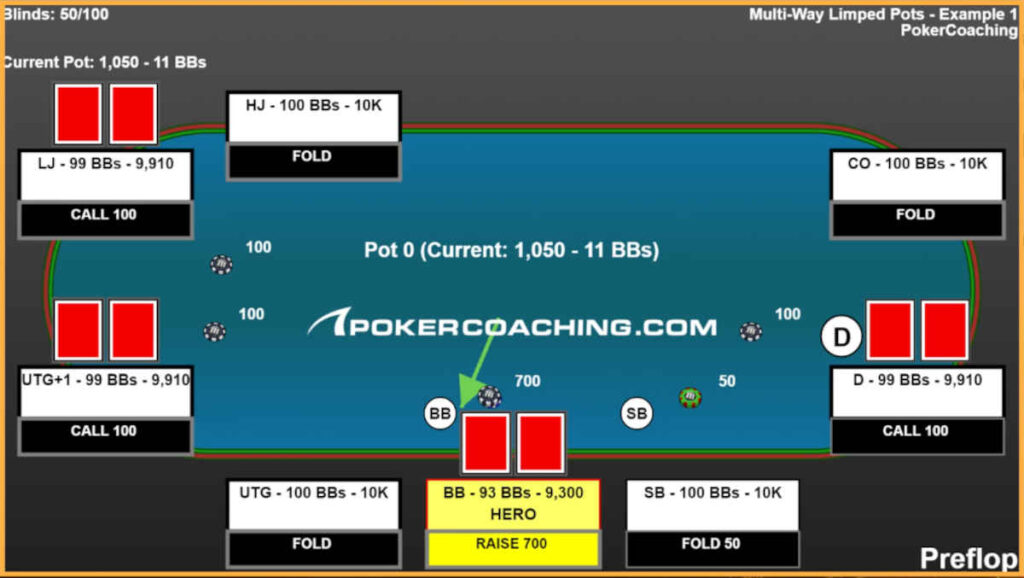
If you figure out they’ll always fold to big raises, start doing that and continue picking up free chips until they adjust.
Even semi-competent players will catch up to what you’re doing eventually, and they’ll either stop limping or they’ll add some strong hands to their limping range to trap you. But, until they do, this can be your license to print money.
Postflop Strategy in Multi-Way Limped Pots
Once you get to the flop after just calling or checking your option, your default should be to check with everything if there are several players to act after you.
One exception to this rule is if you find yourself in a game with a lot of passive players who’ll be happy to check through the flop action. Here, you’ll want to lead with your strong made hands as well as a variety of draws.
These are the types of hands you’ll be looking to check-raise with, but against passive opponents, you just won’t get that opportunity. Thus, it’s better to take the betting lead.
After you check, if there is a bet and call or a bet and a raise before the action gets back to you, proceed with extreme caution.
Many players make the mistake of continuing with a hand like a middle pair with no kicker, believing they have five outs. However, this often won’t be true, and even when you do improve to a winning hand, it won’t be easy to get paid, playing out of position.
In these spots, especially if there is a bet and a raise, you should only continue with hands that have the potential to turn into the nuts (or very close to it).
This pretty much sums up a solid strategy for playing against limpers in the blinds. Figure out what their strategy is, adjust your play accordingly, and be ready to change gears if they start catching up, always staying one step ahead.