
Image courtesy of World Poker Tour
In today’s article, we’ll talk about poker ranges and, more precisely, how to think along these lines and narrow down your opponents’ ranges as a hand progresses.
In poker, you’ll never know your opponent’s two specific cards; that’s not how the game works. Thus, you need to think in terms of all the hands they could reasonably have.
Simply put, range is a collection of poker hands that a particular player could have based on their actions, as well as specific and general tendencies.
Narrowing Down the Range
Assigning ranges in poker is a dynamic process. As a hand progresses, you’ll be narrowing down each player’s range based on things such as:
- Betting actions: did they call, raise, or re-raise?
- Bet sizes: did they bet small, big, massive, or move all-in?
- Opponent’s tendencies: are they a loose player or someone who only gets involved with the best hands?
- Any physical tells you can pick up?
In this group, physical tells can be very helpful when playing live. They can help you narrow down a player’s range based on certain behavioral patterns, such as sitting up in their chair when they pick up a good hand. Thus, you need to always pay attention to what’s happening around you.
Lacking some very specific information, you should assign reasonable and logical ranges, while keeping in mind that not everyone plays the same.
Reasonable ranges don’t necessarily mean what GTO suggests. For example, in small stakes cash games and tournaments, if someone 3-bets you preflop, they are probably not bluffing enough. The general player pool tendency is that they’ll have a significantly stronger range than (theoretically) they should have in this spot.
As you learn more about your opponents, you’ll be able to make better assumptions about their ranges. So, pay attention to everything that goes down at the table, but try to maintain a fun and casual atmosphere. If things become too serious, this will likely result in players playing more conservatively, which means they’ll make fewer mistakes.
A Hand Example
Let’s look at an example of how the process of narrowing down a range looks in practice. Say a player raises from the button at an eight-handed table. The chart below shows what hands they’re supposed to be raising with (shown in red).
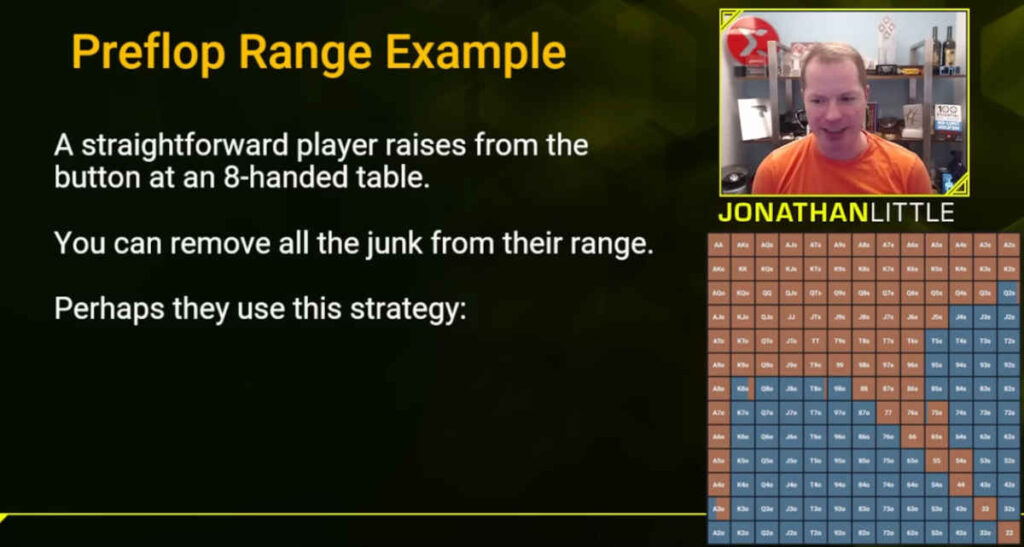
They may be a bit tighter or a bit looser than what the chart suggests, but most players who spent some time studying poker have a decent understanding of button raising ranges.
As you move on the flop and later streets, your assessment of their range will change based on the board texture, actions taken, and the opponent’s tendencies.
So, in this spot, you call from the big blind, and the flop comes K-6-2, rainbow. After you check, they fire a continuation bet of two big blinds.
This is a fairly dry, disconnected board, where you can presume the opponent will bet with their entire range. Their range contains a lot of kings, as well as pocket pairs (77+), but if they are betting with 100% of the hands, they will also miss a lot.
With this in mind, this is a spot where you can definitely get away with some check-raises, especially if they’ll only continue with made hands.
On this occasion, though, you decide to call and see an 8 peel on the turn. Now, if you know that your opponent will bet with a pair of eights or better and check back with everything else, you can play perfectly.
This is exactly where many small stakes players make a mistake. They will raise correctly before the flop, c-bet on the flop, but they will shut down on the turn if they don’t have at least a middle pair. So, they’ll slow down and hope for a cheap showdown.
If you know this about their range, you can comfortably fold all your bluff catchers when they bet on the turn. If they check back on the turn, you now know that their range is weak, and you can exploit this by betting big on the river, putting them in a very difficult spot.
Keep Building Your Experience
It’s not hard to become great at assigning ranges, because you can go through this process with every single hand of poker you play for the rest of your life.
You should be paying attention and assigning ranges in every hand, even when you’re not involved in the pot. Although you often won’t see if you were right, as many hands don’t reach the showdown, it’s important to get used to this process.
With time, it’ll become something you do without actively thinking about it.
If you’re missing these opportunities to gain experience while your opponents are getting better, you’ll fall behind, so don’t let that happen.
With lots of practice, you’ll become excellent at narrowing ranges, making better decisions, and, as a result, winning more money from poker, which is the ultimate goal!