Image courtesy of World Poker Tour
We all hate folding good hands on the flop, but sometimes it is the right play and the one that will save you a lot of money in the long run.
And, in poker, any money saved is money earned.
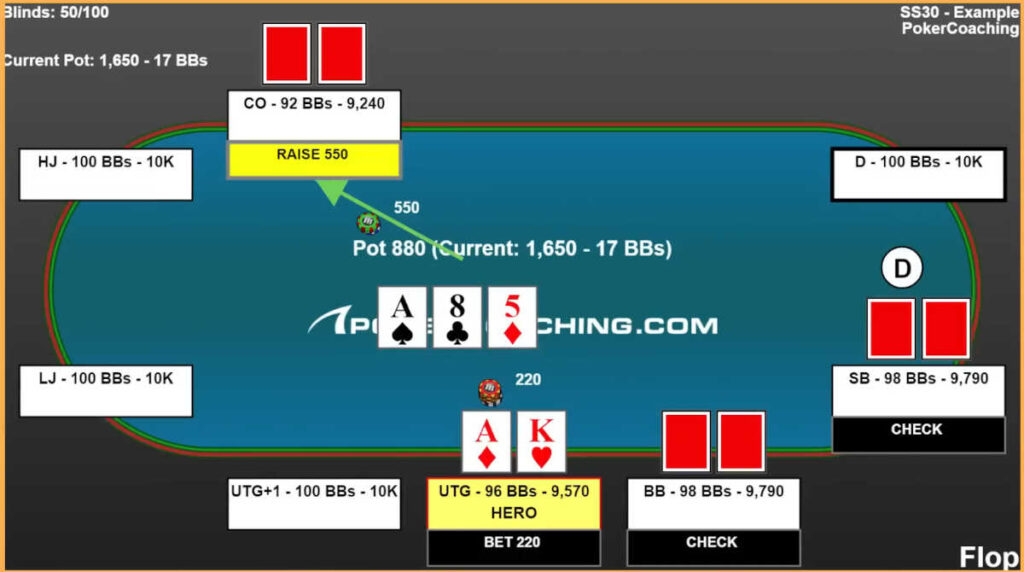
Let’s say we raise with A♦K♥ from UTG and get called by the cutoff, small blind, and the big blind. The flop comes A♠8♣5♦. We fire a continuation bet, and the cutoff raises.
How to proceed in these spots depends on several major factors.
#1 What’s Your Opponent’s Strategy?
Most players don’t exactly stick to the GTO strategy, especially in multi-way pots.
If the raiser’s range contains any ace, which will be the case for some players, then you shouldn’t be folding, as you’ll be dominating a lot of their holdings.
However, if they only raise with two pair or better and an occasional draw, you need to fold as you’ll either be behind or against a hand with a fair bit of equity.
Of course, it’s not always easy to know what your opponent’s strategy is, which is why it’s essential to pay attention while playing. Focus on the action instead of whatever distractions may be around.
Generally speaking, though, most players in most games (especially at lower stakes) are fairly honest and straightforward. When they flop a big hand, they’ll want to build a pot, so when you face a raise in this situation, you’ll probably be up against a hand like A5, A8, pocket 5s, pocket 8s, and maybe AQ or an open-ended straight draw.
With all this in mind, AK becomes just an okay hand in this spot, and nothing more than that.
#2 Don’t Stick Around for Too Long
Folding early will save you a lot of trouble and money. Often, players stick around for too long, hoping to improve to two pair or trips.
What you need to keep in mind is that you’ll only get to improve every now and again, and even when you do, you’ll still end up losing quite often.
If you catch another king, you’ll still be losing to sets. If another ace comes, your two pair will still be behind flopped sets and two pair hands that turned into full houses.
It’s perfectly fine to get out of sticky situations early. Maybe you can take some heat with a hand like AK that could still be ahead of some lighter value raises, but a hand like AT, for example, becomes a very easy fold.
Once more, your opponent’s tendencies are very important when deciding what to do.
Some players will raise on the flop pretty aggressively, but then they’ll shut down on the turn and check back with any hand that’s not at least two pair. Against these players you can let the turn check through and then look for some value on the river with a hand like AK.
One thing you don’t want to be doing is calling flop and turn with the plan of folding on the river. Most players, if they are any good, won’t just give up on a river with a busted straight draw and will fire another bullet with a polarized range.
There is really no clearly defined answer for these spots, which may be annoying to some people, but it really depends a lot on your opponents’ tendencies.
#3 Approach Multi-Way Pots Carefully
When there are several players involved in a pot, the odds of someone flopping a big hand increase significantly compared to heads-up situations, and you need to keep that in mind.
So, if we take our example of AK on the A-8-5 flop, is it a good hand seven ways?
If you bet and get called in one or even two spots, probably. But if someone raises, you’re not likely to be in good shape.
If someone is showing a lot of aggression in a multi-way spot, you should be quick to get out of the way with any non-premium holdings.
You also don’t have to worry about your opponents exploiting this and running you over because AK is pretty much the bottom of your value range in this type of scenario. Thus, your range stays well protected.
The more players there are in the pot, the more you should be checking. So, if you had AT instead of AK, you should check and see what happens. You can call against one player, but if there is a bet and a call in front of you, just get rid of it.
Or, say you open with K-9, and the flop comes K-J-8. In a multi-way pot, you should be checking instead of c-betting, and if there is a bet and a call, folding is the right course of action. Your opponents’ ranges contain two pair, sets, and a lot of strong draws, and you’re not in good shape against that range.
So, to sum it up, always think in terms of ranges, don’t pay off straightforward players (which most players at lower stakes are), and if you do notice someone getting out of line, you can adjust and find more call-downs against those specific opponents.