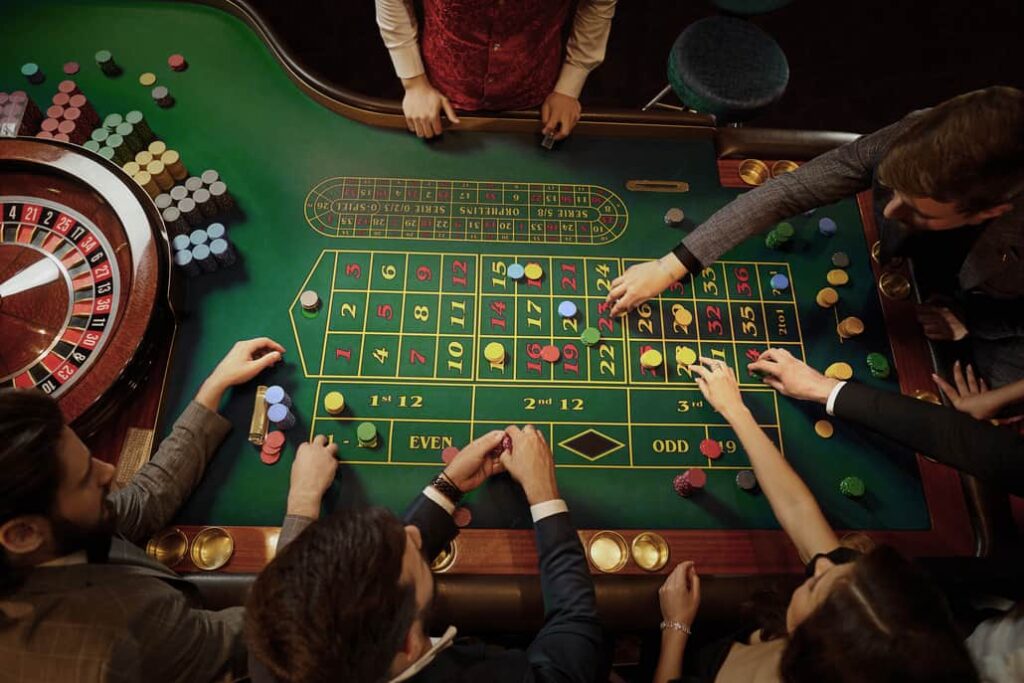
Roulette is a classic casino game of chance in which the core objective is to accurately predict the ball’s final landing spot by placing chips on a predetermined table layout.
The game consists of a wheel featuring numbered pockets and a betting table that reflects those numbers.
Payouts are determined by the specific type of bet placed. Wagering on a single number offers the highest payout, while betting on broader categories that cover more numbers offers lower payouts with higher mathematical odds of winning.
How Roulette Works – A Step-by-Step Guide
Roulette has a standard flow that is the same in each round. Here’s a simple step-by-step illustration of how roulette works:
- Place Your Bets on the Table – Players place their chips on the felt table layout. You can choose between a variety of bets, ranging from specific numbers and colors to groups of numbers.
- The Croupier Spins the Wheel – The croupier spins the wheel in one direction and launches the ball in the opposite direction. Players can usually continue placing bets for a few moments while the ball is in motion.
- The Betting Window Closes – As the ball begins to slow down, the croupier will call out “No more bets” and wave their hand over the table. At this point, no further chips can be placed or moved.
- The Ball Lands in a Numbered Pocket – The ball drops toward the center of the wheel. It bounces off metal deflectors before finally settling into one of the 37 or 38 numbered and colored pockets.
- Losing Bets are Cleared and Winning Bets are Paid – The croupier places a marker on the winning number on the table. They first clear away all losing bets. Finally, they pay out the winning bets according to the specific odds of each wager before the new round starts.
Roulette Wheel & Numbers Explained
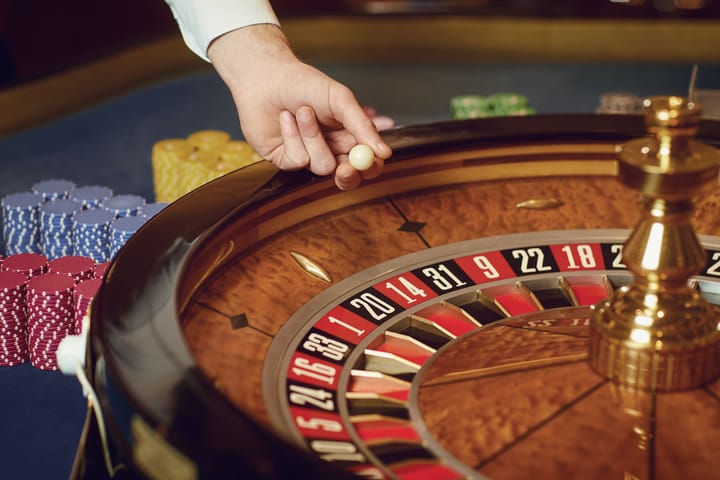
The roulette wheel is composed of numbers 1 through 36, which are divided into red and black. There are 18 numbers of each color, and they alternate around the wheel to ensure a balanced distribution.
You can choose to bet on these numbers individually or through broader categories like Even vs. Odd, which also splits the 36 numbers into two equal groups of 18.
Additionally, every roulette wheel also has a green zero pocket. The handling of zeros depends on the specific version of the game:
- In European Roulette, there is only a single zero, resulting in 37 total pockets. This version is generally preferred by players because the presence of only one green pocket keeps the house edge relatively low.
- American Roulette features both a single zero (0) and a double zero (00), resulting in 38 pockets. Both of these pockets are green. By adding a second zero, the game increases the likelihood that the ball will land on a house-favored number, nearly doubling the casino’s statistical advantage over the player relative to the European style.
Types of Roulette Games
American, European, and French roulette all follow the same basic rules, but the number of zero pockets significantly alters your mathematical chances of winning. American Roulette uses two green pockets (0 and 00), while both European and French Roulette use a single green pocket (0).
Because the payouts for winning bets, like a 35:1 payout for a single number, remain the same across all three games, having fewer green pockets directly increases your odds of success.
While the American and European versions are the most common, French Roulette is often considered the most favorable for players, due to its very low house edge on certain bets. Here’s a direct table comparison of these three popular types of roulette games:
| Feature | European Roulette | French Roulette | American Roulette |
| Total Pockets | 37 | 37 | 38 |
| Zero Pockets | One Zero (0) | One Zero (0) | Two Zeros (0 and 00) |
| House Edge | 2.70% | 1.35% (Not for all bets) | 5.26% |
| Winning Odds for Straight Up Bet | 1 in 37 | 1 in 37 | 1 in 38 |
| Special Rules | None | La Partage and En Prison | None |
Despite differences in the wheel and table’s visual layout (as French tables often use French terms such as Pair for Even and Impair for Odd), the core mechanics remain the same. You place bets on a grid, the croupier spins the wheel, and winners are paid according to the same standard odds.
Roulette Bets Explained
To learn how to play roulette, you should familiarize yourself with all of the bets available to you at the table. The table below outlines the odds and payouts for each bet type for European and American roulette:
| Bet Type | Payout | European Roulette Odds | American Roulette Odds |
| Straight Up (1 Number) | 35:1 | 2.7% | 2.6% |
| Split (2 Numbers) | 17:1 | 5.4% | 5.3% |
| Street (3 Numbers) | 11:1 | 8.1% | 7.9% |
| Corner (4 Numbers) | 8:1 | 10.8% | 10.5% |
| Six Line (6 Numbers) | 5:1 | 16.2% | 15.8% |
| Dozens | 2:1 | 32.4% | 31.6% |
| Columns | 2:1 | 32.4% | 31.6% |
| Red/Black | 1:1 | 48.6% | 47.4% |
| High/Low | 1:1 | 48.6% | 47.4% |
| Odd/Even | 1:1 | 48.6% | 47.4% |
All of these bets can be divided into two main categories: inside and outside bets. Below, you can find these two types of roulette bets explained.
Inside Bets
Inside bets are placed on the inner portion of the table layout, directly on specific numbers or the lines between them. These bets cover a smaller range of possible outcomes, resulting in a higher risk of losing but significantly higher payout ratios if the ball lands on a chosen number. Here are the types of roulette inside bets:
- Straight Up – A bet placed on a single specific number (including zero), offering the highest payout.
- Split – Wager placed on the line between two adjacent numbers, covering both.
- Street – A bet placed at the end of a row of three numbers, covering that entire row.
- Corner – A wager placed on the intersection where four numbers meet, covering all four.
- Six Line – A bet placed at the junction of two adjacent rows, covering all six numbers in those rows.
Outside Bets
Outside bets are placed on the outer sectors of the table layout, covering large groups of numbers rather than specific individual digits. In the inside bets vs. outside bets comparison, outside bets are characterized by a higher probability of winning but offer much lower payout ratios than inside bets. Here’s a full rundown of all outside bets in roulette:
- Red/Black – A wager on whether the winning number will be red or black, covering 18 numbers.
- Odd/Even – Bet on whether the winning number will be an even or odd digit, covering 18 numbers.
- High/Low – A wager on whether the ball lands on the Low numbers (1–18) or the High numbers (19–36).
- Dozens – Wager on one of three specific groups of twelve numbers (1–12, 13–24, or 25–36).
- Columns – A bet on one of the three long vertical columns of 12 numbers on the table layout.
In roulette, the payout for a specific bet is standardized across the American, European, and French versions. The difference in your chances of winning does not arise from the payout amounts but from the presence of the green zero pockets, which alter the total number of possible outcomes.
House Edge & Odds Explained Simply
The house edge in roulette exists because the payout for a winning bet is slightly lower than the actual mathematical risk of the spin. This gap is entirely attributable to the green zero pockets.
Although there are 36 red-and-black numbers, the presence of one or two green zeros yields 37 or 38 possibilities. Because the casino pays you as if there were only 36 numbers on the wheel, they keep a small percentage of every dollar wagered over time.
The green zeros specifically disrupt even-money bets. Many players assume these bets offer a 50/50 chance, but if the ball lands on a green zero, you would lose the bet no matter which side you chose.
This ensures the casino wins more often than the players do. Because European roulette has only one zero, compared with the two on American wheels, it offers better long-term odds for the player by reducing the frequency of these house-favored outcomes.
Common Roulette Rules & Betting Strategies

While roulette is largely a game of chance, the specific roulette rules and betting patterns you choose based on your preferences can influence how you manage your bankroll. Focusing on the former, if you play the French roulette variation, you should know how its two specific rules, La Partage and En Prison, work and how to utilize them.
Both of these rules apply to even-money bets when the ball lands in the green zero pocket. Under La Partage, you immediately receive half of your wager back. En Prison instead “locks” the bet for a second spin. If the next spin wins, the original wager is returned in full, effectively giving you a second chance to recover your stake.
You should also be mindful of table limits, which dictate the minimum and maximum amounts that can be wagered on a single spot. These limits can often differ between inside and outside bets. Because outside bets cover more numbers and have a higher hit frequency, their minimum requirements are sometimes higher than those for specific number bets.
These limits are crucial to consider because they act as a ceiling for progressive betting systems, preventing players from doubling their bets indefinitely. With this in mind, let’s go over a few popular betting strategies:
- Martingale – This is a negative progression system that requires you to double your bet size every time you lose. The logic behind this risky strategy is that a single win will eventually occur, covering all previous losses and returning a profit equal to the original starting bet.
- D’Alembert – Often viewed as a safer alternative to the Martingale strategy, this system uses a more gradual approach. Instead of doubling, you simply increase your bet by one unit after a loss and decrease it by one unit after a win.
- Fibonacci – This strategy utilizes the famous mathematical sequence where each number is the sum of the two preceding ones (1, 1, 2, 3, 5, 8, 13, and so on). You move one step forward in the sequence after a loss and move back two steps after a win.
- Andrucci – This is a high-variance strategy based on the concept of short-term trends. You observe the wheel for about 30 spins to identify which numbers appear to be landing more frequently and make straight-up bets on them.
- Paroli – Known as a positive progression system, the Paroli focuses on compounding wins rather than chasing losses. You keep your bet at the base minimum after a loss but double it after every win, typically for a maximum of three consecutive wins.
Conclusion: Is Roulette a Game of Skill or Chance?
Ultimately, roulette is a game of pure chance. Unlike some other casino games, where your decisions or mathematical strategies can influence the outcome, every spin of the roulette wheel is an independent and random event. There is no physical way for you to influence where the ball lands. Moreover, previous results have no bearing on the number that will appear next.
It’s a common misconception that betting systems can overcome the house edge. While systems like the Martingale or Fibonacci can help you manage your bankroll or structure your wagers, they do not change the underlying mathematical odds of the game.
The house edge, built into the wheel by the green zero pockets, remains constant regardless of how you fluctuate your bet sizes or which patterns you follow.
With this in mind, understanding the rules and the different versions of the game is not about gaining skill, but about managing expectations and making informed choices.
By knowing that in the European vs American roulette comparison, the former offers a more player-friendly house-edge, or that French rules can protect your stake on even-money bets, you can choose the environment that gives you the most play-time for your money.
Recognizing the reality of the house edge will allow you to enjoy the game as a form of entertainment rather than a means of generating profit.