
Studying poker feels easy when you throw on a stream, half-watch a training video, maybe glance at a solver… and call it productive.
But if you actually want your results to change, your study habits have to change, too.
Here are the biggest takeaways from my experience and something you can use in 2026 to improve the learning process. I turned these takeaways into a practical checklist you can use immediately.
Tip #1. Eliminate distractions and set yourself up to learn
First things first: get rid of distractions.
Watching a stream with someone playing 4–15 tables is entertainment, but it’s not real studying. Watching TV while “kind of” listening to a poker video isn’t studying either. If you want to improve, you need focused, intentional study time.
Also, be realistic about your energy. A lot of people work all day, deal with family life, and then try to study poker for 30 minutes when they’re completely wiped. That’s better than nothing… but you’ll retain way less.
If you want your study time to matter, show up rested, focused, and ready to actually learn. To make this happen, plan your studying time in advance.
Tip #2. Use active learning, not passive content
One of the biggest mistakes I see is that people aren’t engaged with the content.
If you’re just sitting back passively, the odds that you’ll remember what you watched and actually apply it in-game are pretty low.
That’s why short, structured sessions with interaction like quizzes or “what would you do?” moments work so well, and this is exactly what we focus on at pokercoaching.com. You’re forcing your brain to retrieve information and make decisions, and that’s exactly what poker is.
If you’re serious about improving, don’t just consume content. Interact with it. Test yourself.
Tip #3. Fix your solver mindset and start understanding WHY
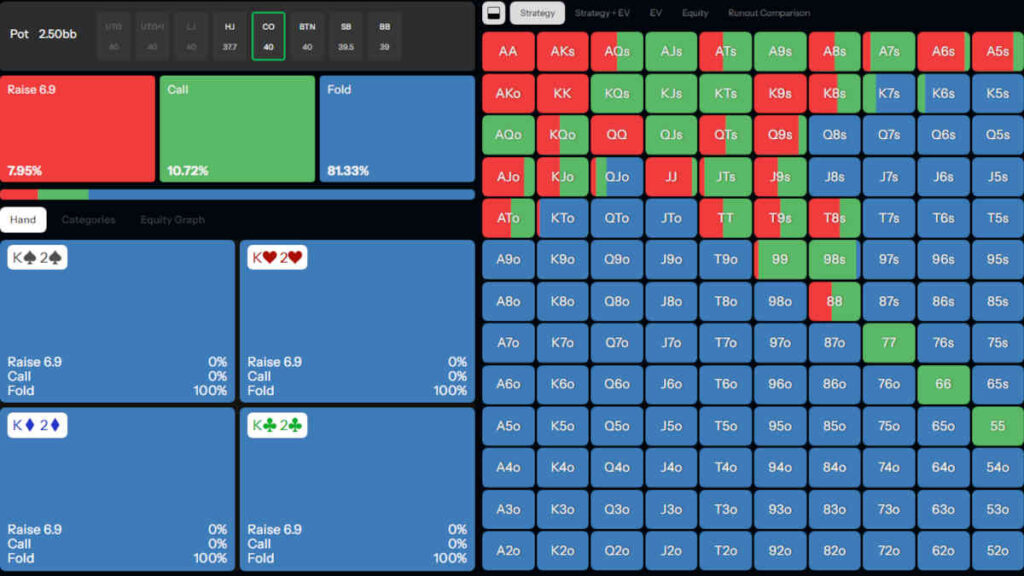
Here’s another huge leak: people use solvers to “grade” one hand, then move on.
That’s not studying. That’s spot-checking.
If you’re going to use solvers or sims, you need to stop thinking, “Did I play this one hand right?” and start thinking, “What does my range do here, and why?”
Two important points:
- You’re not studying one hand. You’re studying every hand in your range.
- The goal is not to memorize solver outputs. The goal is to learn fundamentals so you can make strong decisions in real games.
Your job isn’t to replicate the solver perfectly. Your job is to train yourself to become a real-life solver at the table.
Tip #4. Anchor your study around position + range advantage
When you’re studying postflop poker, your betting frequency is heavily determined by two things:
Range advantage is simply: on this board, which player has more strong hands available in their range?
When you have a big range advantage, you bet more often. When you don’t, you check more often. And position matters a ton because when you’re in position, you get to control the pot, realize equity, and avoid getting blown off your medium-strength hands.
Here’s a practical way to think about common board textures (like raise button, big blind calls):
- Ace-high boards (A-K-10, A-Q-5, etc.): you usually have a big advantage → bet a lot
- High-card boards (K-J-2, Q-10-5, etc.): you usually still have the edge → bet frequently
- Low/connected boards: the big blind connects more → check more, bet less
And when you play a hand, I want you thinking in four buckets:
- Premium hands (top pair good kicker and better)
- Draws (good draws and even some weaker ones)
- Marginal hands (top pair weak kicker, ace-high, king-high)
- Junk
As the board gets better for you, you get to bet more of your marginal hands and sometimes even some junk. As it gets worse for you, your betting range tightens up and becomes more value + draws.
Tip #5. Study/play ratio matters
“How often should you study?” It depends on where you are.
If you’re early in your poker journey, I want at least a 1:1 ratio of studying to playing and ideally more studying than playing. A lot of people just want to battle, but if you don’t know what you’re doing, your time is better spent learning first.
As you get better, something like a 3:1 play-to-study ratio can be fine, but you still need consistent study, especially in the spots that give you trouble.
And if you want an easy way to level up faster, join a study group.
Find like-minded players who work hard and want to improve. Talk hands, debate lines, train spots together, and push each other. Having a community makes it easier to stay consistent and it exposes you to ideas you won’t get on your own.
Final thought: train patterns you can execute in real games
Poker solvers like PeakGTO can help you master the game, but it is not about memorizing random outputs or trying to play 7 bet sizes perfectly.
You want strong, fundamentally sound strategies that you can execute under pressure.
If you study with focus, stay engaged, and learn the reasons behind good decisions, you’ll start showing up at the table with the confidence of someone who actually knows what they’re doing.
Good luck in your games, have fun, and go put in some real study time.