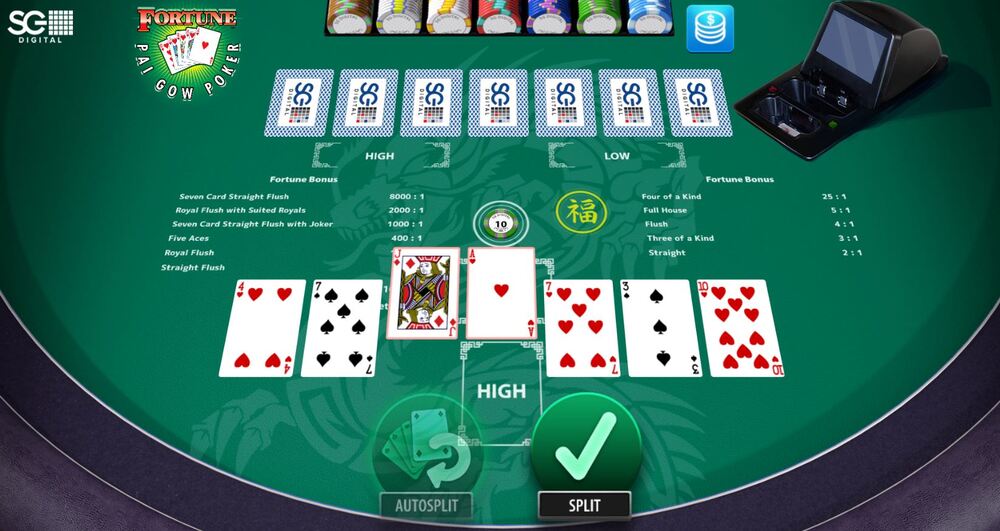
Pai Gow Poker is a casino card game played with a standard 52-card deck and a single Joker card. Unlike standard poker, the game is played against the dealer rather than other players.
Each participant is dealt seven cards, which must be partitioned into two separate hands: a five-card “high” hand and a two-card “low” hand. The basic rule is that the five-card hand’s poker rank must exceed the rank of the two-card hand.
The objective is for both of your hands to outrank the dealer’s corresponding hands. If your high hand beats the dealer’s high hand and your low hand beats their low hand, you win the round. A base Pai Gow Poker bet pays 1:1.
If only one of your hands wins, the round is a push. If the dealer wins both, you lose your wager. Because the Joker serves as a limited wild card and many rounds end in ties, the game is known for its slow pace and low volatility.
How To Play Pai Gow Poker – A Step-by-Step Guide
A standard round of Pai Gow Poker follows a specific sequence, which makes your learning process easier. To make sure you understand all of the fundamentals of playing Pai Gow Poker, we’ve prepared this useful step-by-step guide:
- Placing Bets – Players place their initial wagers in the betting circle. Some tables also offer optional side bets, which pay out for specific high-ranking poker hands regardless of whether you beat the dealer.
- The Deal – Each player and the dealer receive exactly seven cards, dealt face down. Even if seats are empty, cards are dealt to those spots to maintain the deck’s order.
- Setting the Hands – Players arrange their seven cards into a five-card high hand and a two-card low hand.
- The Reveal – Once all players have set their hands, the dealer reveals their seven cards and sets them according to a fixed set of house rules, known as the House Way.
- Comparison – The player’s five-card hand is compared to the dealer’s five-card hand, and the player’s two-card hand is compared to the dealer’s two-card hand.
- Resolution – Based on the comparison of both hands, the dealer collects losing bets and pays out winners. You lose if the dealer beats both of your hands. If you win one hand and the dealer wins the other, the result is a push.
Pai Gow Card Values and Hand Rankings
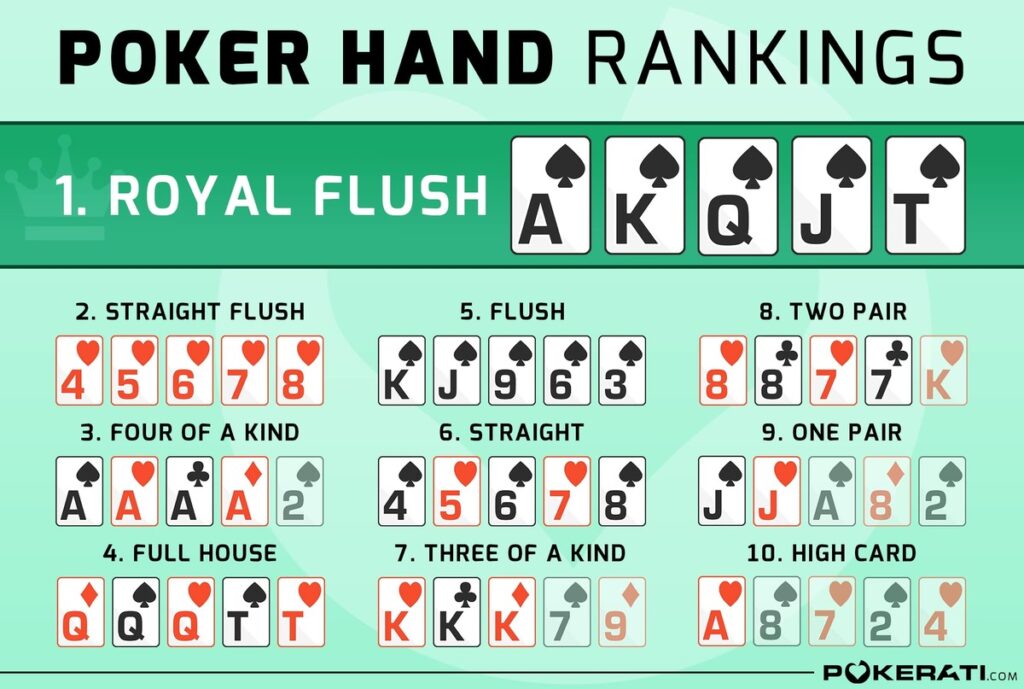
Pai Gow Poker uses standard poker hand rankings, with a few notable exceptions regarding the Joker and specific straights. Here’s a close look at the Pai Gow Poker hand rankings:
The Five-Card Hand (High Hand)
For the five-card high hand, rankings are familiar to most players: starting with the high card and moving up through pairs, flushes, and full houses. However, because the game uses a 53-card deck, the Five Aces hand (four natural aces plus the Joker) is the absolute highest-ranking hand, even surpassing a Royal Flush.
The Two-Card Hand (Low Hand)
The two-card low hand operates on a much simpler scale because the limited number of cards makes most poker combinations impossible. This hand is ranked solely on pairs and high cards.
The most critical mechanic to master is the relationship between these two hands. Your five-card hand must always be stronger than your two-card hand. This requirement influences how you value your cards.
For instance, if you have a pair of Kings and a pair of 5s, you might be tempted to put the Kings in front to win the low hand, but you can only do so if you can still form a higher-ranking hand for the back.
The Role of the Joker in Pai Gow Poker
The Joker in Pai Gow Poker functions as a “bug” rather than a traditional wild card, meaning it can be used only in specific roles. It primarily acts as a versatile filler to complete a straight, a flush, or a straight flush. When used this way, the game assigns it the specific rank and suit needed to finalize the strongest possible sequence.
If the Joker cannot complete a straight or a flush, it defaults to being an Ace. This rule applies regardless of which hand the card is placed in. For instance, in a two-card low hand, a Joker paired with a King creates an Ace-King combination.
Banking in Pai Gow Poker
In most casino games, the house always acts as the bank, but Pai Gow Poker offers a unique feature where players can take turns banking. When you choose to bank, you are no longer playing only against the casino. Instead, you are playing against every other player at the table, including the dealer.
You put up your own capital to cover all winning bets, but in exchange, you collect the losses from every other hand. Some casinos also offer a co-banking option with the house, where you and the casino split the risk and the profits 50/50.
While the casino will still take 5% commission on your winning wagers, banking significantly lowers your house edge. That said, it also carries drastically higher volatility, and you can quickly deplete your bankroll if multiple players beat you.
Pai Gow Poker Dealer Rules – The House Way
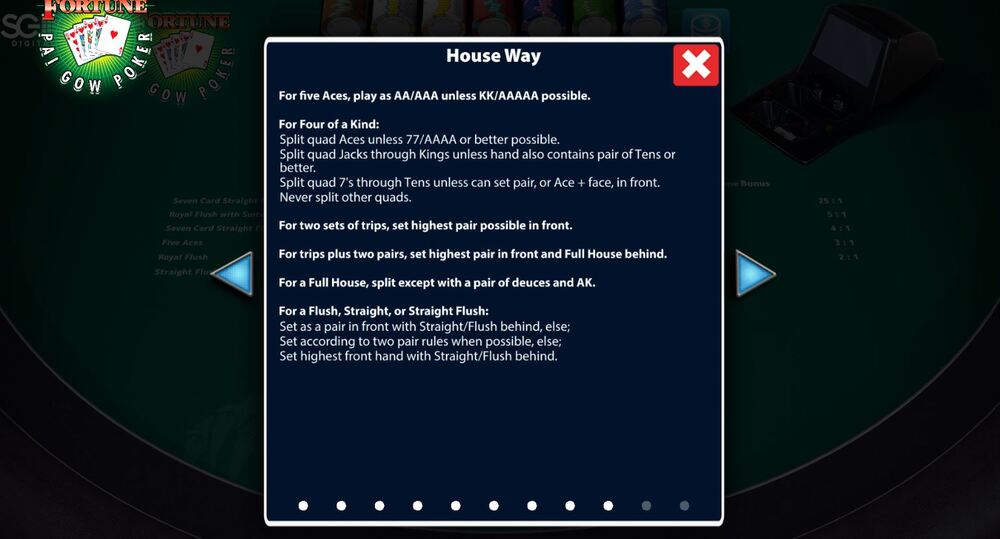
Unlike the player, who can exercise creativity or take risks when splitting their seven cards, the dealer operates under a strict set of rules known as the House Way. These fixed decisions mean the dealer must follow specific instructions for every possible card combination.
For instance, the House Way determines exactly when the dealer must split two pairs or three pairs into separate hands or when they must keep a straight together even if it weakens their two-card hand.
The specific rules of the house way can vary between casinos, so it’s very useful to familiarize yourself with them before playing in a land-based or online casino of your choice. Knowing the house way will make the game more predictable and help you tailor your strategy when playing.
Pai Gow Poker House Edge & Commission
Pai Gow Poker is among the more player-friendly games in the casino, primarily due to its low volatility and a house edge that typically ranges between 2.5% and 2.8%. This statistical advantage for the house is primarily driven by two factors.
The first one is the 5% commission charged on all winning player hands. The second is the “copy” rule, which dictates that the dealer wins all ties on individual hands. For example, if both you and the dealer have an Ace-King low hand, the dealer wins.
Some modern Pai Gow Poker variations offer a commission-free game, though they usually include a rule that increases the number of pushes.
The house edge in Pai Gow Poker isn’t fixed like in some other casino games, as you can significantly affect it with your decisions. You can also reduce the house edge by using the banking option when available.
Side Bets in Pai Gow Poker
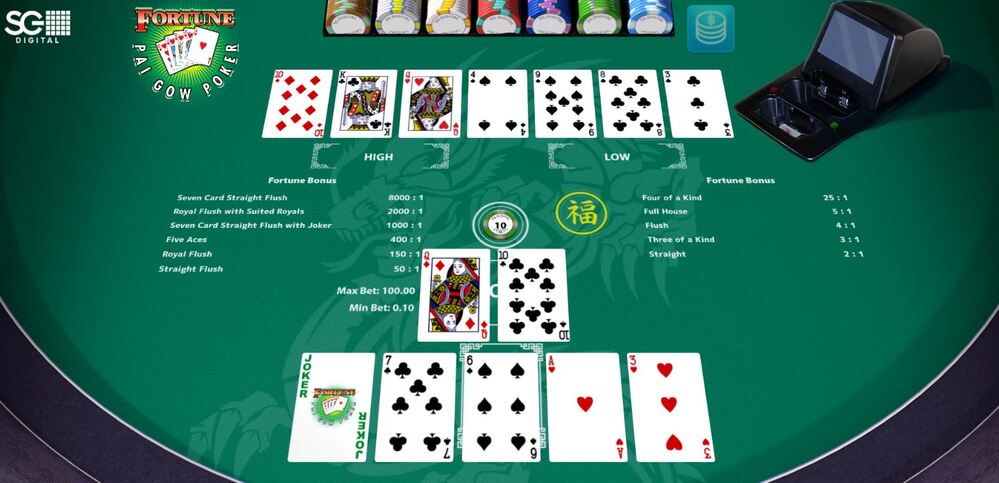
Pai Gow Poker is famous for its side bets, which provide high-stakes excitement to an otherwise slow-paced, low-volatility game. These bonuses are independent of the main game, meaning you can lose your hand to the dealer but still win a massive payout on your bonus wager.
The Fortune Pai Gow Bonus
This is the most common side bet. It rewards you based on the strength of your entire seven-card hand, regardless of how you set it. A unique feature here is the Envy Bonus. If you wager at least $5 at most Pai Gow Poker tables, you can also receive a payout if any other player at the table hits a Four-of-a-Kind or higher.
| Hand Rank | Typical Payout | Envy Bonus |
| 7-Card Straight Flush (No Joker) | 8,000 to 1 | $5,000 |
| Royal Flush + Royal Match (K-Q Suited) | 2,000 to 1 | $1,000 |
| 7-Card Straight Flush (With Joker) | 1,000 to 1 | $500 |
| Five Aces | 400 to 1 | $250 |
| Royal Flush | 150 to 1 | $50 |
| Straight Flush | 50 to 1 | $20 |
| Four-of-a-Kind | 25 to 1 | $5 |
| Full House / Flush / Straight | 5 to 1 / 4 to 1 / 2 to 1 | N/A |
The Progressive Jackpot
This side bet contributes to a rolling jackpot that grows until someone hits a top-tier hand. Because the jackpot is progressive, top payouts can reach massive amounts, up to hundreds of thousands of dollars. It features several tiers of jackpot prizes, usually forming a payout structure such as this:
| Hand Rank | Progressive Payout |
| 7-Card Straight Flush | 100% of the Mega Jackpot |
| Five Aces | 10% of the Mega Jackpot (or 100% Major Jackpot) |
| Royal Flush | 100% of Minor Jackpot |
| Straight Flush | Fixed Payout |
| Four-of-a-Kind | Fixed Payout |
Ace-High Bonus
In commission-free games like Face Up Pai Gow, the Ace-High bonus is a specific side bet that insures you against a dealer push. Since the main bet pushes if the dealer has an Ace-high hand, this side bet turns that specific scenario into a winning payout for the player.
| Dealer Hand Composition | Typical Payout |
| Dealer Ace-High (without Joker) | 5 to 1 |
| Dealer Ace-High (with Joker) | 15 to 1 |
| Dealer Ace-High (Suited) | 40 to 1 |
Conclusion: Is Pai Gow Poker a Game of Skill or Chance?
Pai Gow Poker combines both chance and skill, just like blackjack. The element of chance is inherent in the game’s rules. You have no control over the seven cards you receive. Because of this, which cards you will receive every round is entirely a matter of luck.
However, the skill lies in the “setting” of the hands. Unlike many casino games where the outcome is fixed once the cards are dealt, Pai Gow Poker requires you to make a tactical decision. You must decide how to distribute your cards to maximize the probability of winning, or at least pushing, both the high and low hands.
While you cannot change the cards you are given, knowing the optimal way to split them significantly impacts your long-term results and the house edge. With this in mind, to keep your experience enjoyable and extend your bankroll for maximum entertainment, make sure to understand the fundamentals and enjoy the game’s slow pace.