
Baccarat is a card game played between two hands, the Player and the Banker. Unlike many other card games where you compete directly against the house or other participants, baccarat is essentially a game of prediction.
Participants place wagers on which of the two hands will achieve a point total closest to nine, or if the round will result in a tie.
The game is governed by a strict set of predetermined rules. Because of this, neither the dealer nor the participants makes any tactical decisions once the cards are in play. This makes the game unique in its simplicity compared to other casino card games.
How Does Baccarat Work – A Step-by-Step Guide
Understanding how baccarat works is simple because the game is straightforward and requires little player input. Here is the step-by-step process of a standard round in a game of baccarat:
- Place Your Bet – Before any cards are dealt, you can place your wager on one of three outcomes. You can predict the Player hand winning, the Banker hand winning, or a Tie.
- The Deal – The dealer distributes two cards to the Player’s hand and two cards to the Banker’s hand. All cards are dealt face-up in most modern baccarat variations.
- Calculate Hand Totals – The values of the two cards are added together. If either the Player or the Banker has a total of 8 or 9 from the initial two cards, it is called a “Natural”. The round ends immediately, and the higher hand wins. If neither hand has a natural, the baccarat rules determine if a third card is needed.
- Declare the Winner and Payout – The hand with the total closest to 9 is declared the winner. The dealer pays out the winning players, and a new round of baccarat starts.
Baccarat Card Values Explained
Understanding the point system is essential to following a Baccarat round, as the scoring differs significantly from that of other card games. Most of the deck is valued by the numbers printed on the cards, with 2 through 9 retaining their face value. Aces are always counted as 1 point. However, 10s and all face cards are worth 0 points, meaning they contribute nothing to the hand’s total.
Because the objective is to get as close to 9 as possible, a hand total can never actually exceed 9. When the sum of the cards reaches 10 or more, the first digit is automatically discarded, and only the second digit represents the hand’s value.
For example, if a hand consists of an 8 and a 7, the sum is 15. By dropping the 10, the final Baccarat score is 5. This ensures that every hand remains within the 0 to 9 range, regardless of how many cards are dealt.
Understanding Baccarat Bets

While the rules for drawing cards are fixed, your role as a bettor is to decide which side holds the advantage for the upcoming round. As previously mentioned, you can choose between three bets in baccarat:
The Player Bet
The Player bet is a wager placed on the hand designated as the Player to achieve a total closer to 9 than the Banker hand. If the Player hand finishes with the higher score, the bet is paid out at 1:1, meaning a $10 wager would return $10 in profit.
The Banker Bet
The Banker bet is a wager that the hand designated as the Banker will finish with a total closest to 9. When the Banker hand wins the round, the payout is also 1:1; however, a 5% commission is typically deducted from the winnings to account for the Banker’s slight positional advantage in the drawing rules.
The Tie Bet
The Tie bet is a wager that both the Player and Banker hands will finish the round with the exact same point value. If the totals match, the Tie bet pays out at significantly higher odds, usually 8:1 or 9:1.
The Third Card Rule
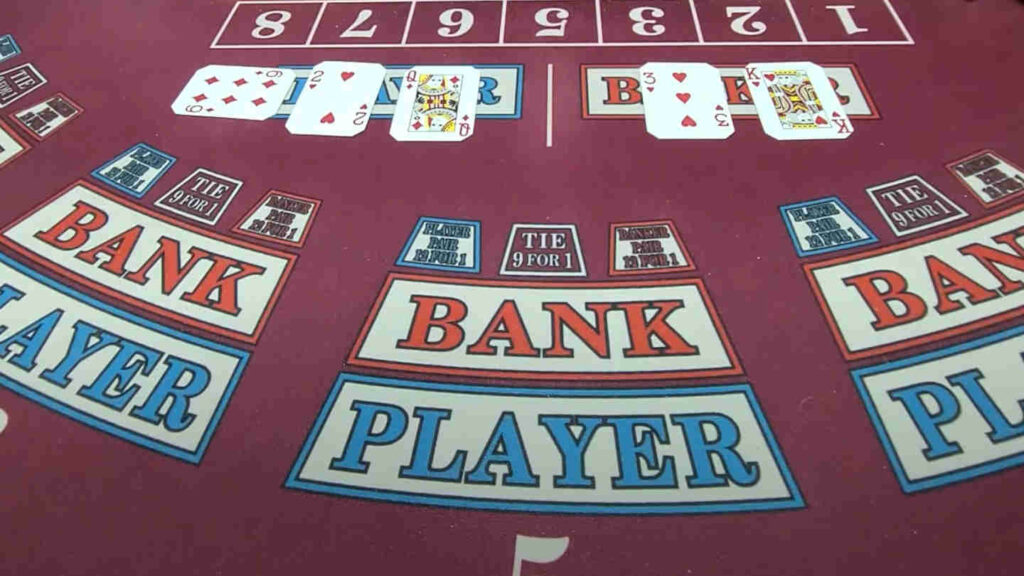
The “Third Card Rule” acts as a fixed set of instructions that determines whether the Player or Banker receives an additional card. These rules are mandatory, and the dealer executes them without any input from the players. Here’s how the rule applies:
Player’s Rule
The Player’s hand is always evaluated first for a third card. If the initial two-card total for the Player hand is between 0 and 5, a third card is automatically dealt to that hand.
If the Player’s hand has a total of 6 or 7, the hand must stand, meaning no additional cards are drawn. Once the Player’s action is complete, either by standing or receiving a third card, the Banker’s hand is then evaluated.
Banker’s Rule
The Banker’s drawing rules are more complex because they depend on two factors: the Banker’s current total and whether the Player’s hand drew a third card. If the Player stands on a 6 or 7, the Banker follows the same simple rule as the Player: draw a card if the total is 0–5 and stand on a 6 or 7.
However, if the Player received a third card, the Banker draws or stands based on fixed rules that compare the Banker’s score against the specific value of the third card dealt to the Player. Here’s a table illustrating when the Banker draws in this case:
| Banker Total | Banker Draws if Player’s 3rd Card is: | Banker Stands if Player’s 3rd Card is: |
| 0, 1, or 2 | Always Draws (Any card) | Never Stands |
| 3 | 0, 1, 2, 3, 4, 5, 6, 7, or 9 | 8 |
| 4 | 2, 3, 4, 5, 6, or 7 | 0, 1, 8, or 9 |
| 5 | 4, 5, 6, or 7 | 0, 1, 2, 3, 8, or 9 |
| 6 | 6 or 7 | 0, 1, 2, 3, 4, 5, 8, or 9 |
| 7 | Never Draws | Always Stands (Any card) |
House Edge in Baccarat
Compared to many other table games and slot machines, the house edge in Baccarat is remarkably low, making it a preferred choice for those seeking to minimize the cost of play. That said, while you can play with a very small house edge, it can vary significantly based on the bets you place.
The Banker bet is statistically the most favorable option, carrying a house edge of just 1.06%. This low figure exists because the Banker hand draws its cards second, allowing the fixed rules to provide it with a slight positional advantage over the Player hand.
Even after the casino deducts a standard 5% commission on winning Banker bets, this wager remains the one with the house’s statistical advantage at its absolute minimum.
The Player bet also features a competitive house edge of 1.24%. While slightly higher than the Banker bet, it is still very low overall. Because it does not require a commission on wins, it is a straightforward alternative that maintains a high return-to-player percentage throughout a session.
In contrast, the Tie bet functions very differently from the other two options. Despite offering attractive payouts of 8:1 or 9:1, the mathematical reality of the Tie bet results in a much higher house edge, typically around 14.36%.
While the potential for a larger win is a primary feature of this bet, the frequency of a tie occurring is low enough that the house retains a much larger portion of these wagers over time compared to the Player or Banker positions.
Common Baccarat Variations
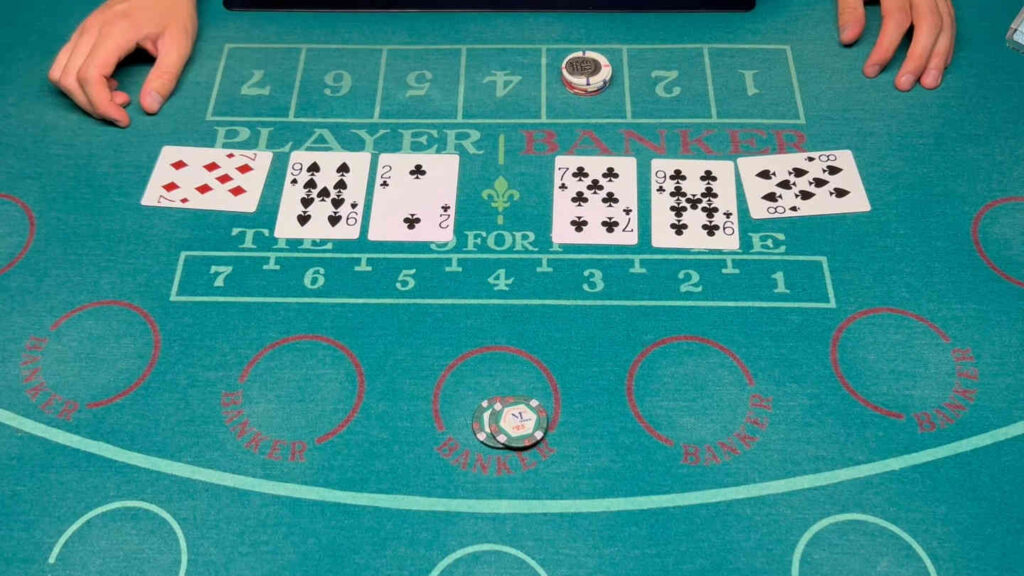
While the core objective remains the same, baccarat is played in several distinct formats that vary by dealer role, play speed, and stakes.
Understanding these versions is key to knowing how to play baccarat in different casino environments, whether you are on a high-stakes floor in Macau or playing on a mobile app. Here’s a closer look at the common baccarat variations:
Punto Banco
Punto Banco is the most common version of baccarat found in modern casinos worldwide. In this variation, the casino acts as the bank at all times. Players have no say in whether a third card is drawn. The dealer simply executes the play based on the hand totals. This makes Punto Banco a very beginner-friendly baccarat variation.
Chemin de Fer
Chemin de Fer is the original French version of the game and offers a more social, interactive experience. Unlike Punto Banco, the players compete against each other rather than the house. One player at the table is designated as the Banker, setting aside an amount they are willing to wager, and other players take turns challenging them.
Baccarat Banque
Baccarat Banque is a classic European version of the baccarat card game where the Banker position is more permanent, often held by the player willing to risk the largest bankroll. While it follows standard scoring, it allows for more strategy. The Banker and players may draw or stand on a total of 5, adding a layer of choice to the usual baccarat rules.
Mini-Baccarat
As the name suggests, Mini-Baccarat is a scaled-down, faster version of the standard game. It is played on a smaller table and typically features much lower betting minimums, making it accessible to a wider audience. The rules are identical to Punto Banco.
Conclusion: Is Baccarat a Game of Skill or Chance?
Ultimately, baccarat is almost entirely a game of chance. Unlike blackjack, where you must decide whether to hit or stand, baccarat players only have to decide which hand to bet on before the cards are dealt. Once the round begins, the outcome is dictated by the shuffle, leaving no room for tactical play to influence the hand’s result.
That said, while there is no skill element, it is still crucial to understand the mathematical odds to know which bets to make and avoid, and to have a proper bankroll management strategy. Understanding all of the baccarat fundamentals will enable you to play baccarat optimally and enjoy this simple and fast-paced game.