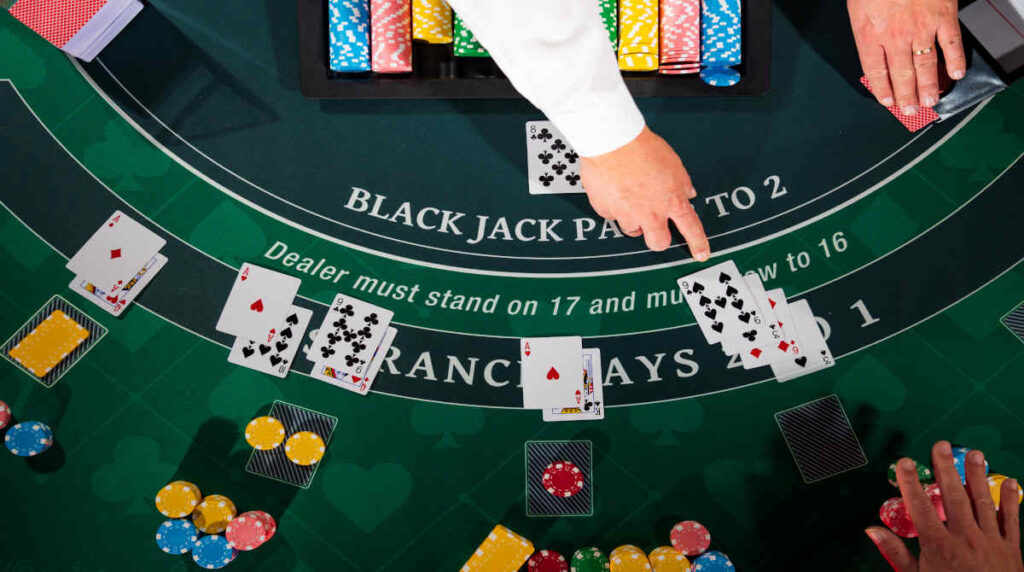
Blackjack is a popular casino card game played with one or more standard 52-card decks. The primary objective of the game is to achieve a hand value that is higher than the dealer’s total without exceeding 21.
You play exclusively against the dealer, not the other players at the table.
Even in a full game, each player’s hand is an independent contest against the house. Your success is determined solely by comparing your final hand value to the dealer’s, regardless of what the other participants are holding.
How Blackjack Works – A Step-by-Step Guide
While blackjack does involve some strategy and decision-making from your part, every blackjack round follows a specific sequence from start to finish. Here’s a step-by-step guide on how blackjack works:
- Players Place Their Bets – Every round begins with players placing a wager using chips in their designated betting area. This must be done before the dealer signals that betting is closed and begins the deal.
- The Dealer Deals the Cards – The dealer distributes two cards to each player, typically face-up. The dealer also receives two cards. One is placed face-up for everyone to see, and the other remains face-down.
- Players Choose Their Actions – Each player evaluates their hand against the dealer’s visible card and decides how to proceed. They can “Hit” to draw additional cards and increase their total, or “Stand” to keep their current hand. This phase continues until the player either chooses to stop or busts by exceeding 21.
- The Dealer Plays Their Hand – Once all players have completed their turns, the dealer reveals their face-down hole card. The dealer must follow fixed blackjack rules, at which point they must stand.
- Winning Bets are Paid – The dealer compares their final total against each remaining player’s hand. If the player’s total is closer to 21 than the dealer’s, or if the dealer busts, the player is paid. If the dealer has the higher total, the house collects the bet. If the totals are equal, it is a “push”, and the player’s bet is returned.
Blackjack Card Values Explained
To accurately know how to play blackjack and give yourself the best chance of winning, you must first understand how points are tallied. The value of a hand is the sum of the points of every card held. Here’s a closer look at how the scoring works in blackjack:
- Numbered Cards (2 through 10) – These cards are worth their face value. For example, a 3 is worth 3 points and a 7 is worth 7 points.
- Face Cards (Jack, Queen, King) – All face cards are worth exactly 10 points each.
- Aces – The Ace is unique because it can be valued at either 1 or 11 points. The value used is whichever is most beneficial to the hand without exceeding 21.
The highest and most desirable hand in the game is known as Blackjack. This is achieved when your initial two-card hand consists of an Ace and any 10-value card, totaling exactly 21.
If the cumulative value of your cards goes over 21, the hand is considered a bust. Once a hand busts, it is an automatic loss, and the player is eliminated from that round regardless of the dealer’s eventual score.
Player Actions in Blackjack

Once the initial cards are dealt, you must decide how to navigate your hand based on its current total and the dealer’s visible card. These core blackjack player actions allow you to control the progression of your hand before the dealer plays their own hand. Below you can find these options and their blackjack rules explained in more detail:
Hit
To hit is to request an additional card from the dealer to increase the total value of your hand. This action can be repeated multiple times if you believe your current total is too low to beat the dealer. However, each hit carries the risk that the new card’s value will push the hand total over 21, resulting in an immediate bust and loss of the wager.
Stand
Choosing to stand means you are satisfied with your current card total and wish to end your turn without receiving any more cards. Once you signal to stand, your total is finalized, and play moves to the next player or the dealer. This action locks in a score and waits for the dealer to either beat it or bust.
Double Down
The double down action allows you to increase your initial bet by up to 100% in exchange for committing to stand after receiving exactly one more card. This is a one-time addition to the hand. After the third card is dealt, your turn automatically ends regardless of the total. It is a way to increase the potential payout when you feel confident in your position after the first two cards.
Split
A split is an option available only when your starting two cards are of equal value, such as a pair of 8s or two Kings. You separate the pair into two independent hands and must place a second bet equal to the first on the new hand. The dealer then provides a second card for each, and you play them one at a time as completely separate opportunities to win.
Surrender
If the specific table rules allow it, you can choose to surrender your hand after the initial deal but before taking any other actions. When you surrender, you forfeit the hand immediately and give up half of your original wager. The dealer collects the cards and half the bet, and you take no further part in the round, effectively ending your risk for that hand.
Blackjack Dealer Rules Explained

In Blackjack, the dealer does not have the same freedom of choice as the player. Instead, they must follow fixed blackjack dealer rules that dictate every move based on the hand’s total.
The dealer always reveals their hidden hole card after all players have finished their turns and must continue to hit until their hand reaches a total of at least 17. Once the dealer’s hand is 17 or higher, they must stand.
A common variation involves the “Soft 17” rule, which refers to a hand totaling 17 that includes an Ace valued at 11. Depending on the specific table, the rules will state whether the dealer must stand on all 17s or hit on a Soft 17.
Because the dealer follows these precise instructions, they cannot choose to play conservatively or aggressively based on the players’ bets.
Blackjack Outcomes & Payouts
Payouts are based on your original wager and the specific way the hand was won. Here’s a table overview of the possible blackjack outcomes and the respective payouts you can expect from them:
| Outcome | Result | Payout | Description |
| Blackjack | Win | 3:2 (or 6:5) | A 2-card 21 (Ace + 10-value card). |
| Regular Win | Win | 1:1 | Your total is higher than the dealer’s without busting. |
| Push | Tie | Bet Returned | You and the dealer have the same total. |
| Bust | Loss | Loss | Your hand total exceeded 21. |
Additionally, it’s important to note that a natural Blackjack made with two cards beats any dealer hand that reaches 21 using three or more cards. If you get a Blackjack and the dealer eventually hits 21, you still win the higher payout.
When it comes to payouts, always check the table felt or the sign next to the dealer. A 3:2 payout is the standard, paying $15 on a $10 bet. A 6:5 table is less favorable for the player, as it only pays $12 on a $10 bet for the exact same hand.
House Edge & Odds in Blackjack
Blackjack is widely considered one of the most player-friendly games in the casino because of its exceptionally low house edge. In most casino games, the house edge is a fixed percentage that the casino expects to keep over time.
In blackjack, this edge can be as low as 0.5% because the game is based on mathematical probabilities rather than total randomness. This means that, for every $100 wagered, the statistical expectation is that the house retains only about 50 cents.
The most unique feature of blackjack is that your decisions directly impact the house edge. Because you can choose to hit, stand, double down, or split, you have the power to navigate the hand toward a more favorable outcome. So, if you make informed choices based on the cards you see, you can minimize the casino’s advantage.
Conversely, when players make decisions based on emotion rather than the logic of the cards, the house edge increases significantly.
Keep in mind that the house edge isn’t identical at every table. It varies according to the specific rules the casino sets for that game. For instance, a table that pays 3:2 for a natural Blackjack has a much lower house edge than one that pays 6:5.
Common Blackjack Rule Variations
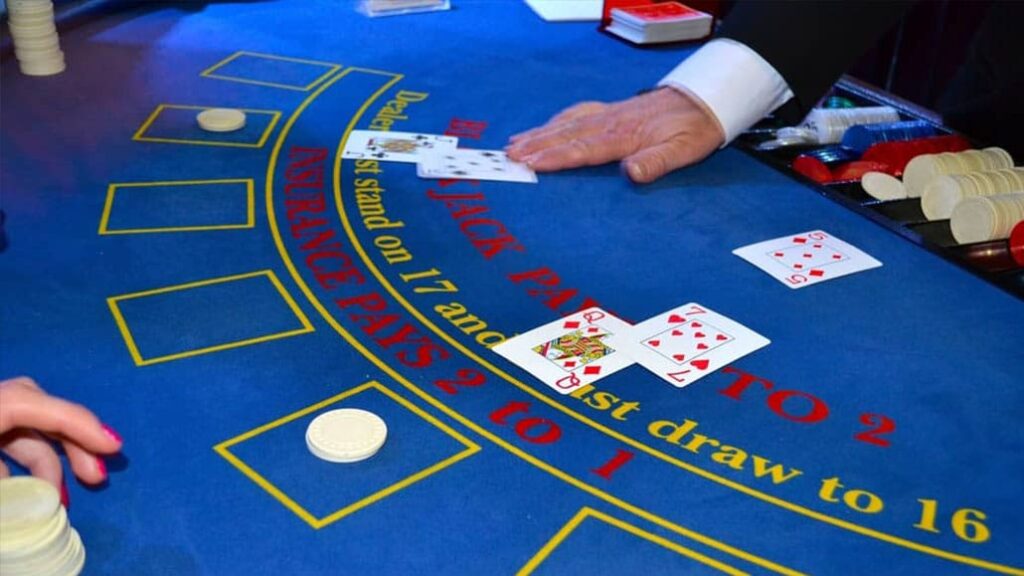
While the core objective of Blackjack remains the same, specific rules can vary significantly from one table to another. These variations are often printed directly on the table felt or on a small placard next to the dealer. Understanding these differences is essential, as they can change the flow of the game and the overall player experience.
Number of Card Decks
Games can be played with anywhere from a single deck to an eight-deck shoe. Generally, games with fewer decks are considered more favorable for the player because the distribution of cards is more predictable. Most modern casino tables use six or eight decks to keep the game moving without frequent shuffling.
Blackjack Payouts (3:2 vs. 6:5)
As previously mentioned, the 3:2 vs 6:5 example is a difference that can have a significant impact on your bankroll. Because the payout is lower for 6:5 tables, these drastically increase the house advantage, making 3:2 tables the preferred choice for most players.
Double After Split (DAS)
Some tables allow you to double down on a hand you just created through a split. For example, if you split a pair of 8s and receive a 3 on the first 8 (totaling 11), a DAS rule allows you to double your bet on that new hand. If this is not allowed, you can only hit or stand after splitting.
Resplitting Aces
In most standard games, when you split a pair of Aces, you receive only one card on each, and your turn ends. However, some tables allow you to Resplit Aces, meaning if you receive another Ace after your first split, you can split another time to create a third hand. This player-friendly rule is not available at every casino.
Conclusion: Is Blackjack a Game of Skill or Chance?
Blackjack is unique among casino games because it sits at the intersection of chance and decision-making. While it is impossible to predict exactly which card will be dealt next, the game is not entirely based on luck. The element of chance is found in the random distribution of the cards, but the element of skill is found in how you choose to play the cards you are given.
Unlike games like slots or roulette, where the player has no influence once the round begins, blackjack grants you the agency to change the course of a hand. This is why it’s crucial to understand all of the rules, as well as blackjack odds and payouts, so you can make informed choices when playing.
Ultimately, while no amount of knowledge can guarantee a win in any single round, a thorough understanding of the fundamentals significantly improves the quality of your decisions. Mastering the mechanics of the game allows you to play with the highest possible efficiency, even though the final outcome will always be subject to the luck of the draw.