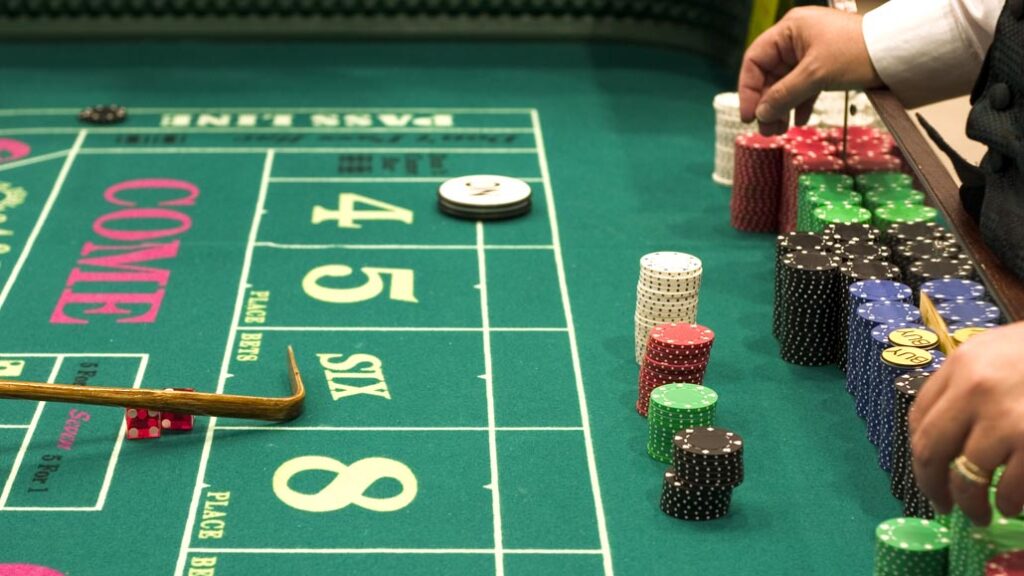
Craps is a fast-paced, high-energy dice game where players place wagers on the outcome of a roll of a pair of six-sided dice. It is one of the most popular and social games in any casino environment, as it allows up to 20 players and creates a unique atmosphere where the table wins or loses together.
A central element of the craps game is the shooter, the player currently responsible for rolling the dice. While the shooter is the one physically initiating the action, all players at the table can participate in every roll by placing their own wagers.
Unlike many other casino games, where players compete strictly against the house in isolation, craps allows participants to bet on the same outcomes as the shooter or even against them, which adds to the dynamic, shared environment.
How to Play Craps: A Step-by-Step Guide
Here is a closer step-by-step outline of the standard progression of a craps game, from the opening roll to the conclusion of a round:
- The Come-Out Roll – Every new round begins with the come-out roll. This is the shooter’s initial toss of the dice. For this roll to be valid, the shooter must throw the dice so they strike the back wall of the craps table.
- Immediate Natural or Craps Outcomes – If the shooter rolls a total of 7 or 11 on the come-out roll, it is considered a natural. The round ends immediately, and the shooter prepares for a new come-out roll. If the shooter rolls a 2, 3, or 12, it is known as craps, and the round also ends immediately.
- Establishing a Point – If the shooter rolls a 4, 5, 6, 8, 9, or 10 on the come-out roll, that number becomes the point. The dealer will place a physical puck on the craps table over that number to signal to all players that a point has been established.
- The Intermediate Phase – Once a point is set, the shooter continues to roll the dice repeatedly. During this phase, any numbers rolled other than the point or a 7 have no impact on the progression of the round.
- Winning and Losing the Round – The shooter continues rolling until they either roll the point number again and they win or roll a 7 before hitting the point, and they seven out. This results in a loss, the round ends, and the dice are passed to a new shooter.
Understanding the Craps Table Layout
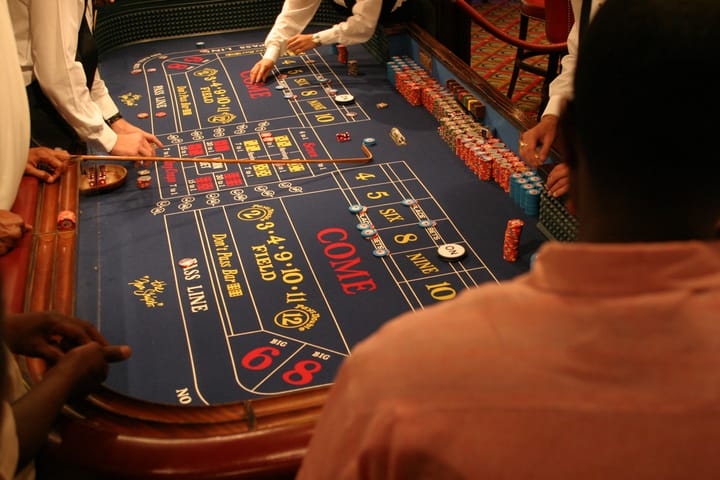
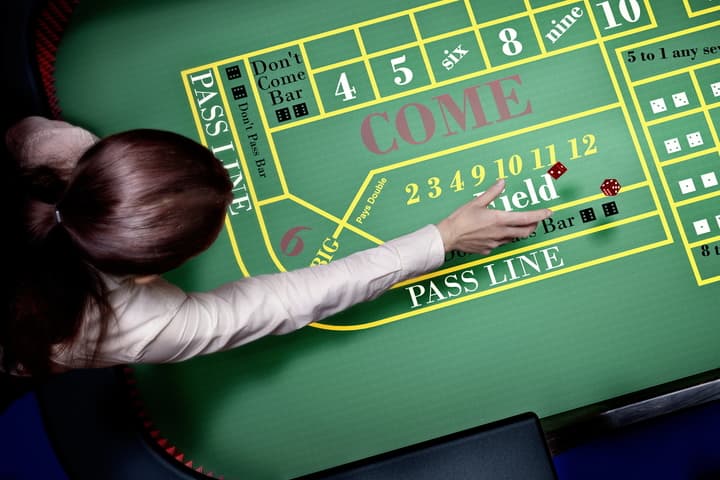
Navigating the table begins with identifying the different sections where chips are placed to indicate specific wagers. With this in mind, the craps table can look daunting and complex to beginners. To make this easier, we’ll go over each segment of the craps game table:
- The Pass Line & Don’t Pass Bar – These sections wrap around the outer perimeter of the layout and serve as the foundation of the game where players place their primary wagers.
- The Field – Situated in the center-middle of each end, this large area is designated for one-roll bets on a specific set of numbers.
- The Come & Don’t Come – Located above the field, these areas are specifically for players who wish to place new bets after the shooter has already established a point.
- The Center Proposition Bets – This middle section contains high-risk, high-reward wagers.
Basic Rules of Craps
In order to follow the flow of the game and understand everything that happens, it’s important to know all of the dice specifics and how they change the state of the game:
Natural (7 or 11)
A Natural occurs when the shooter rolls a total of 7 or 11 on the very first throw, known as the Come-Out roll. In this scenario, all players who placed a bet on the Pass Line win even money immediately. The shooter remains in control of the dice and prepares for another Come-Out roll to start a new sequence.
Craps (2, 3, or 12)
If the shooter rolls a 2, 3, or 12 on the Come-Out roll, it is called Craps. This results in an instant loss for all Pass Line bettors. Despite the loss, the shooter does not necessarily lose the dice. They typically continue to throw another Come-Out roll until a Point is established or they Seven-Out in a later phase.
The Point
If the shooter rolls a 4, 5, 6, 8, 9, or 10 on the Come-Out roll, that number becomes The Point. The dealer places a marker on that number to show it is now the target. For the Pass Line bet to win, the shooter must roll this specific number again before rolling a 7.
Sevening Out
Sevening Out happens when the shooter rolls a 7 after a Point has been established but before they have successfully rolled the Point number again. This is the most common way a round ends. It causes all Pass Line bets to lose and requires the shooter to pass the dice to the next player in clockwise order.
Types of Craps Bets Explained
Craps offers you a wide array of betting options to choose from, with a notable distinction between multi-roll and single-roll bets.
Multi-Roll Bets
These wagers stay on the table for a series of rolls until a specific outcome is reached, such as the shooter hitting their Point or rolling a 7.
- Pass Line Bet – A wager that the shooter wins by rolling 7 or 11 on the come-out, or hitting an established point before rolling a 7.
- Don’t Pass Line Bet – The reverse of the Pass Line. You win if the shooter rolls a 2 or 3 on the come-out or sevens out before hitting their point.
- Come Bet – Functionally the same as a Pass Line bet, but placed only after a point has already been established for the table.
- Don’t Come Bet – The reverse of a Come bet. It acts as a new Don’t Pass wager started after the initial point is set.
- Taking the Odds – An additional wager placed behind a Pass or Come bet that pays at true mathematical odds with zero house edge.
- Laying the Odds – An additional wager placed behind a Don’t Pass or Don’t Come bet, wagering that a 7 will roll before the point number.
- Place Bets – A wager on a specific number to be rolled before the next 7 appears.
- Buy Bets – Similar to Place bets, but pay true odds in exchange for a 5% commission paid to the house.
- Lay Bets – A wager against a specific number, betting that a 7 will be rolled before that number appears. Requires a 5% commission.
- Big Six & Big Eight – A bet that a 6 or 8 will roll before a 7.
- Hardways Bets – A wager that a 4, 6, 8, or 10 will be rolled as a pair (the “hard way”) before a 7 or an easy combination.
Single-Roll Bets
Often called Proposition or “Prop” bets, these are settled immediately on the very next toss of the dice. If the number doesn’t land on that specific roll, the bet is lost.
- The Field Bets – A one-roll bet that the next throw will be a 2, 3, 4, 9, 10, 11, or 12.
- 2 or 12 Bets – High-payout wagers that the very next roll will be exactly 2 or 12.
- Any 7 Bet – A one-roll wager that the next result will be a 7.
- Any Craps Bets – A one-roll wager that the next result will be one of the “craps” numbers: 2, 3, or 12.
- Horn Bet – A combination single-roll bet that splits your wager across the 2, 3, 11, and 12 simultaneously.
Craps House Edge & Payouts
Understanding the house edge and payouts is essential for learning how to play craps effectively. This is because the house edge can vary significantly between a low-risk line bet and a high-risk proposition bet. This table covers all of the information you should know about these numbers:
| Bet Type | Payout | House Edge |
| Free Odds (Supplemental) | True Odds* | 0.00% |
| Don’t Pass / Don’t Come | 1:1 | 1.36% |
| Pass Line / Come | 1:1 | 1.41% |
| Place Bet (6 or 8) | 7:6 | 1.52% |
| Place Bet (5 or 9) | 7:5 | 4.00% |
| Field Bet | 1:1 (2:1 on 2/12) | 5.56% |
| Place Bet (4 or 10) | 9:5 | 6.67% |
| Big 6 / Big 8 | 1:1 | 9.09% |
| Hardways (6 or 8) | 9:1 | 9.09% |
| Hardways (4 or 10) | 7:1 | 11.11% |
| Any Craps (2, 3, or 12) | 7:1 | 11.11% |
| Any 7 | 4:1 | 16.67% |
*True Odds for Free Odds bets depend on the point established. They are 2:1 for 4 & 10, 3:2 for 5 & 9, and 6:5 for 6 & 8.
Common Variations To Keep In Mind
While the fundamental rules of craps remain consistent, casinos often adjust specific table settings to manage their risk or attract different types of players. Here are the most significant variations to note:
- Table Limits – Every table displays a placard showing the minimum and maximum bets allowed. A low-limit table might have a $10 minimum, which is ideal for beginners, while high-roller tables may require $100 or more per wager.
- Odds Multipliers – This is the most important variation for serious players, as it dictates how much you can wager on the 0% house edge Odds Bet. While some casinos offer a flat 2x or 5x odds, many use the “3x-4x-5x” rule (3x on points 4 and 10, 4x on 5 and 9, and 5x on 6 and 8).
- Field Variations – You should always check the Field section of the layout to see the payout for the numbers 2 and 12. Most tables pay 2:1 on both, but some generous casinos pay 3:1 on the 12. This small change has a significant impact on the house edge for Field bets, reducing it from 5.56% to 2.78%.
Conclusion: Is Craps a Game of Skill or Chance?
With all of the above in mind, the only “skill” involved in craps is not in the physical throw or a specific strategic approach, but in your understanding of the table and bankroll management. Just like with Roulette, your success will depend on your ability to navigate the layout and distinguish between bets with a low house edge and those designed to favor the casino.
Still, craps remains a game of luck, with the primary goal of enjoying the high-energy social experience. Whether you win or lose is determined by the random roll of the dice, making it a classic example of casino gambling in which the house always maintains a slight mathematical edge over the long term.