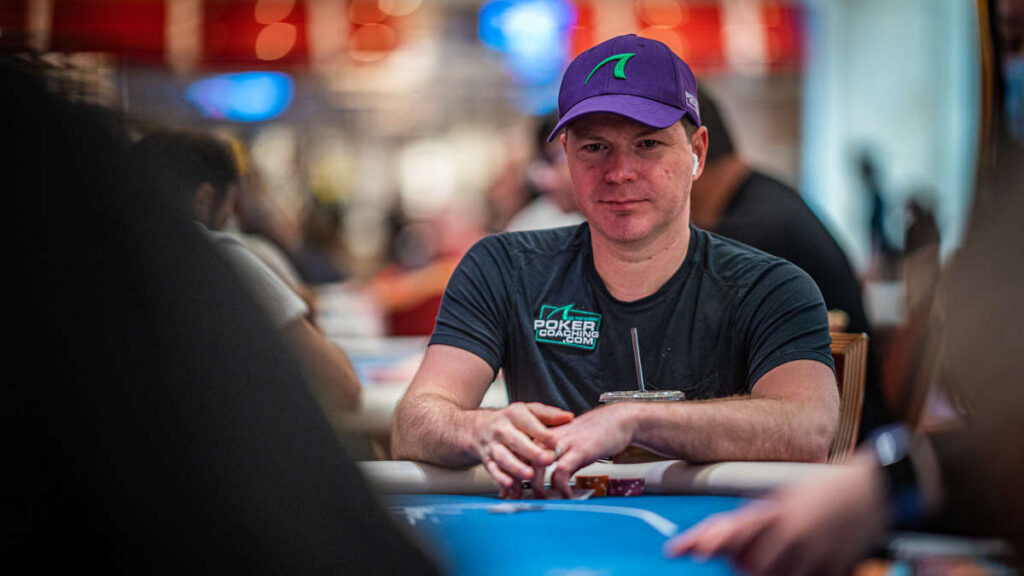
Image courtesy of World Poker Tour
Poker tournaments have been booming in recent years, creating great money-making opportunities. However, to prosper in tournaments, you need two things: a solid understanding of poker fundamentals and knowing how and when to exploit your opponents.
These two elements should give you a significant edge over a large portion of the field, especially in lower buy-in events.
In this article, we’ll cover five key ways to help you run deep in more tournaments and ensure you maintain an edge in today’s MTT environment.
#1 Get a Big Stack Early
Many players approach tournaments with a plan to play tight and stay out of trouble. This approach will get you to the middle stages fairly often and let you keep your seat for five or six hours, but this is not how you win.
Sitting around, waiting to get dealt premium hands, make the nuts, and get paid won’t get you very far.
Instead, you need to play strong, solid GTO poker, where you can get in there and battle to accumulate a big stack that will allow you to push your opponents around during the middle and late stages of tournaments.
Let’s look at some examples of what this looks like in practice.
We are on the button facing a standard raise of two big blinds from the cutoff. You can see on the chart below just how wide we’re supposed to be 3-betting in this spot. In addition to our strongest holdings, i.e., TT+, there are so many bluffs with a variety of suited hands.
Plus, we are calling a lot, even with hands like K3s and 54s. The idea is to play in position, win pots, and build our stack for later stages.
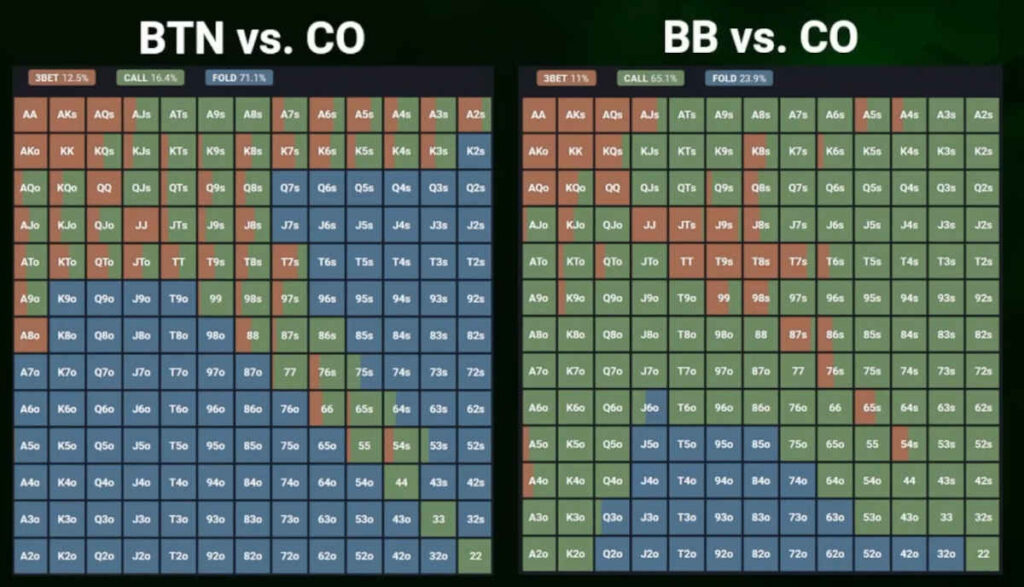
Playing from the big blind, you can see on the second chart that our range is more linear, as we are sticking to hands that flop well. However, we are still doing a lot of 3-bet bluffing with all sorts of suited hands.
#2 Master Short Stacked Poker
Although most tournaments start with deep stacks, you’ll spend most of the time playing 40 big blinds or shorter. Thus, you need to diligently study these spots.
You’ll often hear people say that short-stack poker is like bingo: you get your chips in the middle and hope for the best. This is a poor mindset, and it is also inaccurate.
There is a lot you can do, even when you don’t have a deep stack. Let’s look at a couple of GTO charts to bring this point home.
Playing from the big blind, 12bb deep and facing a standard 2bb open from the button, you’ll notice that we move all-in with all pocket pairs QQ and lower. However, we are slow-playing pocket aces and pocket kings.
We are also jamming all Ax offsuit holdings as well as our best suited aces and weak suited kings.
But then, there is a variety of hands that we can still call and play flops with, even as low as T5s and J7o. This goes to show that we are not limited to just shove or fold.
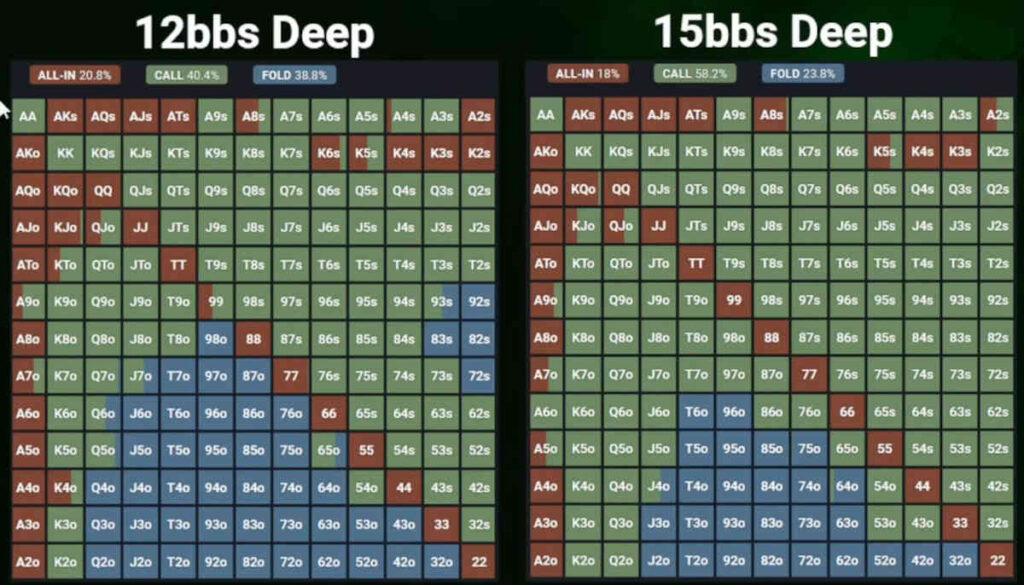
With 15 big blinds, we get to call even wider, and our calling range now includes many weaker off-suit hands as well. It’s fine if you want to fold some of the marginal ones, like J4o, but, for the most part, you need to be defending a lot.
As stacks get deeper and we venture into the 20 – 25bb territory, we also start to introduce some non-all-in 3bets with our best hands, quality suited connectors, and some trash holdings like Q2o and T7o – these are our bluffs that we can easily fold if we get shoved on.
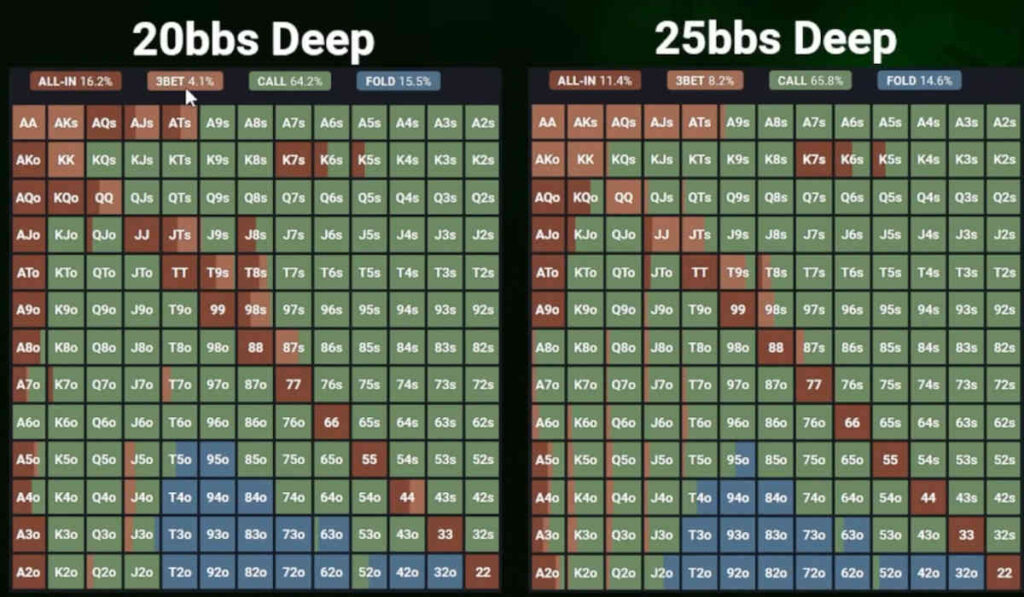
The main takeaway is that most players are too conservative in these spots, often folding hands that should be 3-bet (e.g., J5o). Since most of these are low-frequency plays, you can simplify things by selecting a few hands to 3-bet with and call with the rest, but you need to battle more. Play around with solvers like PeakGTO to master these situations.
#3 Adjust to the Payouts
When you’re close to the bubble, if you’re on a short stack, your main priority is to get to the money. The reality is that you probably won’t win the tournament from that spot, so you need to try to lock up an ITM finish before anything else.
This doesn’t mean you should just sit around and fold. There will still be opportunities to open-shove or jam over a raise to pick up some chips, but you need to be very aware of the situation.
For example, if you have eight big blinds, and there are three or four other players with just two big blinds on a dead bubble, you should never bust before one of them goes out and you make it into the money.
If you have a middle stack, your game plan should be to avoid confrontations with large stacks and put pressure on other middling and short stacks.
As a big stack, you can apply a lot of aggression, which doesn’t mean you have to be all in all the time. By 3-betting and c-betting on the flop, you’ll put a lot of pressure on your opponents, as they’ll be at risk of busting.
The final table strategy is quite similar. As a short stack, you want to try to move up a few spots, but you shouldn’t allow yourself to get blinded out. If you’re a big stack, you can afford to raise wider than normal before the flop and go after pots after the flop using smaller bets that don’t represent a big chunk of your stack, but put your opponents at risk.
#4 Do Not Go On Tilt
You will inevitably experience massive swings while playing tournaments. There will be situations where you go from a huge stack to one big blind, and from just one big blind to a chip leader (and everything in between).
You mustn’t allow for these swings to influence your decisions. Instead, play each hand to the best of your ability. If you start playing poorly after every bad beat, you’ll have no shot at long-term success.
Some people will go on a massive tilt after losing even a small, insignificant pot, causing them to lose a huge stack, just because they’re mad. Some players will give up when they get short-stacked and will rip it in with any two cards.
You can’t allow these swings to influence your strategy. Even if things aren’t going your way, you must try to play great poker. That’s how you’ll set yourself up for success.
#5 Be Mentally Sharp
Finally, you need to make sure that poker is your number one priority every time you’re in a tournament. If you’re very distracted and would rather do something else, you probably shouldn’t be playing.
When you’re not paying attention to the action and are watching a game on TV instead, you’re missing key pieces of information about what your opponents might be doing wrong. Thus, you’re unable to adapt to and capitalize on their mistakes.
Similarly, you shouldn’t be partying the night before the tournament or while actually playing. It’s fine to have some fun and be friendly, but if you start drinking and focusing on everything else apart from playing good poker, the adventure will likely end with you making an early exit.