In today’s article, we’ll talk about how you should make it a point to check-raise with your best made hands and draws.
You want to play big pots with your best hands – that’s pretty self-explanatory. However, if you only raise with your strongest holdings, you become easy to play against.
So, instead, you want to utilize what’s known as a polarized range, consisting of your best hands that you’re happy to get all your chips in the middle with, and a variety of straight and flush draws, depending on the stack depth.
There are two specific scenarios where you should be generally more inclined to check-raise:
- When the flop is excellent for your range (i.e., you call an early position raise from the big blind and the flop comes 7-6-4. The EP raiser doesn’t have any really strong hands in their range, while you have all the straight, set, and two-pair combos).
- You are facing a small bet – tiny bets have become very popular in recent years, and facing these small wagers, you want to check-raise very frequently.
Let’s now look at a few examples of different flops and setups. For all of these examples, we’ll be keeping things simple, using the stack depth of 40 big blinds, which is a rather common scenario in poker tournaments.
Example #1 – Low & Wet Board
The button raises, and you defend from the big blind. The flop comes 6♠3♠2♥, and after you check, the button continuation bets for 3.5 big blinds.
It is important to note that the button’s raising range in this spot is pretty wide, so it interacts pretty well with this flop. That, combined with the bet size of 3.5 big blinds, means that we won’t be check-raising too frequently.
However, we should still do it with hands like A6, K6, Q6, 65, and 64, as these are some of the strongest hands we’ll have in this spot. You’ll notice on the graph below that 54 is mixing between calling and raising, as this is the absolute nuts on the flop, and we aren’t too worried about being outdrawn.
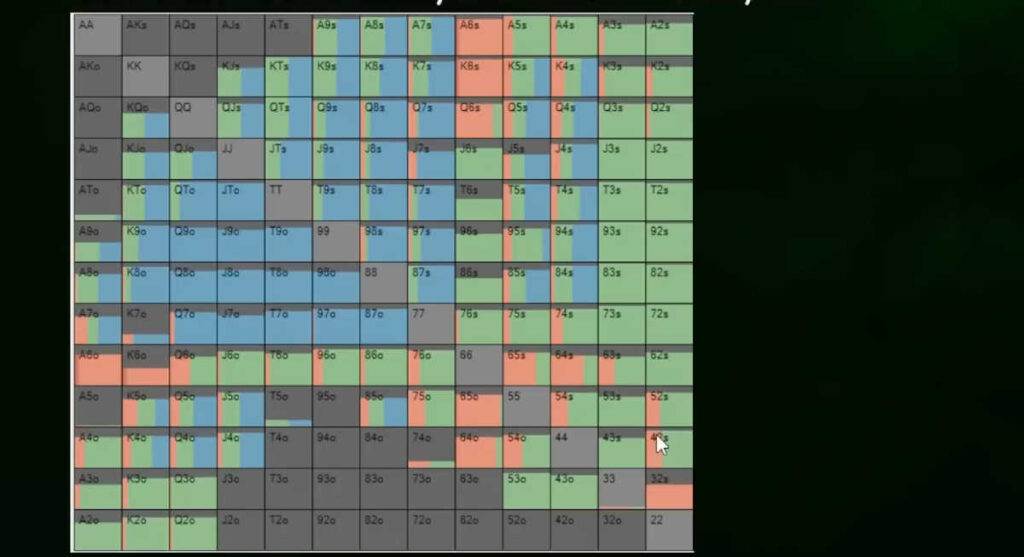
Beyond our strong holdings, our check-raising range consists of logical straight draws, i.e., 74s, as well as K5, A4, Q4, J4, as all of these hands represent a gutshot.
Added to the mix are also hands like 52 and 42, i.e., a bottom pair + gutshot combo.
One of the biggest mistakes players make in this spot is that they don’t check-raise with hands like A6 and K6, not realizing these are some of the best hands they’ll have here. If you’re not raising with the best hands in your range, you simply can’t have enough bluffs.
Example #2 – Paired Boards
Let’s now look at a different type of flop. The button opens, we defend from the big blind, and the board comes Q♠Q♥2♦. The button c-bets for just 1.5 big blinds, which is a common theme in the GTO strategy on paired flops.
Facing a small bet and assuming we have a decent number of trips in our range, we want to check-raise quite frequently, and we can go for a small sizing of 5.5 big blinds.
We should also be raising very often with our deuces, as these will be the best hand a lot of the time, but they are susceptible to being outdrawn.
Beyond these value hands, it’s not super easy to find good draws to use on these textures. The GTO strategy suggests hands that contain backdoor straight and/or flush draws, i.e., combos like JT, J9, T9, T8. You’ll notice that we are folding about a quarter of these, and those are the ones with no backdoor flush potential (clubs).
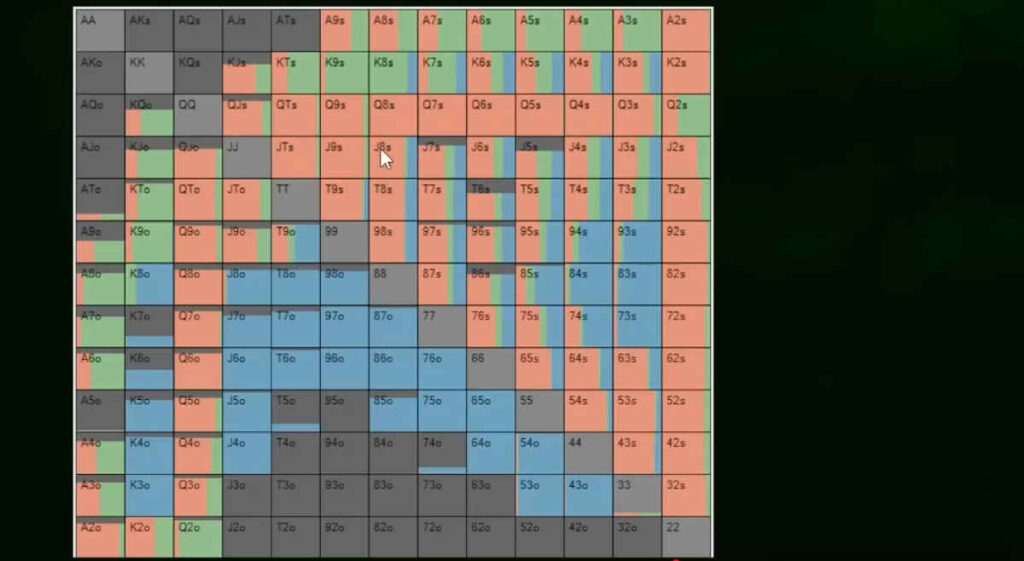
We also have hands that wrap around the deuce, such as 65, 54, 43, etc.
However, because we have so many trips in our range, we can also profitably bluff with a lot of junky hands, such as J4 suited with a backdoor flush draw, K4s, K3s, etc.
It is also worth noting that Q2 specifically isn’t raising very often. When playing 40 big blinds deep and holding a super-nuts, we don’t need or want to raise frequently.
Example #3 – Three-Flush Board
Three-flush boards are an interesting category within the scope of this lesson. If we look at a board of K♠9♠3♠, when facing a small continuation bet from the button, how should we proceed?
We do have to be concerned about the opponent holding a made flush, so we don’t get to check-raise that often. We are doing it at some frequency with all of our flushes (except for the nut flush), as well as hands like K9 and K3 – these are good enough to raise and get it in.
On the bluffing side of things, it’s interesting to see that we should use some bottom pairs, treating them essentially like junky draws, and a variety of hands containing a single spade, as they are flush draws.
Example #4 –High Card Flops
For our final example, we’ll look at a flop ofK♠Q♥6♥. In this spot, almost all hands that we want to check-raise with are strong, but vulnerable to our opponent’s range.
Because of this, we should be going for a large raise, even when facing a small continuation bet, making it something like 7.5 big blinds over a 1.5bb bet.
Players are often reluctant to raise with hands like K9, KT, and even KJ in these spots, but that’s the correct play when you’re 40 big blinds deep.
To balance things off, we can use bottom pairs as our bluffs.
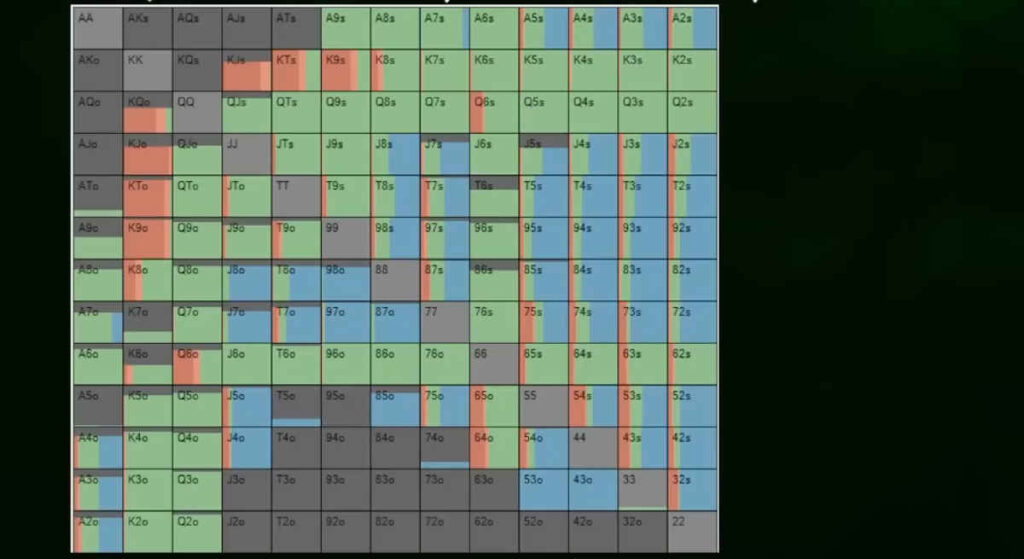
Of course, if the opponent uses a larger sizing, our strategy changes quite significantly. Facing a large continuation bet, we’re not check-raising nearly as often. Against a really big bet that’s over the size of the pot, we are only check-raising KJ, and all the other hands we want to continue with are played as calls.
Make sure to check out the video at the start of this article for a few more hand examples and explanations, and remember: a strong, GTO-approved check-raising strategy will make you a very tricky opponent to play against!