
Image courtesy of World Poker Tour
One of the most profitable spots you can find yourself in at a poker table is having a deep stack and playing against a bad player who is also deep stacked.
This scenario mainly happens in cash games, and you can achieve huge win rates against these players under the right circumstances.
However, to get into these spots, you first need to obtain a big stack, and since many games are capped in terms of how much you are allowed to sit with, you need to build the stack yourself. These three tips will help you consistently achieve that goal.
#1 Splash Around Preflop from in Position
When you are playing in position, you can call quite wide, especially if other players don’t 3-bet often and the rake is low. In games with time rake, for example, you get to play much wider by default.
The picture below shows two scenarios of the button player facing a lojack raise. The one on the left is for raked games, while the one on the right is for games with no rake.
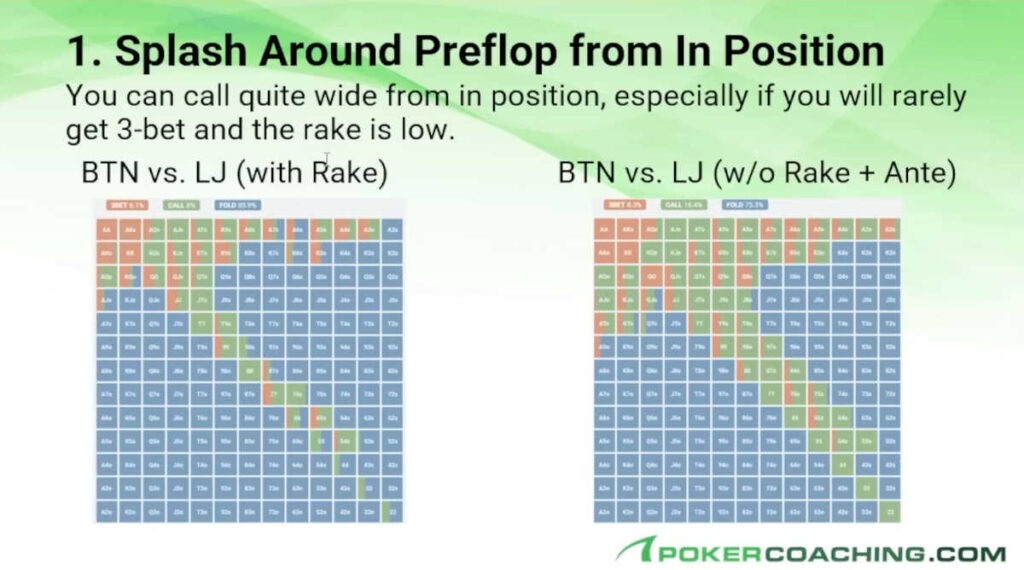
The left chart is the absolutely tightest you should play, assuming your opponents play perfect poker. This is not the case in most live games, especially at lower stakes, so you can pretty much use the chart on the right as your baseline.
As you can see, you should balance between calling and 3-betting with hands like suited aces, suited kings, some suited connectors, and even some unsuited big card combos.
At the same time, hands like small pocket pairs (77 and below) prefer calling and seeing the flop, and even 88 – JJ doesn’t 3-bet that often. You want to see the flop in position and realize your equity, especially against opponents who will make blunders after the flop and stack off lightly.
By playing wider ranges and being more aggressive before the flop, you’ll start to get more action from your opponents. This will be especially beneficial as stacks get deeper if they continue to stack off with hands like a top pair against you.
#2 Don’t Slow Play on the Flop
One common mistake that many players make is that they want to trap their opponents when they flop a big hand. However, with your strongest holdings, your aim is to play big pots, and it’s hard to build a pot when you’re slow-playing.
You should be particularly targeting the situations when the board is good for your opponent’s range, or they are a calling station. In these spots, you should always raise when you have the effective nuts.
Of course, when playing deep stack poker, you’re not looking to stack off with just one pair. You’ll want two pair or better to start piling chips into the middle.
For example, the button raises, and you call from the big blind. The flop comes 9♠8♣3♦. You check, and they bet 2.1 big blinds.
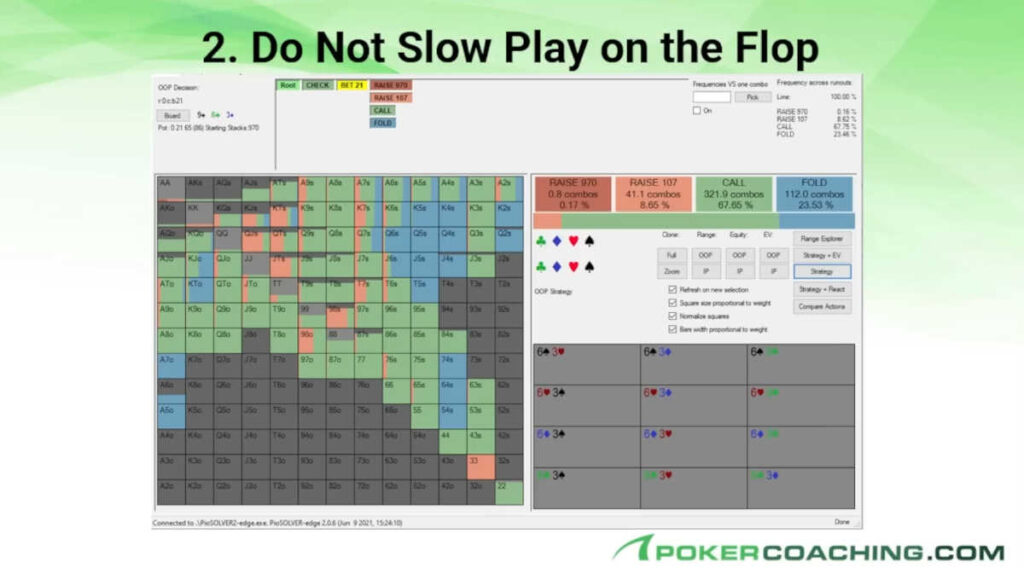
The opponent’s sizing on the flop will somewhat influence your strategy (i.e., the bigger the bet, the less often you should raise). However, generally speaking, we are raising with some of our best but vulnerable hands here 100% of the time: top two pair and bottom set.
You should also add some high and low equity draws to the mix.
So, we are not raising with too wide a range in this spot, but with our strong hands, we don’t want to slow play, especially against players who hate folding. As stacks get deeper, there are more and more opportunities to exploit your opponents.
#3 Master Turn and River Over-Bets
Many players, especially at low stakes, play poorly against over-bets. So, if you can master this strategy, you can extract a lot of value.
Let’s look at one fairly common and interesting spot.
When the flop comes J♠10♣3♠, the preflop bettor gets to bet big on all three streets. This is a situation where you should be blasting off a lot.
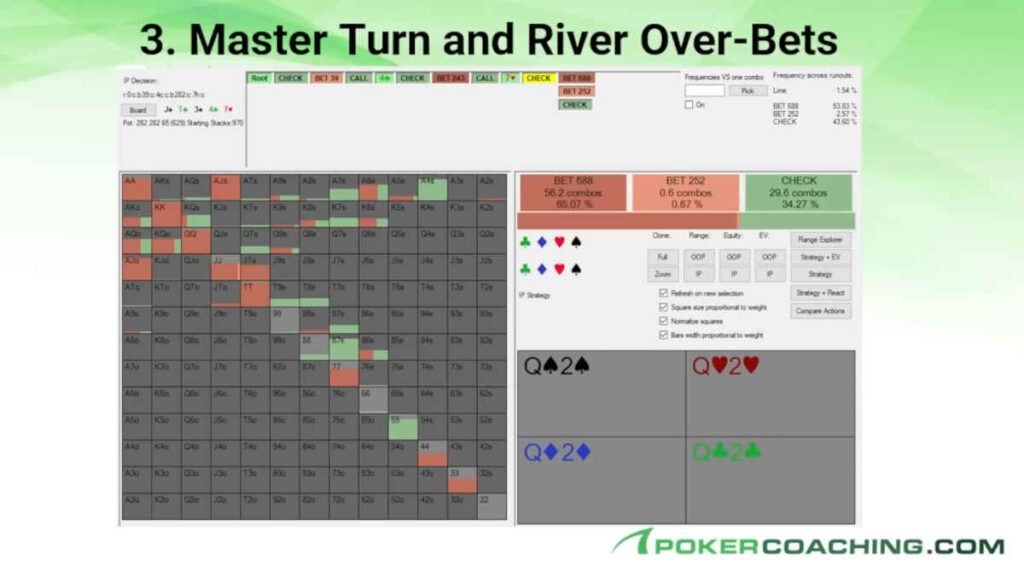
For example, you raise, the big blind calls, and they check to you on the flop. You bet 3.9 big blinds, and they call. The turn is the 4♣.
There are now all sorts of straight and flush draws on the board, which means that the current nuts is not likely to remain the nuts through the river. When that is the case, you should resort to big bets.
GTO strategy suggests betting 22.3 big blinds, which is around 1.5x the size of the pot. Hands that are betting big here are JJ, TT, AA, KK, and AJ. Then, we have a mix of draws all over the place, from very high to very low equity, like AsKs, AQo, K7, and K6 with flush draws, and even pocket 7s as a bluff.
So, we are betting with a strong polarized range, and this sets up an all-in on the river.
So, they call your over-bet on the turn, and the river comes 7♥. Once they check, this is the spot where we can check back or go all in for value or as a bluff. We arrive at the river with a lot of busted draws that we can go after the pot with.
Most people never overbet the turn, resulting in them never overbetting the river, either, which allows their opponents to realize their equity.
However, this strategy is very effective, as it puts a ton of pressure. In your opponent’s shoes, if you have QJ, for a solid top pair, after a turn over-bet and a river shove, it’s hard to find a call. And if you can get them to fold a top pair, you’ll be making a lot of money with this strategy.
Of course, you should be aware of your opponent’s specific tendencies. Some players hate getting stacked, so you should attack them in situations where they don’t have a lot of nuts hands. If they’re not protecting their ranges well, you’ll be able to absolutely demolish them.
On the other hand, some players call way too often. Against them, you should significantly reduce your bluffing frequency and make them pay when you make a monster.
The bottom line is, there are many opportunities to adjust your play and exploit your opponents as stacks get deeper. Master these strategies, and you’ll significantly boost your win rate.