
Image courtesy of World Poker Tour
It’s important to be focused while playing poker, as this allows you to notice players who play poorly and whose strategy may have leaks or weaknesses.
However, observing alone won’t make you money. You need to focus on exploiting their weaknesses, and ramping up your aggression using strong and fundamentally sound tactics is one of the best ways to go about it.
By playing straightforwardly against weak players, you’ll be leaving a lot of money on the table. So, here are some 3-betting tips that will help you crush the opposition.
#1 Attack Weak Opens & Isolate the Opponent
Weak players try to risk a small amount of money to see the flop and make a big hand. This often means they’re raising with ranges that are too wide.
If a player is opening with hands like QTo or 86s from an early position, you can 3-bet them with your strong and even medium-strength holdings. Their range simply can’t withstand a re-raise, especially when they’re out of position.
By employing this strategy, even when you do get called, you’ll usually be in a heads-up pot, removing all other players. This will allow you to navigate the pot much better and win far more often than your actual cards would suggest.
When your opponent misses the flop, they’ll usually fold to your continuation bet without further resistance.
It may be tempting to call instead of 3-bet, but you need to realize that, by doing so, you’re not only allowing, but inviting players behind to enter the pot. Multi-way pots are hard to navigate, as at least one of the players will connect with the board, and if you’re not that player, there isn’t much you can do.
You’re much better off 3-betting, especially because weak players don’t 4-bet nearly often enough. They’ll usually only do it with their best hands, allowing you to play nearly perfectly. You can fold hands like AQ, AJs, and ATs when they show aggression, and build a big pot with these holdings when they just call, knowing you’re crushing their calling range.
#2 Take Advantage of Their Postlop Leaks
These players tend to play a very face-up strategy after the flop, and you’ll have no problems figuring out if they like their hand or not.
They will bet and raise when they have the goods and, for the most part, check and fold to aggression when they don’t connect. They’ll almost never try to bluff you.
One of the biggest leaks that weak players suffer from is that they over-fold to pressure. They will give up on hands like an over-card with a backdoor flush draw or a bad gutshot to a single bet.
If you study GTO strategy, you know that, against a small bet, you have to stick around a lot. You can’t justify folding many hands if they have any potential to improve whatsoever.
Of course, the other side of this coin is that, when they start showing aggression, you need to be able to fold your marginal hands. Against players who only blast away with strong holdings, you need to over-fold. Trying to bluff catch against these players isn’t a profitable strategy.
#3 Seizing the Initiative
Weak players are constantly worried about running into premium hands when they get 3-bet, because they presume you are going to play like they do. They don’t think you’ll 3-bet hands like T9s, 98s, pocket 8s, etc.
When your 3-betting range contains these hands, but they incorrectly put you only on premiums, a simple flop c-bet will be enough to capture the pot a lot of the time.
Plus, when you do flop a big hand with these non-premium holdings, they’ll struggle to put you on a hand. This can get you paid big time in certain spots.
Of course, like in most things poker, position is very important, which means that the best spot for you to open your 3-betting range and attack weakness will be when you’re on the button.
#4 Understanding the Default GTO Strategy & Deviating from It
As mentioned at the start of this article, it’s essential for you to have a good baseline for your 3-betting strategy that you can build upon.
We’ve just mentioned the button, so let’s take a look at what the button’s range facing a cutoff raise looks like, presuming 100 big blinds effective cash game with no antes.
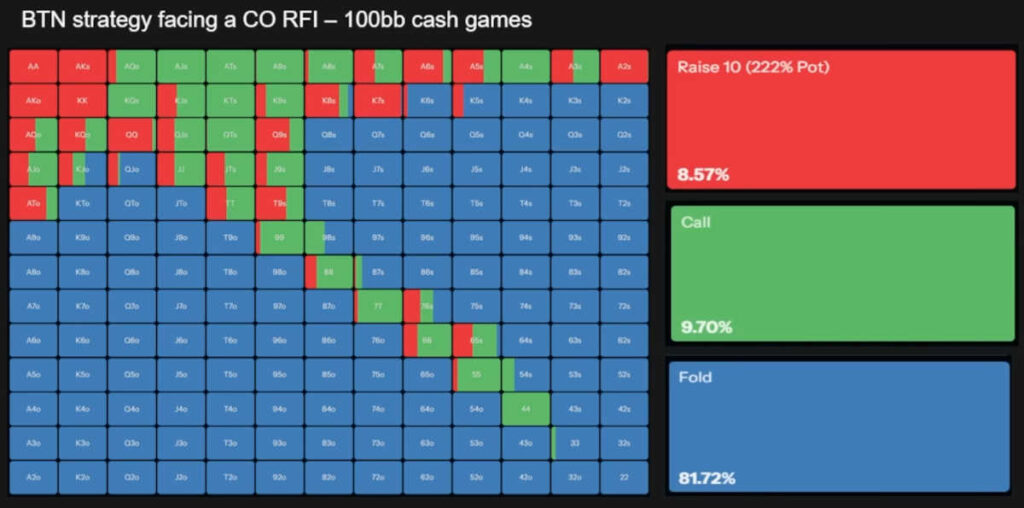
Looking at the chart above, most players have no problems finding their strongest 3-bets. However, many fail to re-raise with weaker holdings, such as some suited aces, K8s, K7s, Q9s, 65s, etc. This results in your 3-betting range being too strong.
Additionally, most players tend to just call with hands like AT, KQ, KJ, etc. However, you should be 3-betting with these hands a fair percentage of the time. If you know that your opponent will over-fold, you should 3-bet more with hands that use a mixed strategy, deviating from the GTO.
Playing from the small blind, we should be using a more linear strategy, focusing largely on our strongest hands.
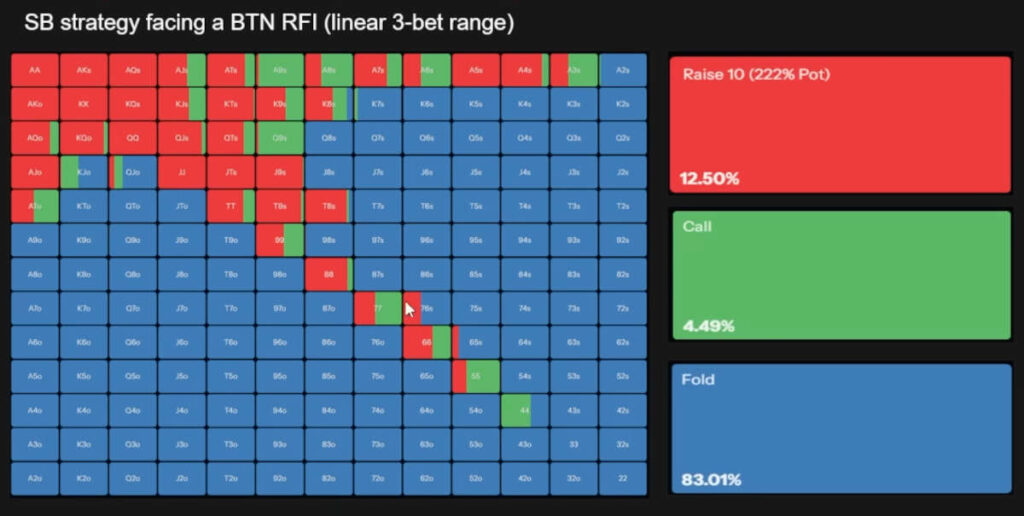
However, there are still some adjustments we can make here. For example, if you know your opponent will call too often, you can lower your 3-bet frequency with draw-ish types of hands like suited connectors and small pairs.
These hands benefit from seeing a flop, and if you know that the big blind player won’t 3-bet often, you can make this adjustment to put yourself in a better position against players who hate folding to 3-bets.