
Independent chip model (ICM) is a mathematical model that calculates the monetary value of chips in a poker tournament.
For tournament poker players, ICM is one of the crucial strategy elements that comes into play, particularly in the late-game.
In this short guide to ICM, we will explain what ICM is, how you can use it to gain an advantage in poker tournaments, and what tools you can use to master the model.
Independent Chip Model Explained
Before we delve into the topic of ICM, it is important to understand that this concept exists only in poker tournaments, where chip value is not equal to monetary value.
In a poker cash game, $100 in chips is worth exactly $100. If you win $100, you can cash out the amount, and if you lose $100 in a pot, that’s the real cash value you have lost.
In tournaments, on the other hand, this is not the case. All players get an equal amount of chips for their buyin at the start, but the game is played until one player has all the chips. Yet, that player does not get all the money.
As such, winning all the chips in a tournament does not result in you winning all the money in play, as it would at a cash game table.
The independent chip model serves as a way to bridge that gap and understand how the value of your chips changes as the tournament progresses, chip stacks change, and the prize pool distribution implications come into play.
What Affects ICM Calculations?
ICM calculations are fairly complex, and they are impacted by multiple elements such as the number of remaining players, prize pool distribution, and each remaining player’s chip stack.
The model determines the value of your chips based on these elements, and its correct application can help you make adjustments to your play that you would normally never make.
One key element that ICM does not consider is the skill level of all the players in play, as this is an intangible element that’s impossible to calculate and convert into a number.
For that reason, tournament poker players sometimes deviate slightly from the correct ICM plays, but for the most part, ICM calculations guide their plays in late-game tournament play.
cEV vs $EV
When talking about ICM, it’s important to differentiate between cEV (chip expected value) and $EV (dollar expected value), as two key concepts.
cEV refers to the standard expected value you see in cash games. For example, if you have 50% equity in a $200 pot, your EV is exactly $100.
$EV, on the other hand, only exists in live and online poker tournaments. It is the expected value of your chips expressed in dollars (or any other currency). This EV is calculated through ICM calculations.
While calculating the exact $EV of your chips at any point in a tournament is basically impossible, understanding how prize pool distribution, chip stacks, and the number of remaining players affect your $EV is essential.
ICM Calculation Example
Many poker players who are just starting to play tournaments struggle to understand the concept of ICM, and an example is the easiest way to explain it.
For the sake of this example, imagine you are playing in a small field local tournament where only three players get paid. The prize distribution is as follows:
- 1st Place: $2,000
- 2nd Place: $1,200
- 3rd Place: $800
There are five players remaining, and you find yourself wondering what your chip stack is actually worth in monetary terms.
For our first example, let us consider all the remaining players having exactly 50,000 in tournament chips in front of them, not a chip more or less.
A quick calculation using an ICM calculator tells us that in this case, each stack is worth exactly $800. That’s because there is exactly $4,000 to play for, and neither player has a chip advantage.
For our second example, let us consider a more realistic chip distribution. This time, the chip stacks and $EV values are as follows:
- Player A: 100k – $1,307.32
- Player B: 70k – $1,088.54
- Player C: 30k – $593.68
- Player D: 25k – $505.23
- Player E: 25k – $505.23
As you can see, player A has the highest $EV, but his 100k chip stack does not guarantee him the first-place prize of $2,000. In fact, his stack is worth just slightly more than second-place money.
On the other hand, the two short-stacks at the table still have $505.23 worth of $EV, as both of them could easily make a comeback and will make the top-three some portion of the time.
Now, let’s take a look at an even more extreme example of chip distribution in the same tournament:
- Player A: 200k – $1,826.83
- Player B: 25k – $931.67
- Player C: 12k – $580.01
- Player D: 8k – $403.06
- Player E: 5k – $258.43
In this example, the massive 200k chip stack is worth nearly the first-place money, but still not the full $2k. That’s because there are still scenarios in which Player A does not finish first at the end of the tournament.
Player B, on the other hand, has 25k chips, just as players D and E did in the previous example. However, because of the chip distribution, his chip stack is now worth $931, which is closer to the amount Player B’s stack was worth in the previous example when he had 70k chips.
Finally, Player E only has 5k chips left, but the chip distribution gives him a reasonable chance of making the money, which is why his tiny stack is still worth $258 in $EV.
How Does ICM Impact Tournament Decisions
There are many ways in which ICM can impact the correct tournament strategy. In some cases, ICM dictates you should play tighter, while in others, it dictates you move all-in with any two cards.
For example, imagine you are the 200k stack from our last example. All players fold to you in the SB, and Player B with 25k chips is in the BB. In this situation, you can move all-in with any two cards, and your opponent will be forced to fold most hands, simply because the two short stacks are very likely to bust out before him. His losing to you now would be somewhat of a disaster for him.
On the other hand, if you put yourself in the shoes of a middling stack on the money bubble of a tournament, facing a big all-in move from one of the chip leaders, the correct strategy is to fold all but the top of your hand range, as busting out before the bubble bursts in a spot where you have 55% cEV edge would be a mistake.
Training regularly with ICM training programs can take your ICM game to the next level and allow you to make the correct decisions that most poker players would never even think of.
Start Training Your ICM Skills Today
If you want to truly crush poker tournaments, becoming a master of ICM is essential. The only way to really do that is to train your ICM skills with software like ICMIZER.
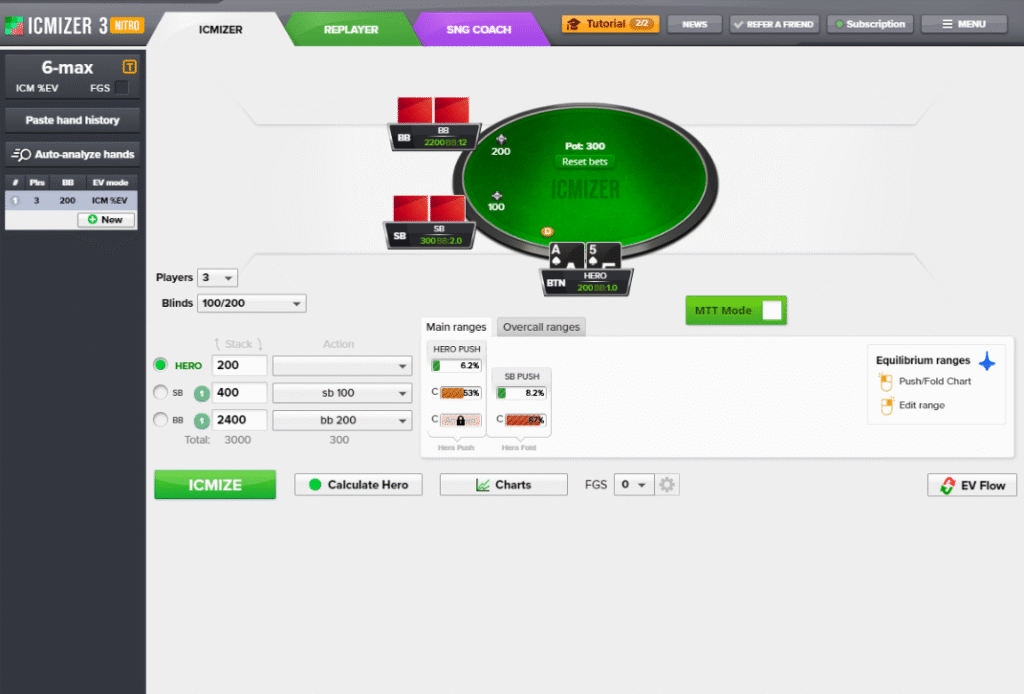
ICMIZER is a powerful poker training tool that lets you train late-game tournament poker push/fold situations while doing the calculations in the background.
Remember that you will never be able to do correct ICM calculations on the spot, as they are too complex, so training with software like ICMIZER is the best way to get a hang of how ICM works and when to make adjustments to your regular play.
Check out ICMIZER now to start training your ICM skills, and remember not to make rash decisions the next time you find yourself late in a poker tournament before considering how ICM might impact your optimal strategy.