Image courtesy of PokerGO Tour
One question that I get from many players is: how do I stop losing with pocket jacks? I often hear that people hate that particular hand, and it can sometimes be frustrating.
However, the simple truth is that this is one of the most profitable hands in poker, if you play it well!
The key is to limit the big mistakes that most players make with it. So, in this article, I’ll cover two important strategies that will help you maximize your profit with pocket jacks and also limit your big losses.
#1 Stop Overplaying Pocket Jacks Before the Flop
Pocket jacks should do a lot of calling when someone re-raises you before the flop, especially when playing deep-stacked and in position.
Let’s look at an example playing $1/$2 No Limit Hold’em, with a stack of $200.
You open from the button with J♥J♦, making it $6 to go. The player in the small blinds 3-bets you to $24.
In this spot, many small-stakes players re-raise, get shoved on, and call it off. However, if you look at the first chart on the left, pocket jacks call the 3-bet most of the time.
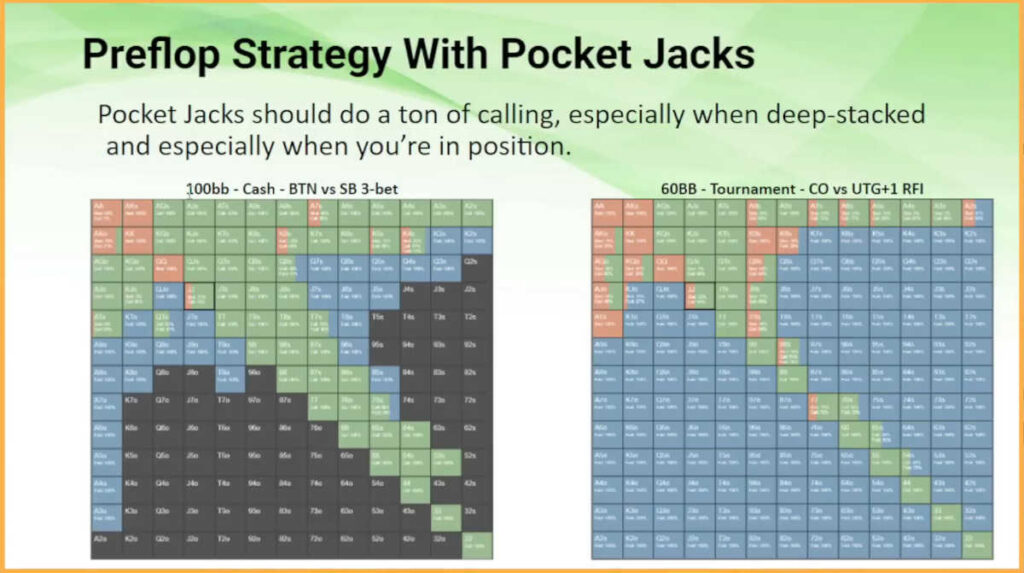
If your opponent is not 3-betting often enough from the small blind, which is quite often the case at low stakes, you should probably just call all the time.
You need to understand that, when you pile all of your money into the middle before the flop with pocket jacks, against players who are playing anywhere near reasonably, they will usually show you aces, kings, queens, and ace-king.
Pocket jacks don’t do very well against that range.
The second chart shows a different scenario, where we are facing a raise from UTG+1 in a tournament, playing 8-handed and 60 big blinds deep.
If you’re in the cutoff with pocket jacks, you’re not doing much 3-betting against an early position open, and if you assume that the UGT+1 player is raising with a strong range that’s tighter than what GTO strategy suggests, you should not re-raise.
If you do and they shove, you then have to call, and you’d rather not do that, especially if you are anywhere near the money.
Instead, call in position, see the flop, and realize that sometimes, things will not go well for you after the flop, and that’s okay.
#2 Stop Overplaying Pocket Jacks After the Flop
You should also stop overplaying pocket jacks once the flop is out. Let’s take a look at a couple of examples where players drastically overplay jacks.
Playing $1/$3 with $300 effective stacks, HJ makes it $10 before the flop with J♠J♥. The button player calls, and the big blind calls.
The flop comes 9♠7♦5♣ and the big blind checks. In this spot, checking is the default play. When there is someone else left to act after you on a low-card board, you should often check with the entire range.
I don’t mind betting if opponents play straightforwardly, which they often do in small stakes games, but against strong players, we need to check more.
In this particular case, we bet $15, the button calls, and then the big blind raises to $45. This is a very annoying spot.
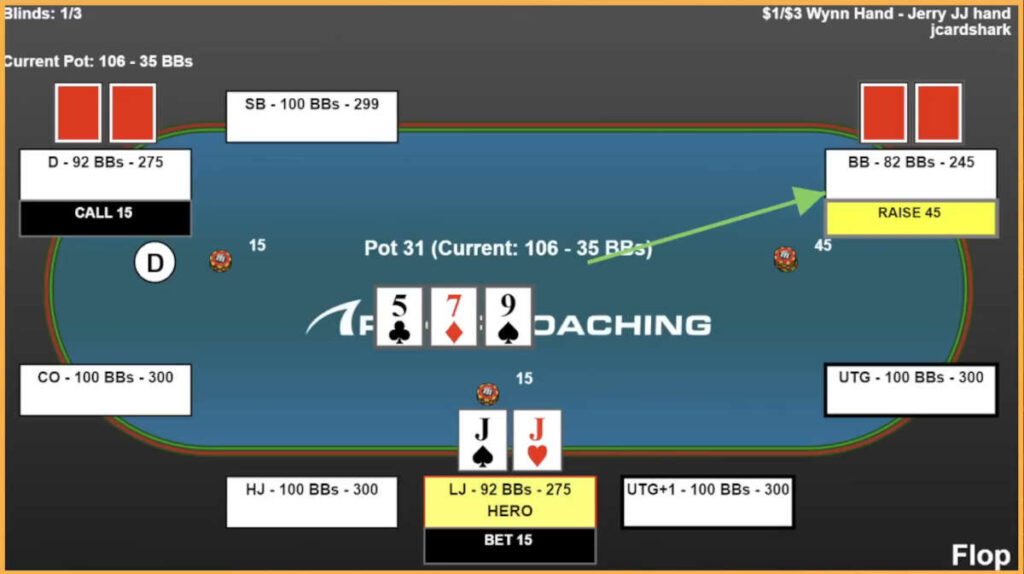
You are beating draws but losing to all logical value hands. Your opponent is probably not playing top-pair type of hands this way (A9, K9, Q9), unless they are really bad at poker.
Additionally, some players won’t bluff with some logical bluffs in this spot, like various gutshot straight draws. This is a situation where your opponents should be very polarized, holding very strong hands they’re happy to get it all in with, and a combination of high-equity and weak draws.
So, facing this check-raise, we should call or fold – these are the only two options that make sense.
However, many players just rip it all in because they don’t want to get outdrawn. Whenever you move all-in, and they have a hand like A8, K8, or Q8, they are going to fold. But they will always call when they have you crushed.
Calling these generic small check-raises is fine, although it can be tricky to play the rest of the hand, as you won’t know what cards are good for you, plus, the button could still raise after you on the flop.
So, in your average small-stakes game, I definitely don’t mind just folding in this spot. Quite often, when using small check-raises, players will do it with hands that they don’t mind giving you good odds with, which is usually the nuts or very close to it.
Let’s now look at a tournament spot, where we raise with J♠J♣ from the hijack, playing 60bb effective. We go for a standard 2.2bb raise, the big blind calls, and the flop comes Q♥10♥2♣.
The big blind opponent checks, and, in this spot, checking back or betting small are both options. Here, we decide to bet small and fire out for 1.5bb. The big blind calls, and the turn comes the 7♠.
Once the opponent checks, this is a tricky spot. We almost always have the best hand here if no additional money goes into the pot. We have a marginal made hand, where, if we bet, we may get some calls from tens, but we are always getting called by a queen, and we can also get check-raised some of the time.
So, checking is the better course of action here. However, in this particular scenario, the HJ goes for a bet of 3bb (one-third pot) and faces a check-raise to 10bb.
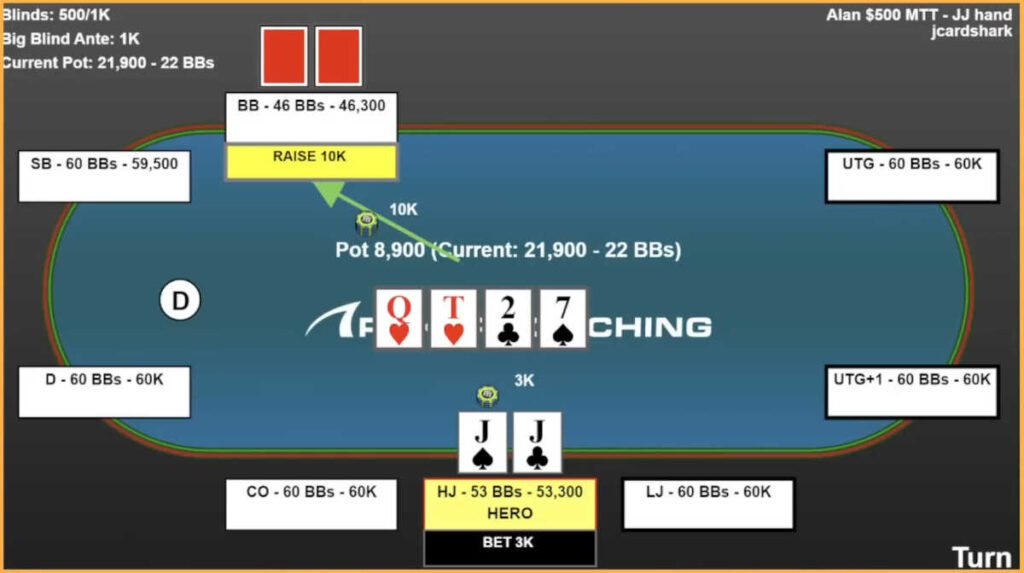
With this action, the big blind’s range is going to, once more, be very polarized: two pair and better, maybe even like KQ+, and then there are some draws, i.e., hands like J8, some bad flush draws, and then some very high-equity draws like K♥J♥.
Given all this information, folding is the best option facing this check-raise. However, in this particular instance, pocket jacks decide to call and see the river of 9♠. The big blind bets out for 15bb.
Given that we are blocking some of the natural bluffs here, in your average $500 live tournament, this is actually an easy fold once again.
The bottom line is, pocket jacks are one of the best starting hands, so if you’re losing with it, it’s probably because you’re putting in too much money in bad spots. Likewise, after the flop, this is often a marginal made hand, and you should treat it accordingly.
Take this advice to heart, stop overplaying your jacks, and enjoy all the extra winnings!