
Image courtesy of World Poker Tour
Despite what those who don’t know much about the game might think, winning in poker isn’t about making sick bluffs, fancy plays, and huge laydowns.
Sure, it’s what’s usually shown on TV, but those are a dozen of the most interesting and exciting hands from an eight-hour session.
To win in poker, you need to have strong fundamentals and make fewer mistakes than your opponents.
Today, we’ll focus on the latter aspect, or, more precisely, two big errors that I often see players make, and how you can avoid them.
Mistake #1: Overplaying Clear Marginal Made Hands
Losing big pots with medium-strength hands is a massive leak that I come across quite often with people who ask me what they could do to improve.
Many people drastically overplay marginal made hands where, from the GTO point of view, they should largely stick to passive actions with these holdings (i.e., checking and calling instead of betting and raising).
Here’s a $1/$3 hand from one of my students that demonstrates this leak.
The hero opens to $10 from the HJ holding Q♠10♠ and only the big blind calls. The flop comes 10♣9♥5♥, and the big blind check-calls the $13 continuation bet. So far, everything is pretty standard.
The turn brings the 6♥ and the big blind checks. In this spot, we should always be checking behind. Maybe if you are playing against the worst players in the world, you can try and go for value here, but, in that case, you have to still be ready to fold when they raise.
However, the hero opts for an aggressive action and bets again for $15. The big blind raises to $40. Once this happens, we are done with the hand. Folding is the only correct play.
Instead, the hero makes the call, and the river comes Q♣, giving them two pair. While this improves the hand in theory, in practice, it doesn’t change all that much. Most players aren’t bluffing enough here, and we are still behind all of the value hands.
The big blind bets $75, and the hero decides to look them up, only to be shown the nuts.
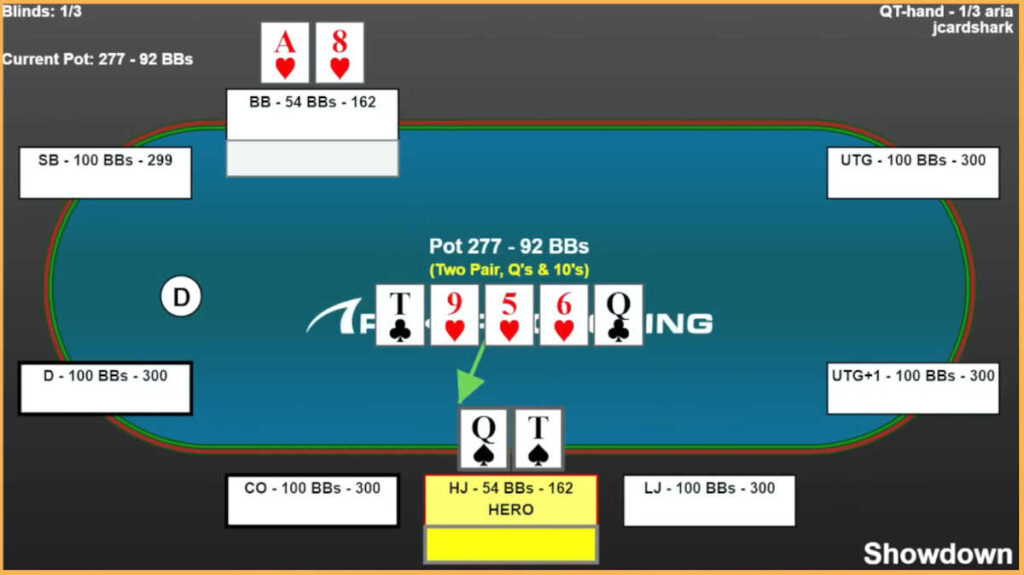
This hand went the wrong way on the turn. We should be checking behind and, if we do bet, we absolutely must fold once the big blind goes for a check-raise.
Mistake #2: Not Playing Balanced Strategies
Balanced means playing a mix of strong and weak hands in the same manner so that you are difficult to predict. If you are always balanced, you keep your opponents constantly guessing, leading to them making more mistakes.
Many players make the blunder of playing all of their strong poker hands in the same way and their weak hands in the same (but different) way.
For example, they’ll put in a lot of money in the middle with the nuts, but they’ll rarely (or never) bluff, or they’ll only check-raise with their draws.
In small-stakes games, many players are unbalanced because they did not study enough or because they believe their opponents are so bad that they can get away with anything.
However, this is not 1999 anymore. Players are kind of decent, even in these small games, which forces you to play at least somewhat balanced strategy, unless you know for certain what they are doing wrong, which simply won’t be the case all that often. Modern players also have access to far more strategy content and information about different poker games than ever before, making today’s games much more competitive overall.
Let’s look at another hand example from one of my students.
The hero is in the LJ with A♠K♥ and, playing $1/$3, they open to $10. The big blind is the only one to make the call, and they proceed to the flop of K♠10♣6♦.
The big blind checks, and the hero fires a continuation bet of $13, which is perfectly fine here. The opponent calls, and they proceed to the turn of 2♦.
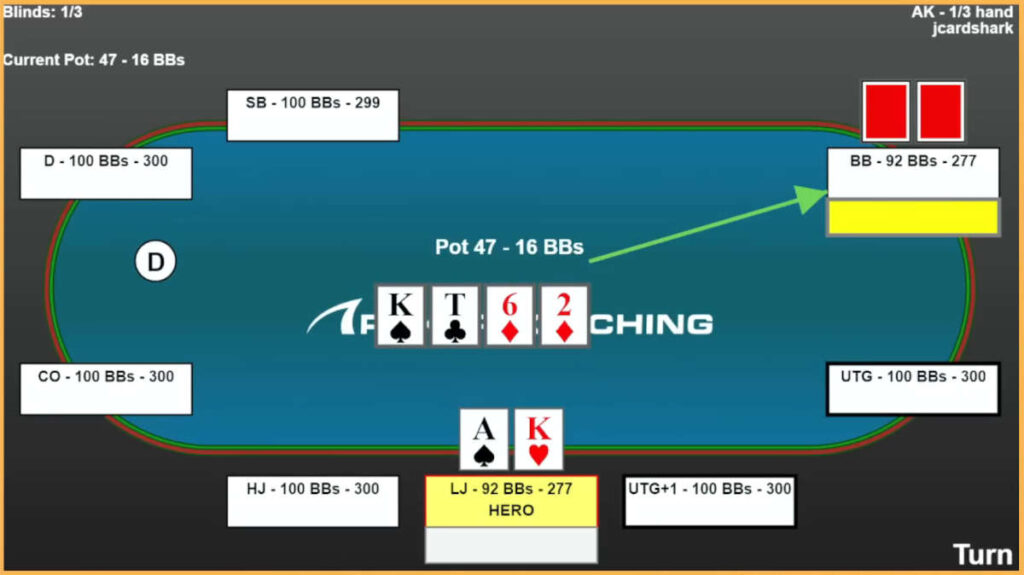
The big blind checks once more, and we definitely want to bet again. The hero bets out $60, which is an overbet, and this is a great spot for it, especially if you think your opponent is a bit of a calling station.
The opponent calls, and the river comes 2♠. This is an easy all-in, and it is also a spot where, if you want to be balanced, you should have some bluffs that you’d play the same way, like missed flush draws.
The hero does move all-in, and the opponent looks him up with K♦J♦, which is one of the best hands they could reasonably have.
Summary
These are two crucial mistakes that you have to avoid if you want to succeed in poker. Once more, you need to:
Stop overplaying marginal made hands – take more passive actions like checking and calling with good but not premium hands.
Stop lacking balance in postflop strategies – you must play your strong and weak hands in the same manner in similar spots to stay unpredictable.
Players today have gotten better, and if they can figure out what your bets indicate, you’ll struggle to win. So, be smart with your marginal made hands, stay as unpredictable as possible across the board, and you’ll see your results improve!