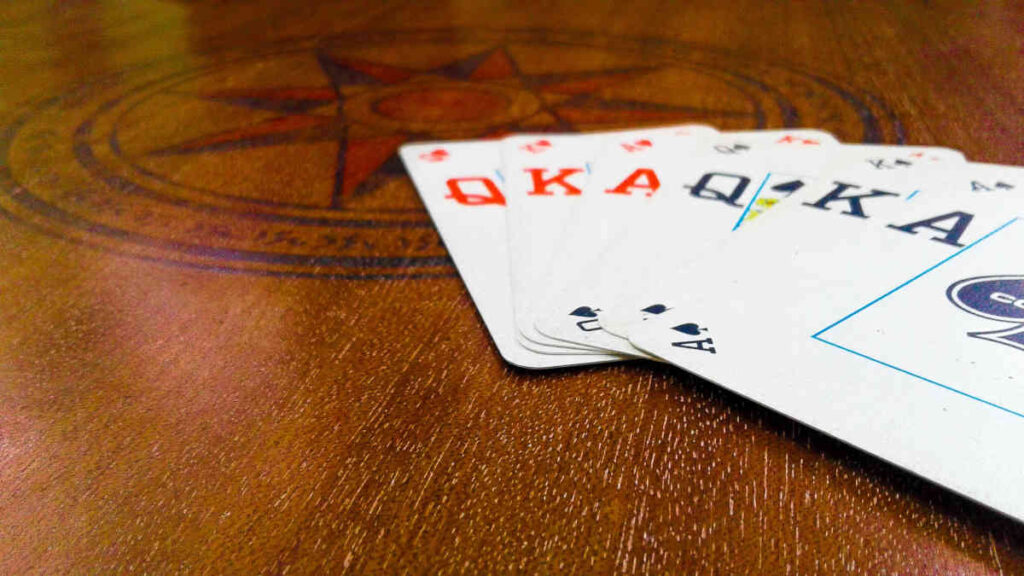
Caribbean Stud uses the hand rankings poker players already know, then changes the contest around them. The dealer’s Ace-King qualification rule affects how hands are settled, where the difficult decisions begin and why one exposed card deserves your attention.
Ace-King is the sort of starting hand that immediately commands attention in Texas Hold’em. In Caribbean Stud, those same ranks carry another significance. Ace-King is the minimum hand the dealer needs to qualify.
You are not trying to read another player’s range or wondering whether a river bet represents strength. Five cards arrive, one dealer card is exposed and you must choose between folding or raising. Continue and the raise costs twice your original ante.
For poker players encountering Caribbean Stud for the first time, the cards look reassuringly familiar. The decisions require a different way of thinking.
The Dealer Has to Earn the Right to Beat You
A Caribbean Stud hand begins with an ante. You and the dealer receive five cards, although only one of the dealer’s cards is visible. Once you have inspected your hand, you can fold and surrender the ante or raise by placing another wager worth twice that amount.
Only then does the dealer reveal the remaining cards.
This distinction is useful when moving between different forms of casino poker and table gaming online. New Zealand players exploring vegas stars nz, for instance, encounter a casino offering that spans pokies, live dealer games and table games. Familiar cards do not guarantee familiar mechanics, so the rules attached to an individual game deserve attention before money is committed.
In Caribbean Stud, the dealer needs at least Ace-King to qualify. A-K-4-3-2 qualifies. A-Q-J-10-9 does not.
| Dealer outcome | What happens |
|---|---|
| Below Ace-King | Dealer fails to qualify. The ante wins even money and the raise is returned |
| Qualifies and beats your hand | Ante and raise lose |
| Qualifies but loses to your hand | Ante wins even money and the raise is paid according to the applicable paytable |
| Hand ties | Ante and raise push |
The unusual possibility is that you can continue with a hand that never has to beat the dealer because the dealer fails that initial test.
Ace-King Is Where the Easy Answers End
The interesting decisions occupy a surprisingly narrow part of the hand spectrum.
With a pair or better, standard Caribbean Stud strategy calls for a raise. With less than Ace-King, the usual decision is to fold. Ace-King hands occupy the awkward territory between those answers.
The three cards accompanying your Ace and King have value because they can break a tie between otherwise similar holdings. The dealer’s exposed card adds another clue.
For example, one widely used strategy calls for raising when the dealer’s upcard from 2 through Queen matches one of the cards in your hand.
Take A-K-Q-7-3 and A-K-5-4-2. Both are Ace-King high, but they are not equivalent hands. The queen in the first holding provides a stronger kicker if the dealer also qualifies with Ace-King. Once the dealer’s exposed card enters the picture, those accompanying ranks can also reveal information about cards that are no longer available to complete the dealer’s hand.
It is a good illustration of why a large casino catalogue needs to be approached game by game. VegaStars works with providers including Pragmatic Play, Hacksaw Gaming, Playson and Wazdan, but a familiar developer, interface or set of playing cards cannot tell you how a particular wager works. The information and paytable attached to the game can.
One Face-Up Card Is More Information Than It Looks
Four of the dealer’s cards remain hidden when you make your decision. The fifth is right there on the table.
Mohammed Abdellaoui and his co-authors, writing in the Journal of Economic Theory in 2025, describe uncertain situations in which people do not know exact probabilities but have “some opportunity for learning.” Their research into learning under ambiguity examined how additional information affected beliefs and attitudes towards uncertainty.
Caribbean Stud offers a neat card-table parallel. You cannot see four dealer cards, but the upcard reduces what is unknown. Your own five cards provide further information because those cards cannot also appear in the dealer’s hand.
The exposed card is not a tell. The dealer has no bluff to sell. Its usefulness comes from information rather than psychology.
An NZ$10 Ante Can Become an NZ$30 Decision
Suppose your ante is NZ$10. Folding limits the loss to that amount. Raising requires another NZ$20, taking your total commitment to NZ$30.
Mathematicians Stewart Ethier and Luca Stefanello explore the mathematics of casino returns in Long-term Behavior of Casino Games, a paper published on arXiv in December 2025 and revised in June 2026. The analysis of casino-game returns and wagers distinguishes between return to player and house advantage when bet sizes can vary or depend on what has already happened during play. Caribbean Stud provides a clear practical case: the amount at risk changes when an initial ante is followed by the decision to fold or raise.
That becomes particularly relevant when choosing your initial stake. For New Zealand players, VegaStars supports NZD across its casino offering, so the same principle can be considered directly in local currency: a NZ$10 starting wager is not necessarily a NZ$10 decision once a game allows or requires additional money to be committed. In Caribbean Stud, continuing means being comfortable with that initial ante becoming NZ$30.
Hold’em Instincts Only Take You Part of the Way
Knowing poker hand rankings gives you a head start. Everyone had to learn them once.
In an interview about Maria Konnikova’s introduction to poker, the author and tournament player recalled using a table-side cheat sheet because she was still learning which hands beat which. She later became a tournament champion.
Caribbean Stud preserves that hierarchy. What disappears is much of the strategic language surrounding conventional poker.
There is no position to exploit against the dealer and no opponent to bluff. That changes the experience when a poker player crosses into the table-game section of an online casino. At VegaStars, live dealer and table games appear alongside a much larger selection of pokies, but recognising the cards is only the starting point. In a house-banked poker game, your decision comes from the cards you can see and the procedure governing the hand.
Three Checks Before You Put Down the Ante
Different presentations can make the same casino game look new. Before staking anything, three details tell you far more than the graphics around the table:
- Read the qualification rule. Establish the dealer’s minimum qualifying hand rather than carrying assumptions across from another poker variant.
- Check the cost of continuing. A two-times raise means your possible exposure should influence the ante you choose.
- Inspect optional wagers separately. Side bets can have their own rules and returns, so treat them as separate propositions.
That habit applies across any varied game library. VegaStars also provides account tools intended to help customers manage their play, including options to take a break or self-exclude. Choosing a stake you can comfortably afford should come before deciding whether a particular hand is worth continuing. The individual game information remains the place to establish exactly what the wager requires.
There is a useful lesson in all of this for poker players. Caribbean Stud looks uncomplicated because so much of it is recognisable, from the five-card hands to the familiar rankings. The real interest lies in what has changed. Ace-King decides whether the dealer can compete, one exposed card gives you information before you act and continuing comes at a defined cost. Understanding those details is where the game starts to make sense.
Responsible gambling: Casino games involve financial risk and should be treated as entertainment rather than a way to make money. Set affordable limits before playing, never chase losses and take a break if gambling stops being enjoyable.