
Image courtesy of the World Poker Tour
One of my favorite sayings about poker is that volume cures variance. Back in a day, I managed to turn $50 into $350,000+, playing a ton of games that I had a tiny edge in, proving this very point.
That opportunity is still available, but to take advantage of it, you have to zone in, sit down, and play a bunch.
There is a lot of variance in poker in the short run, and anyone can win on any given day. But in the extremely long run, there is almost no variance.
The reality is, however, that most people don’t want to put in the work and the hours required to get there.
Of course, just how much variance you’ll have to deal with depends a lot on your choice of games. In tournaments with 1,000+ players where the top ten get the biggest slice of the prize pool, you’ll spend a lot of time being down, while your wins will be sporadic but significant.
Cash games are the exact opposite, where you’ll win or lose a few buy-ins on any given day, and, as long as you have an edge, your graph will trickle upward slowly and consistently.
I’ve said it many times, and I’ll say it again – to win in poker, you need three things:
- Find the game that you can beat – without an edge, you’ll lose in the long run.
- Play a lot – put in as much volume as you possibly can.
- Keep a proper bankroll.
What many players don’t or refuse to understand is that time doesn’t equal volume. If you play three days a week but only play one tournament a day, you’re not putting in the volume, regardless of how many hours you spend at the tables.
Sit & Go – Slow & Steady
When I was younger and eager to build my bankroll, I picked 9-handed sit and goes, a game in which I had a very small edge, with an ROI of 3% to 10%. So, in a $100 game, I’d expect to make about $5, which is not a lot.
However, I did not mind. I would sit down and grind hard, putting in around 100 games a day, and as I’ve gotten better at multi-tabling, that number increased.
The graph below shows how much you win on any individual sample of one day playing 100 sit and goes.
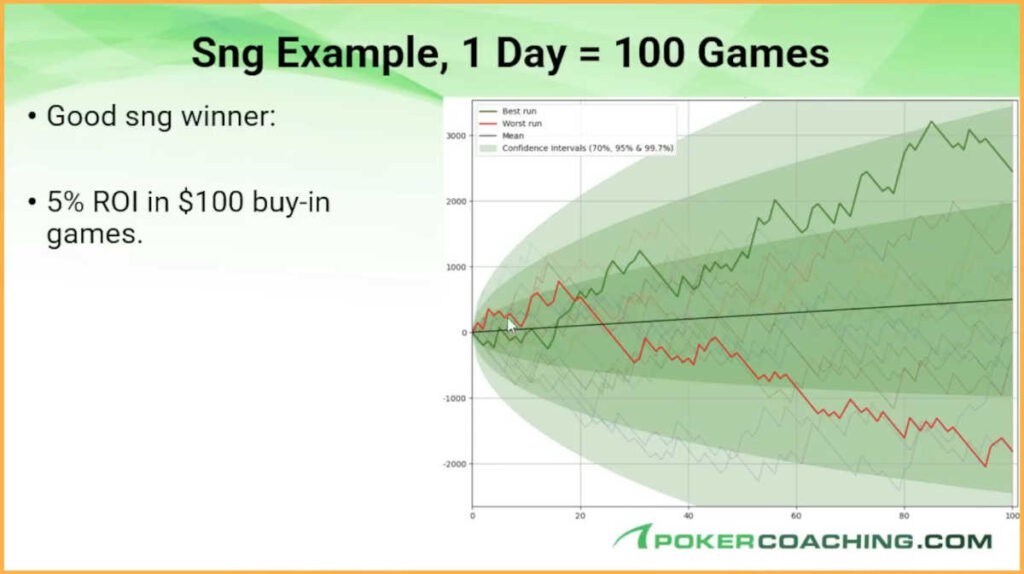
The black line shows how much you will profit on average, which is about $500. The remaining lines show how much we’ll be up or down if we do it 20 times over. Sometimes, you’ll crush it; sometimes you’ll get crushed.
On a single day, your results will be all over the place, and that’s to be expected.
If we play for a full week, so 700 games, there is still a lot of variance. We’ll have four or five losing samples out of 20. Some people are fine with it; some are not. Personally, I’m okay with it, because I zoom out and focus on the big picture.
If we look at a full month, 2,800 games, we see that we’ll have a winning month a majority of the time. In a span of two years that I spent grinding hard, I only had three or four losing months. You’re taking your small edge and playing it over and over and over again.
And over the course of a year? This is where things start to look really beautiful. Over 35,000 games, playing only with a small edge, we can expect to make $150k to $250k.

Of course, you should also look for the best possible rakeback deal to add to your base profits.
The question is, are sit and goes still beatable in today’s online environment? They are at lower stakes, but as you move up, you’ll find them quite hard. So, what other options are out there?
Tournaments – Brutal Short to Mid-Term Swings
Tournaments are definitely beatable, but they entail a lot of variance, as you’ll rarely get a big win. Plus, if you play a wide spread of buy-ins, you can get unlucky and win in your $500s and lose in $3,500s, for example.
If you play live tournaments, you’ll have whole losing years. Some players really don’t like that, and that’s why they say it’s all or mostly luck.
There is certainly a lot of variance or short-term luck involved, but we are only interested in putting in the volume, and if you play live tournaments, you don’t get to play as much.
This is why I recommend that any player who insists they want to play only live tournaments have at least a year of living expenses set aside (and more, if possible), because it is almost inevitable they’ll experience a big downswing at some point.
For example, you play $100 tournaments with 250 players and have 50% ROI, which is doable for solid winning players. If you only play 20 games a month (and serious grinders can put in double that), you’ll notice that results are all over the place.
You’ll end up losing money most of the time; 7 out of 20 times you’ll be up some amount of money, with $1,000 profit on average.
So, are you okay with being down 13 out of 20 times? You better get used to it if you want to play live tournaments.
What about a full year, presuming that we play 240 games? Again, this number can be much higher, as there are usually times of the year where you can get more volume in.
On average, we’ll be up $12,000 over the course of the year. And if we look at a 20-year period, we had a stretch where we were down for three years.
The more we zoom out, the closer our results get to what they are supposed to be. Over a five year period, we can expect to win 95% of the time, winning $20,000 on average, which is not great and not terrible.

What about online players? Let’s say you play 150 games a week, with a buy-in of $100 and 20% ROI in tournaments with 1,000 players.
Short-term results are all over the place, as you’d expect. Even after a month of play, we expect to be down almost half the time. After a year, things start to even out a bit, but there is still a lot of variance at play.
Winning big-field tournaments doesn’t happen all that often. So, if you’re playing to win money and get flustered when you lose, tournaments are probably not for you, as you will lose a lot over the course of the year.
Cash Games – The Best Balance
Cash games are key to consistency. You win or lose a few buy-ins every day and rarely have big downswings, provided you are playing with an edge.
Wins are much more consistent, so cash games are ideal if you don’t like a ton of variance, and none of us really enjoy being down 200 buy-ins. It’s hard to keep showing up and playing your best game under those circumstances.
If we look at a good live player who wins roughly 10 big blinds per hour, their results over 240 hands (eight hours of play) are all over the place.
Over the course of the week, with 1,200 hands, we are looking at three or four losing weeks out of 20. And after a full year of playing, we win every time, and it’s not even close. With a sample of just 60,000 hands, you win a large chunk basically every time.
95% of the time, you’ll end up between 25,000 big blinds, which is $250,000 playing $5/$10, and 13,000 big blinds, i.e., $130,000.

When it comes to online poker, games are tougher. If you’re a good player, you can expect to win five big blinds per 100 hands, and this is maybe too high for higher-stakes games.
With a smaller edge, variance is bigger. Over a month, we will still lose four or five times out of 20, and you need to be okay with this. If you’re not, poker may not be for you.
Over the course of a year, we’ll end up winning 2,500 big blinds about 95% of the time, and over the course of five years, everybody wins, with 25,000 big blinds to the good being the worst result.
Final Thoughts
If you want to make money in poker, the first thing you have to do is increase your volume. Most players are not willing to put in the volume. They come to a casino, play one tournament, and they go home as soon as they bust.
This is wasting your time.
When you go to play, make sure you are properly bankrolled and be ready to fire several bullets. Every time you enter, you are extracting some edge, although it may diminish as you buy in later.
If you play cash, make sure you get a seat as soon as you arrive so that you don’t spend two hours on the waitlist, doing nothing.
You need to figure out if you have an edge, and the best way to do it, especially if you’re starting, is by playing as much as possible. To this effect, you should also put a small amount of money online and try beating micro stakes.
If you are good enough to beat these games, you’re probably good enough to beat the smallest stakes live.
Start slow, take your time, and put in the volume. You should also study constantly to improve your game and, of course, always look for the softest games you can find!