Most poker training tools have the same weakness of having a lot of content, but not leading players thoughtou the learning journey. You put in an hour, you close the app, and the next day there is no trace of the work. Nothing tells you what to do next or whether yesterday’s hands moved the needle.
PeakGTO, the trainer bundled with PokerCoaching, went straight after that problem.
Progress Tracking is live as of today, and while the surface is XP, levels, and badges, the machinery underneath is a study system that decides what you train, remembers what you got wrong, and gives you a reason to open the app every day. Check it out yourself.
What’s new on PeakGTO
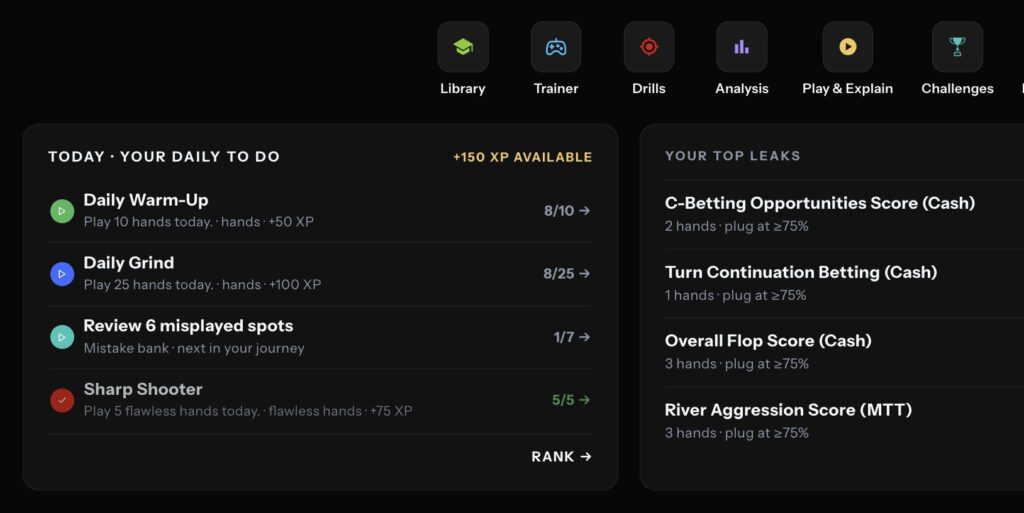
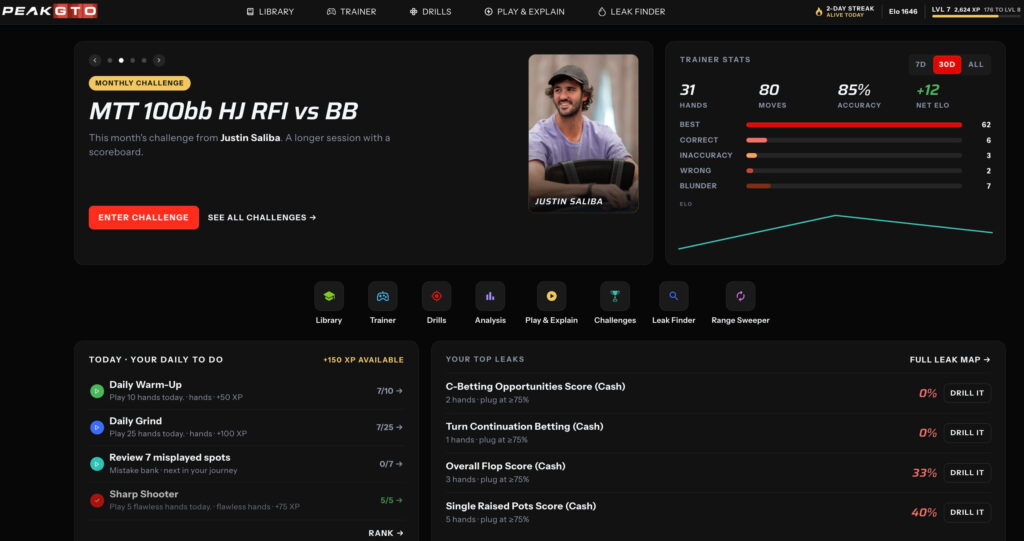
The biggest change is the home screen. It used to be a menu of trainers, and you had to choose. Now it opens on a plan for the day. Daily missions, a streak counter, your trainer stats, your top leaks, and one suggested next step.
That sounds small until you think about where study time actually goes.
Most players spend the first ten minutes of a session deciding what to do, pick whatever feels comfortable, and end up drilling spots they already play well. A dashboard that says “your biggest leak is three-bet pots out of position, here is today’s drill” removes the decision and points the work at the weakness.
Pathways sit on top of this.
They’re structured sequences of drills and spots that take a player from one level of understanding to the next, so someone who has never opened a solver isn’t dropped into turn overbet frequencies on day one. Missions, daily and weekly, are the short-term version of the same idea. Finish these three things today, and the next thing tomorrow.
The Mistake Bank is doing the teaching
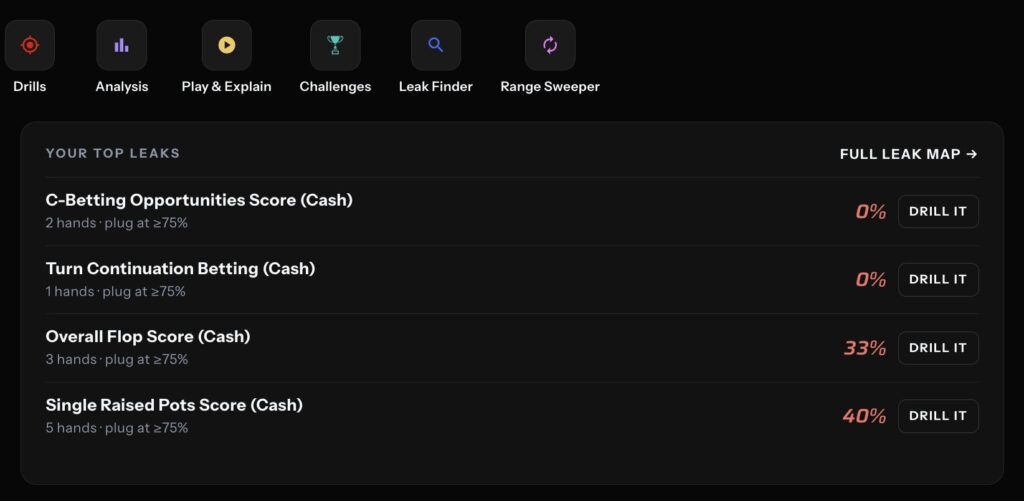
This is the feature to pay attention to.
Every hand you get wrong in the trainer is saved automatically. Then, on a spaced schedule, PeakGTO puts the exact same spot back in front of you. Not a similar spot, the same one, days later, when the answer is no longer fresh.
That is spaced repetition, and it’s the most reliable learning technique we have evidence for. Language apps run on it. Medical students pass board exams with it. The idea is that memory gets stronger when you’re forced to retrieve something after you’ve partly forgotten it, and it’s far more effective than reviewing the answer once and moving on.
Poker has never really had this.
Players review a hand, see the solver output, nod, and lose the information within a week because nothing ever tests them on it again. The Mistake Bank closes that loop. A spot stays in rotation until you’ve shown you can play it, and the badge for clearing your bank is called Leak Destroyer for a reason.
Rank and streaks are there to keep you coming back
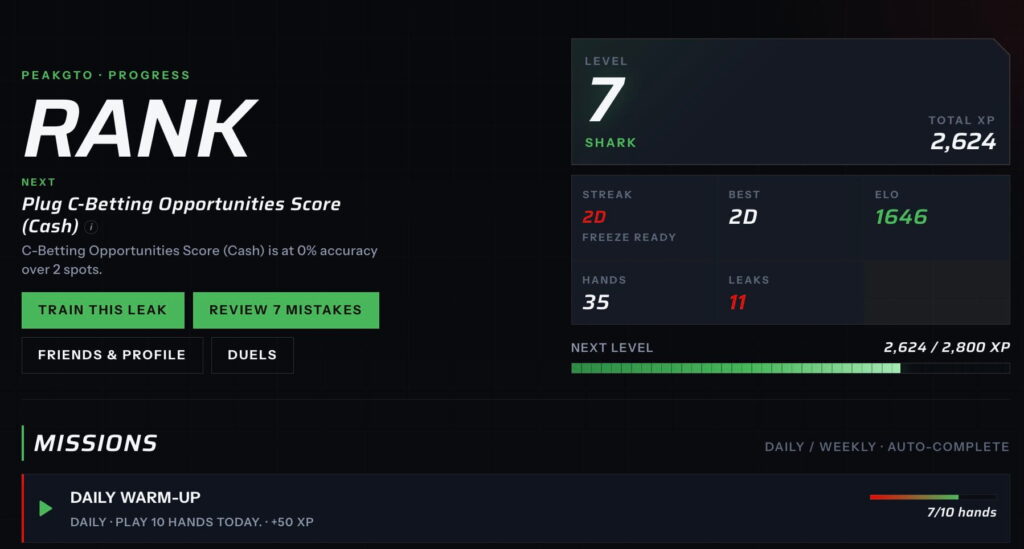
Now the part that looks like a game. Every hand adds XP, which then builds levels and titles. A stats bar follows you around the app with your level, ELO, and streak, and a Rank page pulls it all together. Achievements are tiered, badges are collectable, and you can equip titles, frames, and card backs in the trainer.
None of that makes you better at poker by itself, and PokerCoaching isn’t claiming it does.
What it does is make consistency visible.
A streak you can see is a streak you don’t want to break. A rank that only moves when you play hands rewards volume of practice rather than hours of video watched. Public profiles add a bit of social pressure, which for a lot of players is the difference between studying and meaning to.
The honest framing is this. The Mistake Bank and the dashboard are what improve your game. Rank, streaks, and cosmetics exist so that you’re still using the Mistake Bank and the dashboard in month three, which is where most study plans die.
Duels and Play and Explain
Two more additions round it out.
Duels let you challenge a friend, or send a link to anyone with a Peak account, and play the same spot head-to-head. Lowest EV loss wins. It’s the first genuinely social thing a solver trainer has done, and a decent way to drag a friend into studying.
Deal of the Day has been renamed Play and Explain. Same daily featured spot with a coach walking through the hand, now wired into your missions and streak so it counts toward the day.
The catch
Everyone starts at zero. Rank and XP only count hands played from launch, so long-time users log in to a level one account today. Trainer history and saved leaks carry over, but past work doesn’t earn retroactive credit.
That’s a defensible choice, since it puts everyone on the same scale, but expect a few grumbles from people with hundreds of hours in the trainer.
The larger question is whether a gamified system holds up once the novelty wears off. Streaks work until the first time you break one, and plenty of apps have watched engagement fall off a cliff at that point. Whether PeakGTO has thought about what happens on day thirty when a player misses a session is something we’ll know in a few months, not today.
Progress Tracking is live for all PeakGTO users and switches on the moment you log in, so take a look at PeakGTO at PokerCoaching and try it today.