
Image courtesy of the World Poker Tour
In this article, we’ll talk about how to deal with aggression on the flop, i.e., what you’re supposed to do when the flop comes and someone bets.
The most important concept for this discussion is the flop Equity Realization (EQR).
As you probably know, the Minimum Defense Frequency (MDF) is the percentage of the range you have to continue with to prevent your opponent from profitably bluffing. MDF presumes you get 100% of your equity out of the pot.
However, that’s not how the flop plays out when you’re not all-in, and there are future betting streets to come, just like you can’t take insurance while there is still more betting to come.
Your equity realization is of the utmost importance, and this is raw equity you expect to realize throughout the hand.
Your EQR increases with the range and nut advantage, as well as when you are playing deep-stacked and in position. When you have a deep stack and have to play out of position, that’s bad for your equity realization.
Adjusting Your Flop Defense for EQR
Generally speaking, your equity realization on the flop can range from 60% to 120%, depending on how these various factors line up.
When your EQR is <100%:
- You have a large range disadvantage (bad flop).
- You are out of position.
When your EQR is >100%:
- Small range disadvantage/range advantage (good flop).
- Playing in position.
So, a simple conclusion from all this is: the higher the amount of realized equity is, the less you fold.
Let’s look at some examples.
We are playing in the big blind, 50bb deep, defending against a LJ open. The flop comes A♣A♥10♦.
We check with the whole range and the LJ bets 25% of the pot. In this spot, we are out of position and have a significant range disadvantage, with the equity of just 31%.
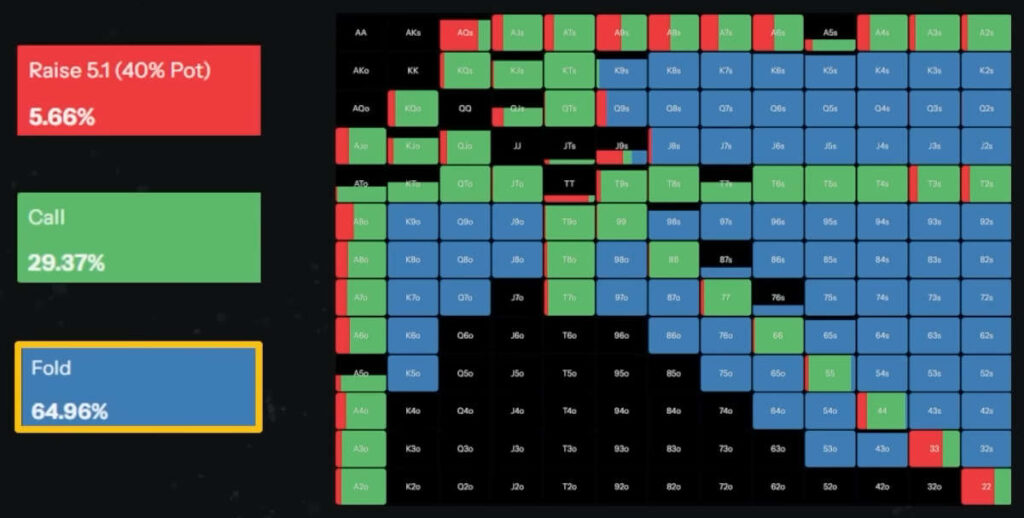
We are folding 65% of the time, which is a lot. MDF would want us to fold only 20%, but that doesn’t matter when we are not facing an all-in bet.
We are continuing with any ace, any ten, any pair, and then all gutshots, and that’s pretty much it. Everything else folds, as we have incredibly low EQR in this spot.
What happens in the same scenario but on a different board, for example J♣9♥3♥. In this instance, our equity goes up to 38.5%, and our equity realization will be fairly okay. Here, we have a lot of decent draws that realize their equity pretty well.
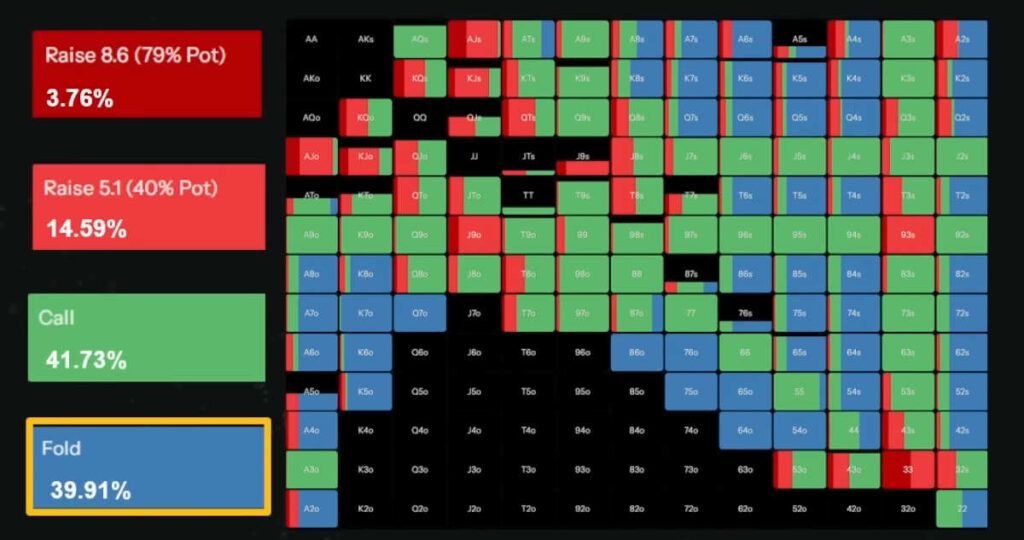
There is simply more stuff in our range that has potential, whereas on the previous flop, it’s much harder to find reasonable hands to stick around with.
If we look at the flop of 9♣6♥5♥, we are barely disadvantaged, and we have 46.58% equity. In this particular scenario, facing a small bet, we get to defend more than the minimum defense frequency, and we are only folding around 17%.
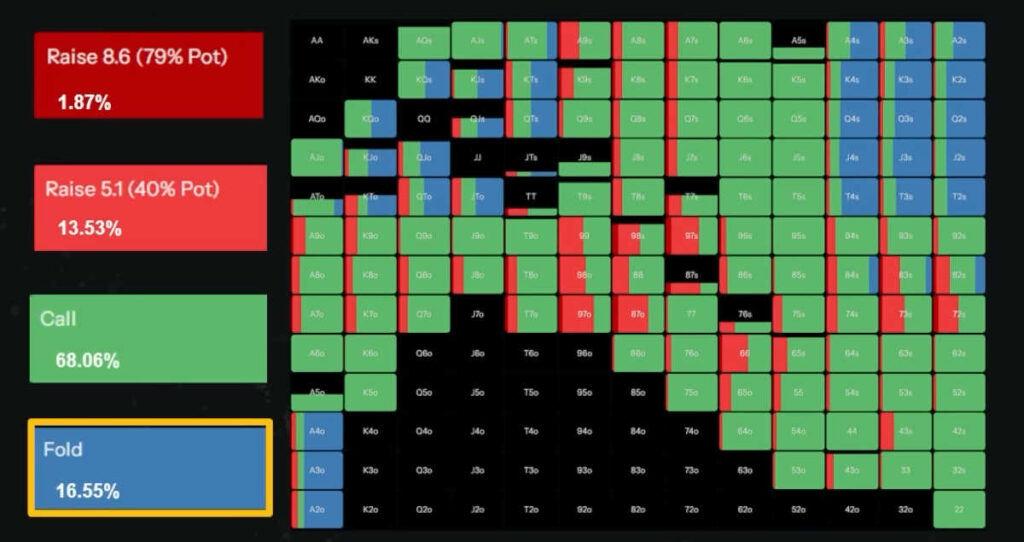
This board is much better for our overall range; we have a fair number of nutted hands, our equity is decent, and we are getting solid pot odds, which all allows us to stick around much more.
Playing in Position
Let’s continue with this analysis, but look at the scenarios where we are playing in position. So, the LJ opens, and we call from the button. The flop comes K♣Q♦J♥.
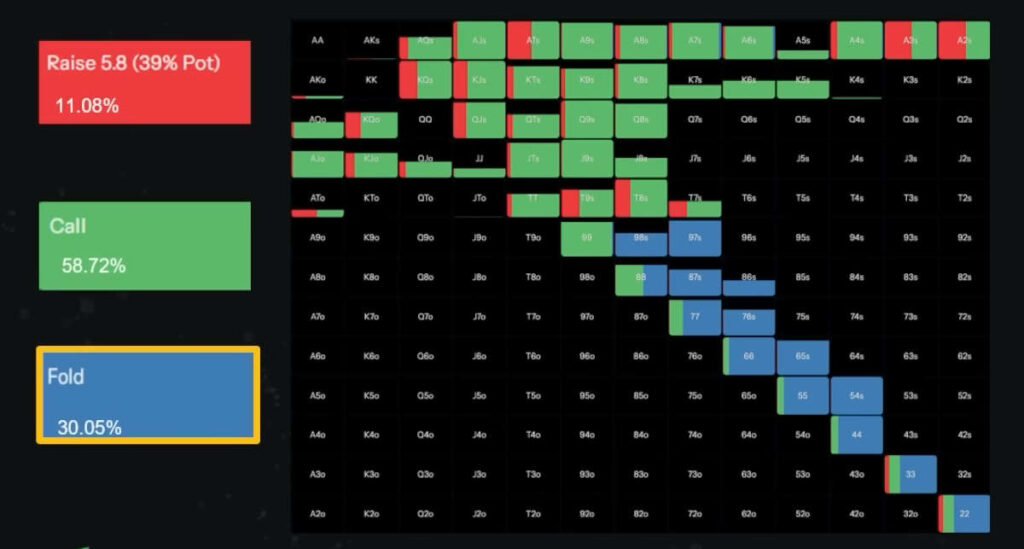
We have a strong range disadvantage against the opener, but we are in position, which means we get to defend far more. Essentially, this is a pretty bad board for the button, but even on this board, we are still defending way more often than out of position.
Although our equity is just around 40%, we are only folding 30% of the time. If we were OOP, we’d be folding far more often.
So, what happens on a more favorable board, like K♣5♥2♥?
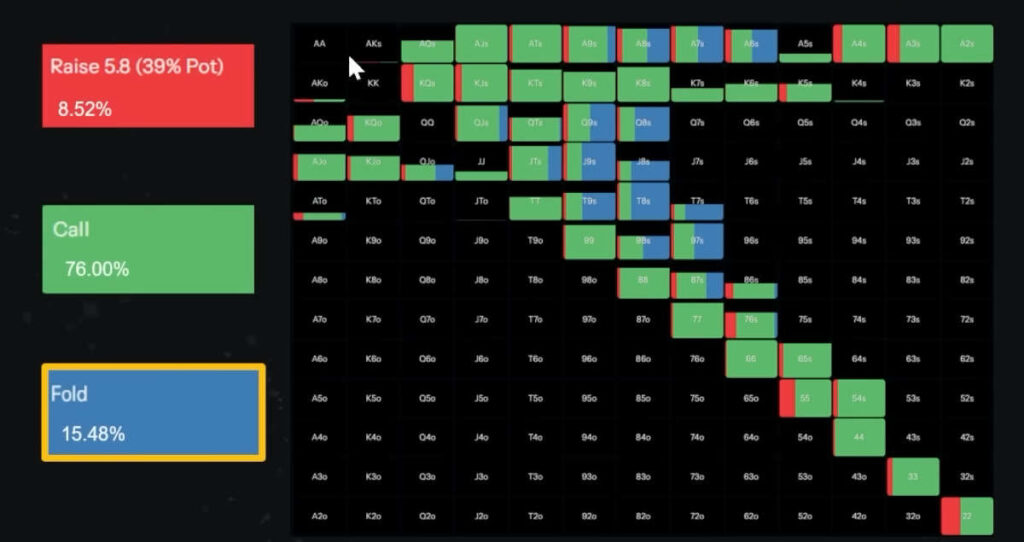
We are folding only 15% of the time facing a small continuation bet. We get to stick with hands like ace-highs and even queen-highs with backdoor draws. This is one of those spots that many players miss and end up over-folding.
Being Sensitive to Position & Bet Sizing
When defending against aggression on the flop, position and bet sizing play an important role in tailoring our strategy.
In this context, position isn’t just about being in or out of position yourself. It’s also about what position you’re up against and what that tells you about their range.
The stronger the range you’re up against, the less equity you’ll have against their aggression.
For example, playing from the big blind, you’ll fold a lot facing a continuation bet from a UTG opener, and you’ll fight the hardest against the button.
You also have to consider the size of the bet. The pot odds that you’re getting will play a significant role in your decision.
In general, as the opponent bets bigger, you should naturally fold more often, and when they bet really small, you have to fight really hard.
Adjusting Based on the Position
Let’s look at a comparison where we defended from the big blind and are now facing a 25% continuation bet from a UTG+1 player and the button player on the same K♣6♦4♥ flop.
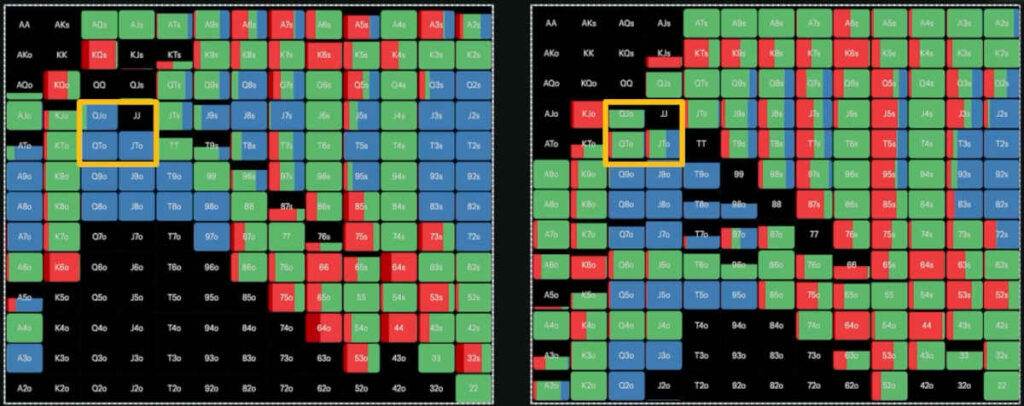
Right off the bat, we get to the flop with much different ranges, as we are defending much tighter against a UTG+1 open. Our equity against UTG+1 is 38.5%, compared to 44.4% against the button.
So against UTG+1 we are folding 41% against a small continuation bet, and only 29% against BTN because we have more equity.
Some of the major differences between the two ranges are hands like QJ, QT, and JT, which are folding vs. a UTG bet, but QJ, QT, and quite a few JT combos are calling facing a small button bet. Also, all ace-highs stick around against the button, while we are folding the ones with no backdoor draws against UTG+1.
So, what are some of the major differences between the two ranges? QJ, QT, and JT are folding vs UTG+1, but QJ, QT, and a lot of JT are all calling against BTN facing a small bet.
All ace highs stick around vs. BTN, while a lot of UTG+1 gets out of the way with no backdoors.
When it comes to raising, the frequency is similar, but we are also finding a lot of check-raises with hands containing 5s and 7s against the button, as the button has a wider range and will have a harder time continuing.
Adjusting Based on the Bet Size
Let’s now discuss adjustments based on the bet size. We are in the big blind facing a continuation bet from the HJ. How do things change when the bet size is 25% vs. 66% of the pot on the flop of A♣8♣4♦?
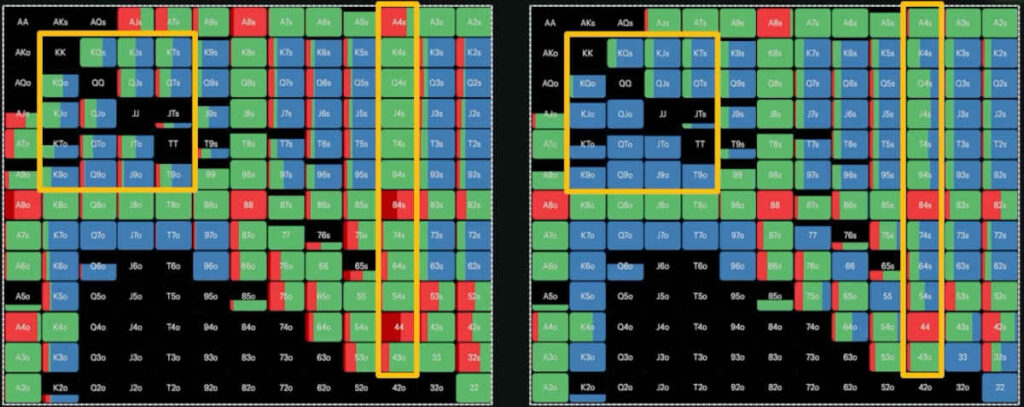
Against a small bet, any pair on the board sticks around, while against a big bet some of those pairs are already mixing between calling and folding.
Various unpaired high cards, especially with a club, are check-calling facing a 25% bet, but they are not sticking around against a two-thirds pot bet.
Also, when the opponent bets smaller, we are raising much more often. Facing a 25% bet, we are raising about 15%, while we only do it 7% of the time against the bigger bet. Larger bets usually indicate a stronger, more polarized range, which means we can’t raise for thinner value.
Equity vs. Playability
As we said earlier, MDF doesn’t matter on the flop because there is more money to bet. All that really matters is your equity realization.
Your overall range will, in general, over- or under-realize equity, but specific poker hands will do a much better job over-realizing equity, while some others will regularly underperform.
Hands that do well at over-realizing are the ones that can improve to strong holdings that rarely have to fold. These are hands like over-cards with backdoor draws.
Weak pairs with junky kickers, on the other hand, are often good at the moment, but will have a difficult time getting to a showdown. Future playability is far more important than the direct equity on the flop.
Playing 50bb deep, we defend from the big blind against the LJ and face a 66% continuation bet on the flop of 10♣5♥3♣.
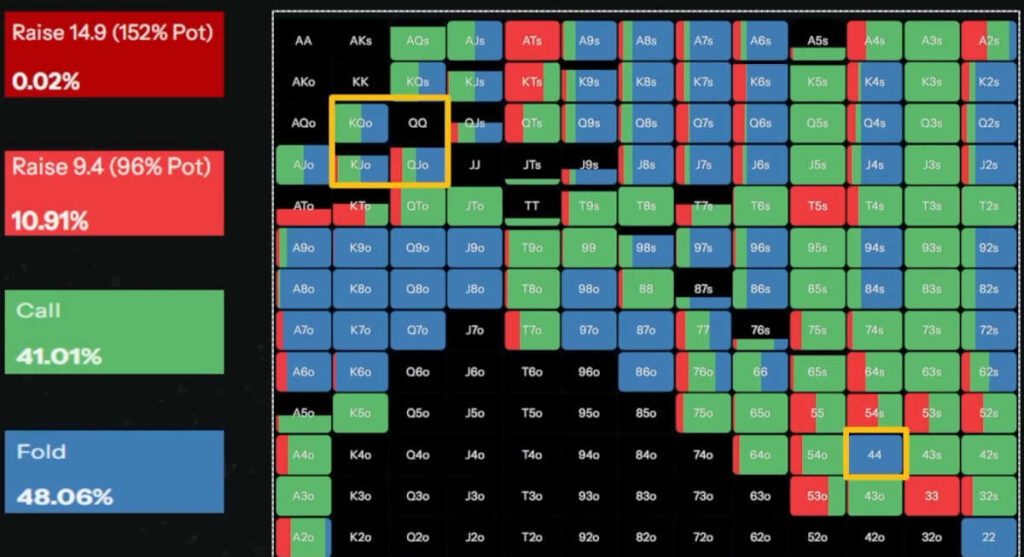
I want to focus on two very specific hands here. KQ, especially with a club backdoor flush draw, and pocket fours with or without a club. Many people believe pocket fours are a better hand here. And, if we look at numbers, pocket fours have about 47% equity, which is a pretty good amount. KQ with a club has only 38%.
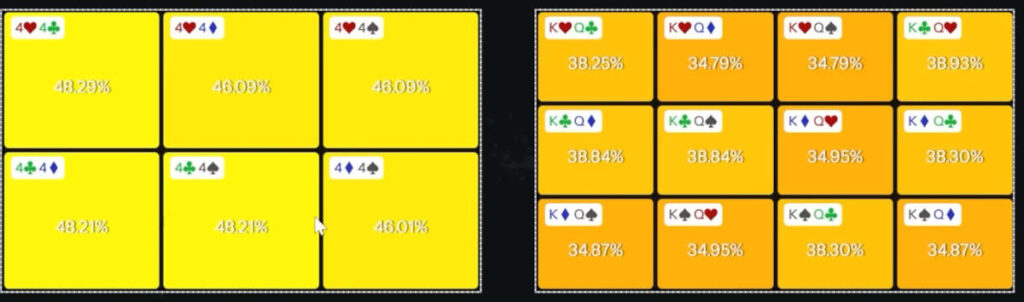
However, despite these numbers, KQ always calls in this spot, while pocket 4s always fold.
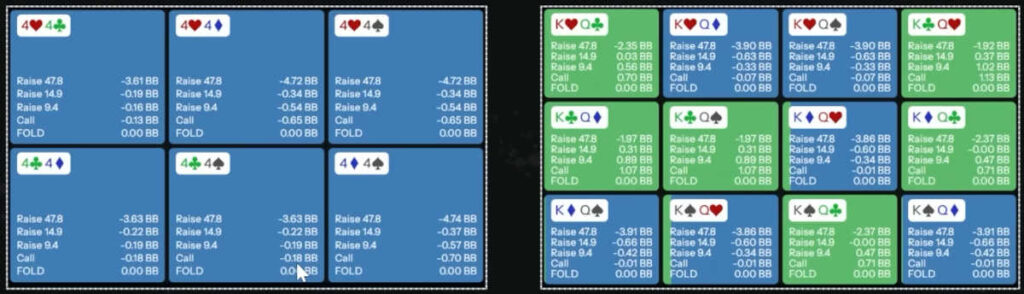
The reason for this is that pocket fours will drastically underrealize their equity, while KQ will over-realize in this spot.
If a high card comes on the turn, the opponent will often continue betting, forcing you to fold the small pair. However, big cards will improve to top pairs, straight draws, and good flush draws, making them much easier to play.
Developing Strong Check-Raise Strategy
One final topic that we’ll briefly address in this article, but without going into detail, is developing a check-raise strategy on the flop, in particular when you are in the big blind.
To develop a good check-raise strategy, you need to focus on frequency and the bet size.
- Frequency is determined by the size of the bet, who has the nut advantage, and stack depths.
- Your size is determined by the bet size, board dynamics, stack depth, and the opponent’s betting frequency.
As we’ve already discussed, you need to be very sensitive to the opponent’s position, as this tells you a lot about their starting range, and the bet size. A bigger sizing usually implies a big range or nut advantage or a good, polarized portion of the range; a smaller bet indicates a wider portion of the range, often without the nut advantage.
Our check-raise frequency goes up or down based on their bet size. The larger the bet, the less often we check-raise, as we won’t be favorites to win, on average.
In terms of sizing, the larger the bet, the smaller our raise should be, and vice versa. For example, facing a two-thirds pot bet, we can raise 2.5x that amount. Against a very small bet, like just one big blind, we should go 5 – 6x.
The idea is, we don’t want to give the opponent great odds, and we also want to set things up so that they could potentially risk their entire stack by the river.


