Ever since the prediction market operator Kalshi started offering betting odds on poker, the world’s largest tournament seemed ripe for a lucrative future.
In the past five months, Kalshi has gone past $1 billion in monthly trading volume, paired up with GGPoker Global Ambassador and seven-time WSOP bracelet winner Daniel Negreanu, and now they’ve partnered with The Lodge Card Club.
Is this week’s prediction market on whether there will be 10,000 entrants in the WSOP Main Event an innocent move to offer betting value to poker fans and players, or the first move in a series of changes to the way live poker and sportsbetting merge into one and the same business model?
Kalshi’s Investment in Poker
Many betting companies have latched onto poker since its first successes. Global betting brands have sponsored poker tours, sent qualifiers to the Main Event, and adorned patches with the images of world champions for decades.
In all that time, the WSOP Main Event has never changed.
Almost since its inception over half a century ago, it has been a $10,000-entry freezeout. A poker tournament of prestige and purity. So why could a prediction market betting operator threaten that structure?
On the face of it, Kalshi’s involvement in poker is less insidious than it is indicative of solidarity. Poker, often maligned as a game that risks being abandoned by lawmakers yet looked down on by mindsport games like chess and backgammon, is currently in the middle of a period of not only growth but stability. Poker is the foundation of the deal.
Despite likely being available in only 9 states by the end of 2026, online poker has returned to the United States. Live tournament festivals have never been better attended. Poker’s appeal for brand partnerships couldn’t be higher. So is it irrational to fear that sportsbetting could be in control of its partnership with poker more than the game we all love, holding the best hand?
Betting on the WSOP Main Event
While an official line on the number of attendees has never been released to the public, that doesn’t mean players and fans haven’t wagered on outcomes in the World Championship before. The action ends at the table, but has often started with running an unofficial book on the great game.
Poker’s stratospheric rise from the gold rush games of lore has been steep and not without its challenges along the way. At every step, betting on the outcome of the cards has never been consigned to the players at the felt. Off-Strip betting books were set up in Las Vegas to back players in the Main Event as far back as the 1980s, with poker legends such as Jesse May previously speaking about the excitement it lent the action.
Kalshi may be attempting to legitimise betting on poker outcomes, but the act itself is nothing new. Side bets, prop bets, and even public bets in the early days of Twitter marked poker with an X for off-book betting long before the social media site adopted that name. The same is true in the casino itself. Binion’s was a hive of betting activity on the Main Event in the 1990s, a situation only exacerbated by the popularity of the 1998 movie Rounders and the subsequent ‘Moneymaker Effect’ caused by Chris Moneymaker in 2003.
By the next decade, betting on poker outcomes had merged with staking other players. In the late 2010s, staking sites had popped up online, allowing players to bet on their favorite players and grab a piece of their action at the same time. Updates online via Google Sheets, word of mouth, or social media became prevalent. This decade, the practice of staking has itself become a major sector of the industry, with PokerStake and Stake Kings among the major sites where backing players has become the most reliable way to bet on them.
How Betting on Poker Outcomes Could Change the Game
There can be no doubt that betting on live poker involves some risk. Backing a player to the tune of buying 10% of their action isn’t the same as betting on them to win; they are directly incentivized to play the best they can in order to win both themselves and your money.
The way Kalshi could change betting on poker is by exploiting the way futures markets are open to manipulation. In the recent Hustler Casino Live game, you could bet on or against the prediction that Alan Keating would fire a rate of 70% VPIP throughout the show via the predictions market offered by HCL partner Polymarket. Fairly obviously, if you were sitting opposite Keating at the felt and had backed him to achieve 70% VPIP, you could tailor your actions to provoke that level of putting his money into the pot.
If Polymarket is big, Kalshi is currently bigger, overtaking their industry rival in September of last year when they exceeded $1bn in monthly trading volume for the first time. This week’s partnership with The Lodge Card Club in Round Rock, Texas, seals a deal to make Doug Polk, Andrew Neeme, and Brad Owen’s poker room even more lucrative than before. Live-streamed poker, bet on in real time with prediction markets, is raking in huge money before a card goes into the air. All online, and thanks to Kalshi being the first-ever regulated prediction market in the U.S., above board.
Could the WSOP Main Event Become a Re-entry Event?
The World Series Main Event is, to most people, the last sacrosanct poker tournament in the world. Where other events bring in unlimited rebuys, the WSOP Main Event, also known as the World Championship, is untouchable. But will that change?
In recent years, GGPoker’s takeover of the WSOP has undoubtedly had a positive effect on the biggest brand in poker. Attendances are up, more bracelet events than ever play out in Las Vegas every summer, the WSOP Online series is mushrooming, and the powers that be even moved WSOP Europe from Rozvadov to the much more popular Prague. The game has grown immensely, and the WSOP Main Event with it, with fields now
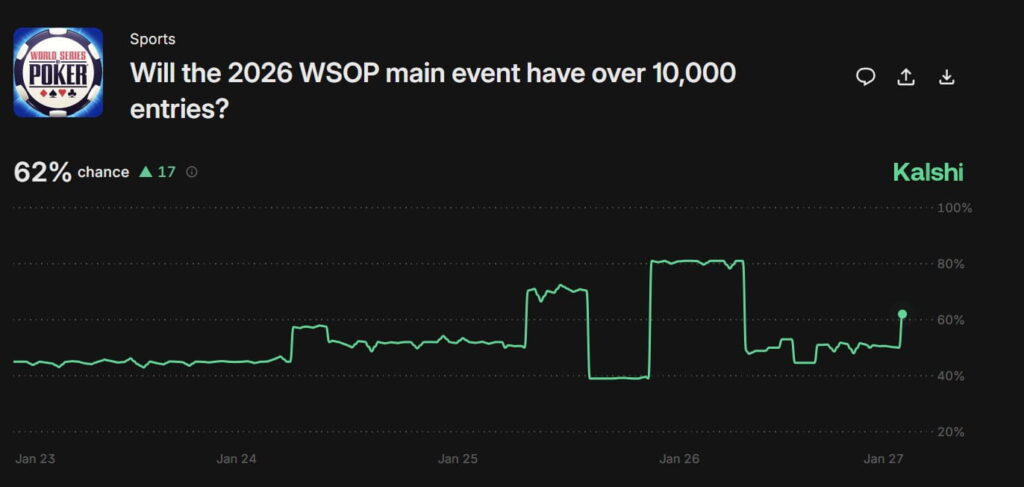
This week, Kalshi announced a very special predictions market on their site: whether the 2026 WSOP Main Event will have over 10,000 participants. On the face of it, the likelihood is that it would, after all: the 2023 field of 10,043 was bettered in 2024, with a world record 10,112 entering the $10,000 buy-in freezeout. Last summer, however, 9,735 was the number, meaning the three-year average of 9,963 is actually below the number required of 10,001.
Currently, 62% of bettors believe that this year’s WSOP Main Event field will exceed 10,000 in number. This could have several knock-on effects. Firstly, major bettors able to stake millions on the outcome might be able to pervert the numbers by staking players to take part, taking a percentage of their winnings as a payback, all the while knowing that if they’ve bet on more than 10,000 to play, they are perverting the player field in their favor.
Secondly, and perhaps more worryingly, the level of interest in the betting market could lead the WSOP to change the world’s oldest freezeout event into a rebuy event. This would have a potentially devastating effect on the recreational player, with amateurs famously able to buy into the Main Event under its current guise as a freezeout event exactly the same number of times as the world’s richest high roller.
Once.
If, as has been done in the $25,000-entry WSOP Paradise Super Main Event, the tournament were to become a re-entry event, then the prize pool might go up, and the play field would almost certainly increase. Yet the purity of poker’s finest freezeout event may be lost forever, and the chances of the aspiring amateur to reach the world championship may be gone forever.
In Conclusion
The introduction of regulated, legalized betting on poker’s most marginal outcomes as prediction markets is exciting for anyone who cannot get a seat in the game but still wants to win. We need to be mindful of the possibility that we could lose the heart and soul of poker along the way unless we’re very careful.