
Image courtesy of World Poker Tour
In today’s lesson, we’ll talk about how you can identify and attack weak continuation bets to significantly improve your win rate.
Before we dive in, a weak continuation bet is a bet that you identify as unlikely to contain the strongest value hands in your opponent’s perceived range.
There are two common spots where these types of weak bets occur, and this isn’t isolated just to the smallest stakes:
- When they shouldn’t be c-betting from the GTO point of view, but they do anyway.
- They should be betting larger with their strong hands (and they know this), but they use smaller sizing, presumably with their weakest hands.
We’ll now look at both of these situations and check out some examples to see how to best profit from these mistakes.
#1 When Your Opponents C-Bet Too Often
Back in the day, players would raise before the flop and continuation bet almost every single time on the flop. This strategy still works if your opponent folds too often and they don’t check-raise enough, but players have generally become much better.
The problem when you c-bet everything is that your range is too weak and hard to defend, so your opponent can check-raise a lot and crush you.
To identify the situations where this applies, we first need to remind ourselves how betting frequency works.
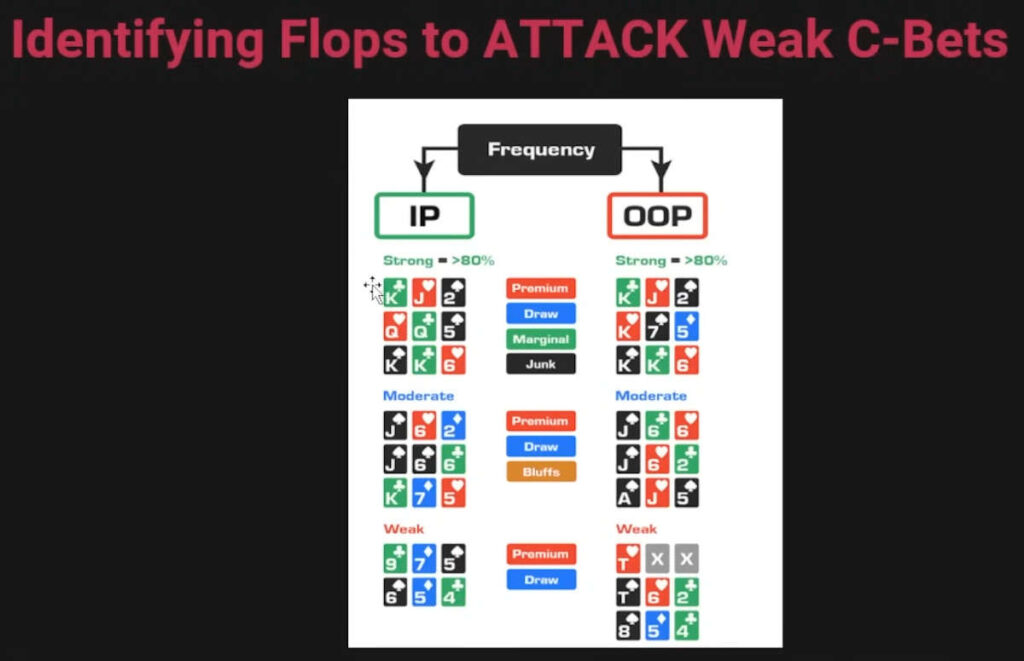
From the GTO standpoint, the betting frequency is tied to range advantage. The larger the range advantage, the more often you can bet.
So, if your opponent bets frequently on boards that favor the preflop raiser, there isn’t much you can do about it, as this is what they’re supposed to do. Instead, you need to focus on boards that are better for your defending range, and then you can attack those boards.
The chart below shows how different types of boards correlate with the preflop raiser’s range, both in and out of position.
Let’s now look at a couple of examples.
The HJ raises to 2.2 big blinds playing 40 big blinds effective, and we defend from the big blind with 7♠6♠.
The flop comes K♣10♥5♠. We check, the opponent continuation bets for 2.4 big blinds. What should we do?
On this board, they are supposed to c-bet quite often, because the flop connects with their range. We don’t have a hand that connects well with this board. So, from a purely poker math point of view, barring some special reads, we should just fold.
Let’s now look at the same scenario, but the flop comes J♠8♥8♣. We have the same backdoor straight and flush draw, but the HJ player should check back this board a lot.
This is also the board where the big blind’s range contains a lot of off-suit hands containing an eight, whereas the hijack’s raising range does not.
This is a spot where we should be check-raising very aggressively with our backdoor draws like what we have. If the opponent c-bets too often, they have many hands in their range that are difficult to continue with.
We don’t even have to raise all that big. If they bet 1.5 big blinds, we can make it 5 big blinds. This applies a lot of pressure to unpaired hands and even hands like pocket sevens. They can call on the flop, but if you keep blasting on turns and rivers, this puts them in a really tough spot.
As you can see from the chart below, the hijack player should actually be checking about 40% of the time on this particular board. You can see that many pairs like 7s, 6s, and 5s are checking behind, because getting check-raised is a disaster.
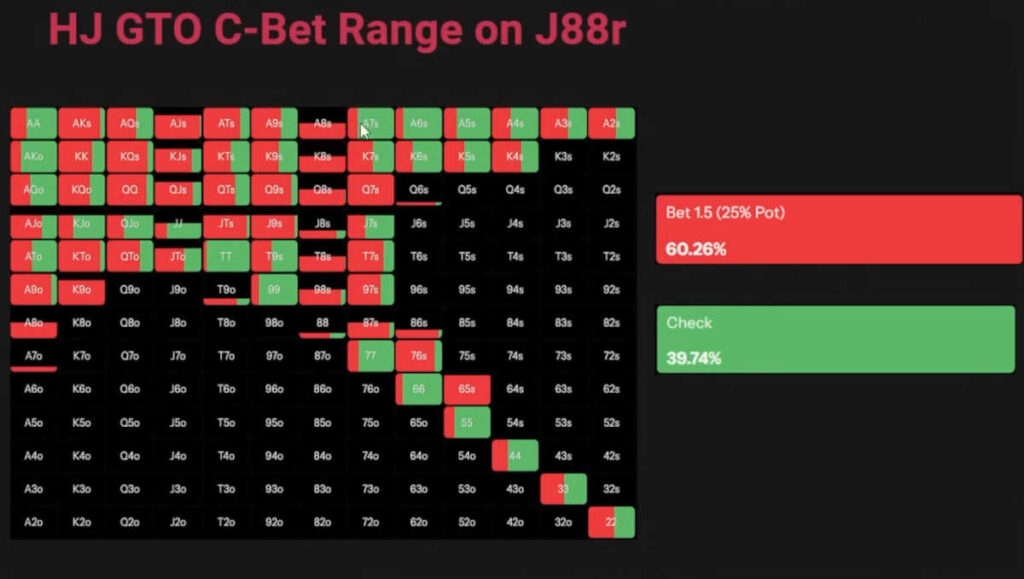
The same goes for a lot of Ax hands, especially those that don’t have an over-card to the jack. If you bet and get raised, you put yourself in a bluff catching scenario, and that’s not the spot you want to be in when the big blind has many eights in their range.
#2 When They Use a Weak Bet Sizing
C-bet sizing is largely tied to who has the nut advantage and how well your opponent’s range connects with the board when it comes to their marginal holdings.
In a situation where the board connects with your defending range but your opponent has a nut advantage, and the stacks are short to medium, when they bet, they should use a large sizing. This is because their best hands crush your best hands, plus, you also have a fair number of okay-ish holdings that they can get value from.
Let’s look at an example. Once again, we are playing 40 big blinds deep, and the hijack raises. We call from the big blind with J♥8♦ and the flop comes 10♣7♥6♥.
After we check, the opponent bets small.
The hijack should be betting on this board using the big size only. The chart below shows what range they should be c-betting with, and the only bet size they should be using is two-thirds pot.
So, if your opponent uses the small bet, are they betting small with this GTO range, or are they doing it with hands that are best played as a check?
If they are betting small with the GTO range, there isn’t much you can do because that range is naturally strong and well protected. However, if they are betting small with some of the hands in green, this is a good spot to attack your opponent.
What a lot of people do is bet big with the most obvious hands, i.e., JT+, and bet smaller with the weaker portion of the range, like A7, pocket twos, or pocket eights
If this is the case, you can attack their c-bet because their range when using small sizing is too weak. So, how do you take advantage of this?
You can take hands that are already mixing check-raises, like J8, J9, 54s, which, as you can see, already check-raise some portion of the time. So, you can take these hands and check-raise with them (much) more often.
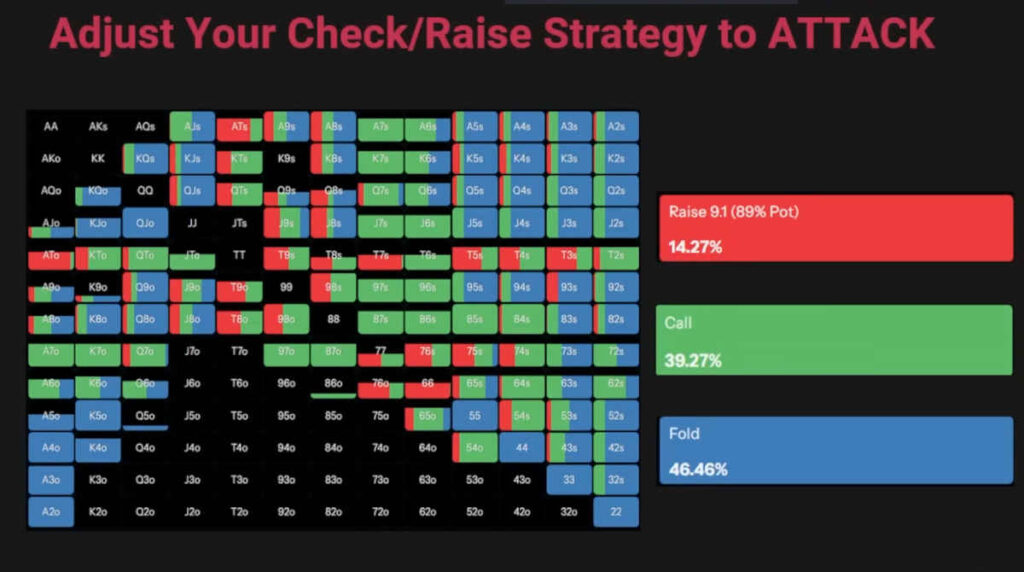
You don’t want to take hands that don’t have good properties and use them in this spot, like A6o, A5o, or even KQ.
Draws are usually the most obvious types of hands to raise. As you see, lots of hands containing an eight or a nine put in a raise a lot of the time. Instead of c/r some of them, I would default to raising with almost all of them, if I think the opponent is using small size with a weak range.
On top of that, if they bet everything, going back to our first point, you can also check-raise them a lot with these types of hands.
One final tip is that you should be raising relatively large in relation to the bet amount, because you have to consider the size of the pot instead of just focusing on the size of the c-bet.
These are two excellent ways to go about spotting and attacking weak continuation bets. When people bet too often and/or when they bet too small, you can go after their bets. This approach will make you much harder to play against, and you will end up stealing a lot of pots that don’t belong to you!