
Four Card Poker is a popular casino table game that offers a unique twist on traditional poker by challenging players to create the best possible four-card hand. Unlike standard games like Texas Hold’em, where you compete against other people at the table, Four Card Poker is played strictly against the dealer.
A distinct feature of this game is that the player is dealt five cards while the dealer is dealt six. Furthermore, the dealer does not have a qualifying hand requirement, meaning you are always in a head-to-head showdown regardless of how weak the dealer’s cards may be.
Beyond competing with the dealer, the game incorporates an Aces Up element that functions as a proposition bet. This allows you to win based solely on the quality of your hand, regardless of whether you beat the dealer.
Four Card Poker Hand Rankings
The hierarchy of hands in Four Card Poker is one of the most critical elements to master because it differs from standard five-card poker hand rankings. Since you are only using four cards to form your hand, the mathematical frequency of certain combinations changes.
This shift dictates a ranking system where Three of a Kind is statistically harder to achieve and therefore more valuable than both a Straight and a Flush.
At the top of the hierarchy is the Four of a Kind hand, which serves as the strongest possible hand in the game. It’s followed by the Straight Flush. Below that, Three of a Kind is the third-strongest hand, followed by the Straight and Flush hands.
The lower end of the spectrum follows a more traditional ranking. Two Pair is the next hand in line, followed by a One Pair hand. If neither the player nor the dealer can form a pair, the winner is determined by the Highest-Ranking Card.
How to Play Four Card Poker – A Step-by-Step Guide
A round of Four Card Poker moves quickly, following a structured sequence that allows for both independent side bets and head-to-head play against the dealer. Understanding the flow of the deal is essential, which is why we crafted this helpful step-by-step guide:
- Placing Initial Bets – To begin, you must place your wagers in the designated circles on the table. You can choose to play the Ante (competing against the dealer), the Aces Up (betting on your own hand strength), or both simultaneously.
- The Deal – The dealer distributes five cards face down to each player. The dealer then deals six cards to themselves. Five of these remain face down, but one is dealt face up to provide players with a small piece of information for their upcoming decision.
- Evaluating the Hand – You determine your best four-card combination. Because you have an extra card to work with, you must decide which card to exclude to form the highest-ranking hand possible.
- The Fold or Play Decision – After viewing your cards, you must choose to stay in the game or forfeit. If you fold, you lose your Ante bet. If you wish to continue, you must place a Play wager equal to 1x, 2x, or 3x your original Ante.
- The Dealer’s Reveal – Once all player decisions are made, the dealer turns over their remaining five cards. From their total of six cards, the dealer selects the best four-card hand to compete against the table.
- Comparison and Payouts – The dealer compares their best four cards against your best four. If your hand is higher than or equal to the dealer’s, your Ante and Play bets are paid out. Both of these pay out even money (1:1). The Aces Up bet is also settled at this time based on the fixed pay table, regardless of who won the hand.
Ante Bonus and Aces Up Payouts in Four Card Poker
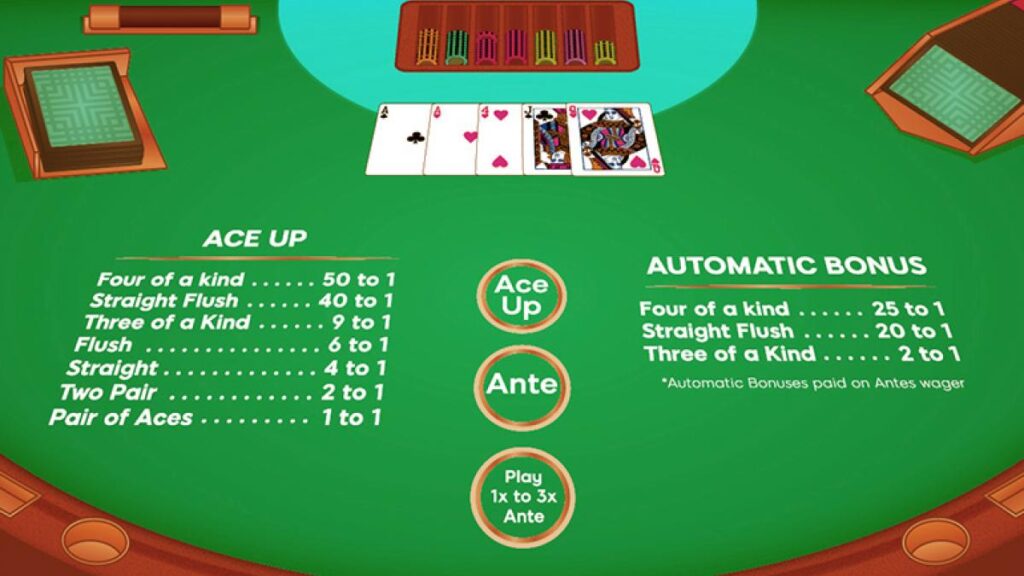
The Ante Bonus and Aces Up bonuses are separate from the standard 1:1 payout you receive for winning against the dealer. They are paid even if the dealer’s hand is stronger than yours and you lose the Ante and Play bets. Here’s how the Ante Bonus and Aces Up bonuses pay based on your hand’s strength:
| Hand | Ante Bonus Payout | Aces Up Payout |
| Four of a Kind | 25 to 1 | 50 to 1 |
| Straight Flush | 20 to 1 | 40 to 1 |
| Three of a Kind | 2 to 1 | 8 to 1 |
| Flush | N/A | 5 to 1 |
| Straight | N/A | 4 to 1 |
| Two Pair | N/A | 3 to 1 |
| Pair of Aces | N/A | 1 to 1 |
House Edge in Four Card Poker
The house edge in Four Card Poker stems primarily from the dealer’s card advantage. The dealer receives six cards, while you receive five. Naturally, selecting the best four cards from a pool of six yields a stronger average hand. In the Ante-Play portion, the house edge typically ranges from 2.8% to 3.4%, depending on the specific Ante Bonuses pay table.
Additionally, this edge is also influenced by how you utilize the Play wager. Because you can bet up to 3x your Ante, you can capitalize on strong hands. Players who consistently bet only the 1x minimum on strong hands effectively increase the house’s advantage against them in the long run.
While offering higher payouts, the Aces Up side bet carries a significantly higher house edge, typically 4%-6%. This varies based on the casino’s specific payout schedule for Flushes and Straights.
Common Rule Variations
Some casinos adjust specific rules to manage the house edge, increase the game’s volatility, or add a different layer to the experience. For instance, some venues might offer a Progressive Jackpot feature. It serves as an optional side bet, usually requiring a fixed $1 or $5 wager placed before the deal.
The progressive winner is determined using all five cards dealt to the player. Many casinos that offer the Progressive Jackpot side bet also feature an Envy Bonus, which gets you a certain fixed amount payout if any other player at the table triggers the Progressive Jackpot.
Additionally, the Bad Beat Bonus is another variation, designed to soften the blow of losing with a high-ranking hand. This side bet pays out if you hold a strong hand, typically Two Pair or better, and are still beaten by the dealer. It generally requires a wager of the same size as the one for the Progressive Jackpot.
Conclusion: Is Four Card Poker a Game of Skill or Chance?
At its core, Four Card Poker is driven by chance. Every card dealt is a random event, and no amount of expertise can change the fact that the dealer receives six cards to your five. That said, while you have no control over the cards dealt to you or the six cards the dealer receives, the outcome of the round is still influenced by your decisions.
This is because the skill element manifests through your hand selection and wagering strategy. Since you are dealt five cards but only play four, you must correctly identify the strongest possible four-card combination to maximize your rank.
Furthermore, the Play wager allows you to scale your bet based on the confidence of your hand. This means that making the wrong choices directly impacts your long-term results and the house edge.
With this in mind, it’s important to remember that even with perfect play, the house maintains a mathematical advantage. Always approach the table with the mindset of playing for fun and stay within your limits. Manage your bankroll responsibly to ensure the game remains enjoyable.