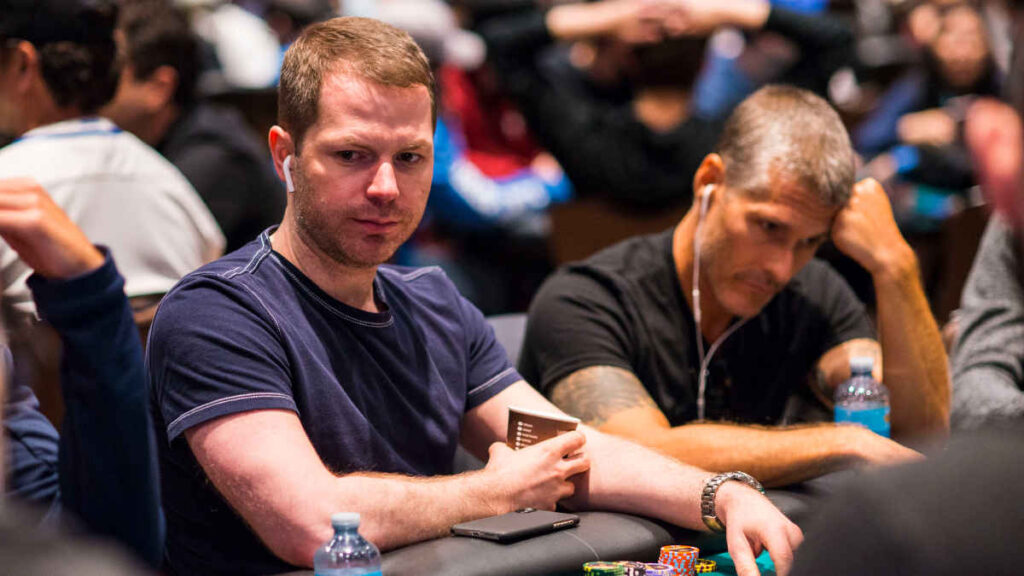
Image courtesy of World Poker Tour
Whenever you find yourself in a poker situation where there is an abnormal structure, you have to ask an important question: What has actually changed?
Final tables of poker tournaments represent such situations, where you make money every time you fold. This is because, when you fold, other players have a chance to bust before you.
This idea becomes even more important if there are several shallow stacks while you have a big or medium stack.
Because of these changes in dynamics, your ranges change quite substantially compared to when there are no payout implications. In these scenarios, you can’t blindly follow GTO charts if you want to do well.
In this article, we’ll try to explain why this is the case and what types of changes and strategic adjustments you can make to maximize your winnings.
A Simple Final Table Example
Let’s start with a very simple example of a final table. There are four players left, with each player holding 25% of the chips in play. The payout distribution is as follows:
- $1,000 for the winner
- $700 for the runner-up
- $400 for the third place
- $200 for fourth place
Since every player holds exactly one quarter of the remaining chips, it’s easy enough to calculate how much every stack is worth. We do this by adding all the prizes together and dividing that number by four:
- ($1,000+$700+$400+$200)/4 = $2,300/4 = $575
So, what happens when two players get it in on a coin flip (with 50% equity each)? The player who wins ends up with $800 in equity, and the player who loses gets $200 in equity.
You can verify these numbers with any ICM poker calculator out there, but the math is clear. Although the total value going into the pot is $1,150 ($575 + $575), players only get back $1,000.
The rest of the money goes to the two players who folded. By not getting involved, they received an immediate pay jump.
If you’re wondering why the player who doubled up doesn’t get more equity, the reason is the fact that the first place is $1,000, so that’s the most they’re ever getting. However, with 50% of chips in play, they are far from guaranteed to win every time. Even if they held 90% of all chips, they still wouldn’t win every time.
So, with these numbers broken down, you might be wondering who should be applying pressure at the final table.
As a general rule, when you have more chips than the players remaining in the pot, you can usually afford to be more aggressive. The largest stacks get to put pressure on everyone.
In fact, as a big stack, you can even apply pressure to the other large stack. Most players are reluctant to bust, and they won’t fight fire with fire. Instead, they’ll try to stay out of your way and focus on other players instead.
Applying the same logic, our hand ranges will change significantly depending on the situation.
For example, if you have 40 big blinds, there are three players with 2 big blinds each, and then there is a player still left to act with 60 big blinds, you have to be very tight.
On the other hand, if you have 40 big blinds and you are up against two 2bb stacks and two 30bb stacks, you can be very aggressive, as you can bust everyone, and you’re not in direct danger of busting yourself.
Key Final Table Concepts to Understand
Understanding how payouts influence your decisions at the final table is an important first step. There are a few other key concepts you should learn as well:
- Stack Distribution – if other players are likely to bust after you fold, your fold becomes more valuable. Thus, when a fold is worth more, you should play tighter.
- Payout Structure – in flatter payout structures, busts are worth more, so you should play tighter.
- Ante Size – the more chips there are to win in the pot, the harder you should fight. So, when antes are big, you should adopt a more aggressive strategy.
- Let your raise sizes reflect your situation – when you have to play very tight, bet using a larger size. When playing looser, use a smaller size.
- Blockers go way up in value – you want to disincentivize the action at the final table. Because of this, low pairs and small suited connectors go down in value, while Ax, even off-suited, goes up.
- If you don’t want to bust, don’t go all-in – there are many spots where, instead of going all in, you can min-raise with decently strong hands like ATo or KQo and then fold to a shove.
Strategic & Exploitative Adjustments
While learning all these concepts is vital, you should also understand that not everyone at a final table will be aware of or care about the payout implications.
There are players who haven’t done any studying at all, and there are some who simply don’t care about anything other than winning.
Conversely, some players will let their stacks dwindle down to nothing because they care way too much about pay jumps, and they don’t want to go out.
Whatever the case, you want to be mindful of what your opponents are doing wrong and adjust accordingly.
Another leak that many players have is that they overvalue “strong” poker hands. In a final table situation, many of these premiums go down in value simply because you can make so much money by folding and letting other players bust.
When you’re facing a bet for all or most of your chips, your calling range must be very tight. This is the concept of risk premium, where, as the amount of money you are risking becomes more valuable, your correct call-off range becomes tighter and tighter.
In some cases, where there are two big stacks battling it out, you may be correct to fold everything except aces and kings. It may sound counterintuitive, but it is simply profitable.
This concept is even more amplified if there are several short stacks at the table. If there are two 30bb stacks and four 5bb stacks, the two larger stacks know that they are likely to outlast most, if not all, short stacks by simply folding. So, if there is another 50bb stack in the mix, they can run over the table, since the correct strategy for medium stacks is to stay patient and fold almost everything.
One final strategic adjustment I’ll mention in this article has to do with big stacks that play like lunatics. Every now and again, you’ll find yourself in this situation. These players think it’s their job to bust everyone.
Against these players, you can go all-in for 15 – 30 big blinds over their light opens. Since you know they’re opening all sorts of nonsense, they won’t be able to call, and you’ll get to pick quite a few small pots with very little risk.