Image courtesy of PokerGO Tour
To be a winning player in today’s poker environment, you must master the fundamentals and learn GTO principles. This is one of the reasons why many of the successful old-school players are no longer crushing it in the highest stakes games.
Back in the day, bad players were really bad. They did not know they should continuation bet often, they didn’t know how or when to bluff, and they were, for the most part, just clicking buttons.
Today, the situation is different. Most bad players have read some books, watched some training videos, and learned some basic things about poker strategy.
So, you won’t win by just playing okay – you need to study GTO.
That said, to really be successful and win big, you also need to understand when to throw the GTO principles out of the window and exploit your opponents’ mistakes.
In this article, we’ll cover three of the biggest mistakes I see players make, even when they’re decently studied and have a good grasp of GTO fundamentals.
Mistake #1: 4-Bet Bluffing Against Straightforward Players
A lot of players who studied GTO are obsessed with finding fancy 4-bet bluffs that solvers tell them to do. However, how profitable are these bluffs against players who only 3-bet with their best hands before the flop?
The reality is that you need to adjust your play against these opponents, and to do so, you’ll be over-folding. You can’t call nearly as often as you should in theory, and you should only 4-bet for value.
Let’s look at an example.
We are in the HJ, playing 40 big blinds deep, and we open to 2bbs. The button 3-bets to 5.5bbs. The chart on the left shows the GTO strategy in this spot.
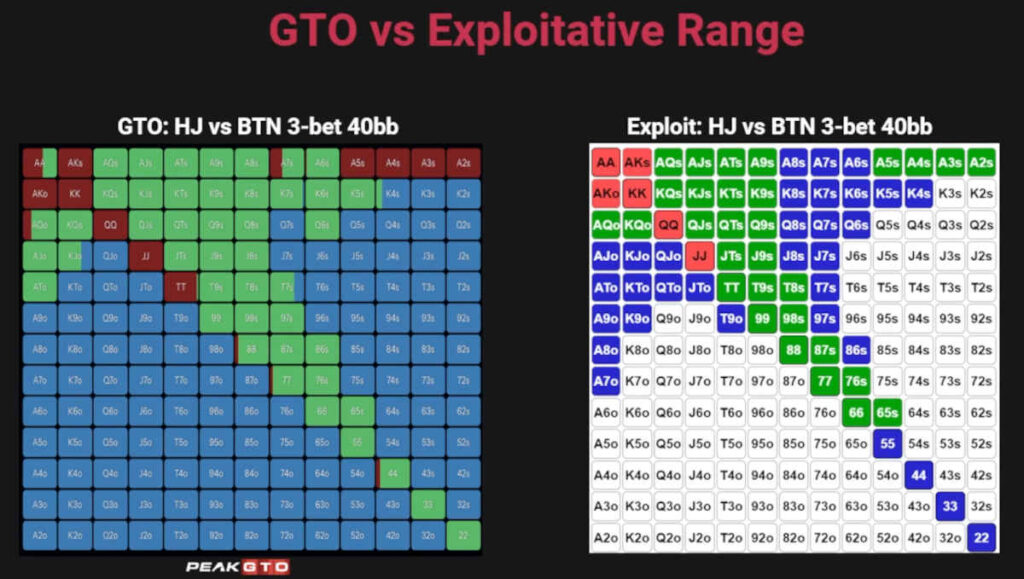
As you can see, hands in red are the ones we are shoving with, and the hands we are shoving as bluffs are A5, A4, A3, A2, and A7 suited, which is fine in the GTO world. But, if they are not bluffing often enough, what should you do?
Your strategy should be much more in line with what’s shown on the right graph, where the only hands we are going all-in with (marked in red) are value hands. You’ll also notice that we never slow-play aces (unlike in GTO) as we know the opponent has a strong hand and we want to get the money in the middle right now.
Mistake #2: Hero Calling With GTO Bluff-Catchers
A bluff-catcher is a hand that loses to all value hands your opponent would bet. Say you have a top pair and a weak kicker. If you know your opponent will never bet for value with less than a top pair – top kicker, your weak top pair and all weaker holdings are bluff-catchers.
However, if we presume that the opponent bluffs 5% less often than they should on the river (according to GTO), how much less often should you call with your bluff catchers?
The answer may surprise you, as it is – never. If you know the opponent is under-bluffing on the river, even if it’s just by 2%, you should simply muck all your bluff-catchers.
Of course, if they are wild and over-bluffing, the opposite is true – you call with all of them. But most players don’t bluff often enough, especially when risking their entire stack.
Let’s look at another example:
We have Q♠10♦ in the big blind and facing a raise from the HJ, playing 100 big blinds deep. We call, and the flop comes Q♣J♣9♦.
We check-call the opponent’s half-pot bet. The turn is the 3♠, and they bet again, this time for about 60% of the pot. Once more, with our top pair and an open-ended straight draw, we call.
The river comes the 6♣, completing a flush, and after we check, the opponent bets two-thirds pot.
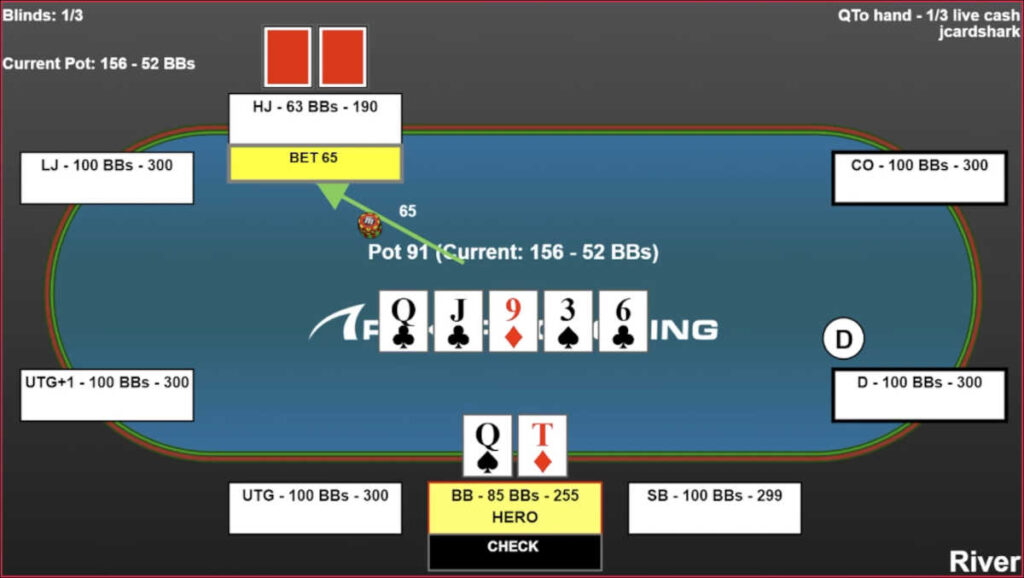
This hand is a clear example of a bluff-catcher, even though it’s a pretty good one. The opponent is never value-betting worse here, and they’re never bluffing with a better hand, either.
If your opponent doesn’t bluff often enough with random over-cards, this is just a fold. In most small stakes games, where players don’t three-barrel bluff often enough, you have to fold in these spots.
On average, against more straightforward players in low stakes games, you’ll be saving a lot of money by finding these folds.
Of course, against an opponent who you know will bet many random over-cards on the turn and then proceed to bluff the river, this is a fairly easy call.
This is where poker gets tricky. Against strong players, it’s bad to fold, but against weaker players, you should absolutely give up, so you need to pay attention and figure out who’s who at the table.
Mistake #3: Going for GTO Bluffs into Tight Ranges
Let’s now flip the script. If your opponent is calling 5% too often, how much less often should you bluff?
The answer is, you should never bluff. All the bluffs that want to go for it in the GTO world are no longer viable. I know it sounds crazy, but that’s the reality.
Say we open Q♠J♠ from the LJ playing 100 big blinds deep and only the big blind calls. The flop comes K♥5♣2♦ and the big blind checks.
This is a great spot to bet frequently and small, pretty much 100% of the time. There is an argument to be made for checking if you think your opponent will play straightforwardly on all turns, betting when they have it, and checking when they miss.
However, it is dangerous to apply these blanket statements in your games as they simply won’t be accurate across the board. This is why it’s better to stick to the GTO strategy, especially when the right move is to bet small and often.
So we bet small, the opponent calls, and the turn is the 10♠. After they check, in the GTO world, you should be betting this turn a medium amount of the time, often using big sizing.
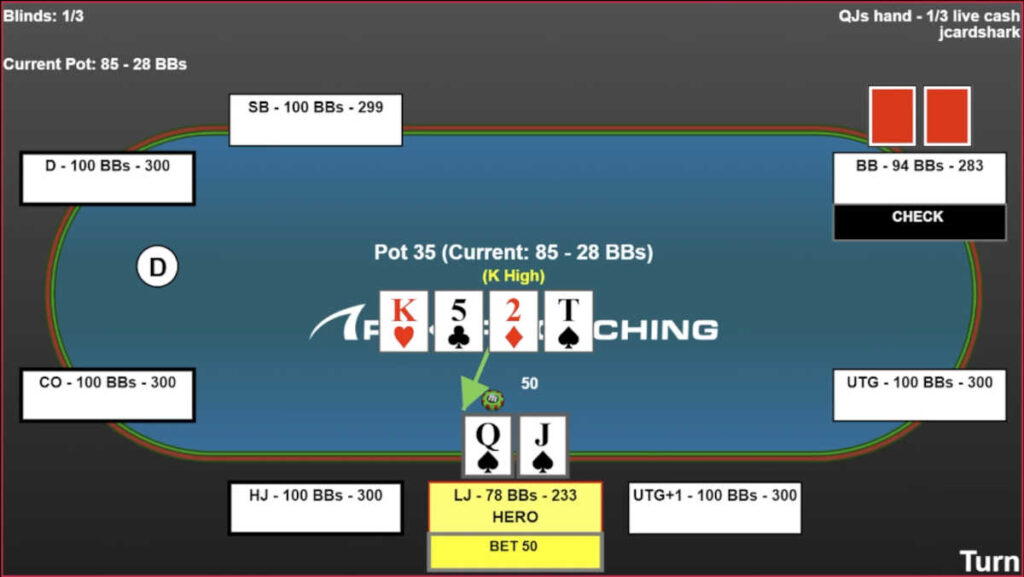
However, when you bet big and the opponent calls, their range gets very strong. If you force their range to be strong, the question becomes, what should that make you do on the river when they check to you? The answer is that you should drastically under-bluff.
You’ve already extracted most bluffs on the turn, so when they continue, they’ll likely do so with a very strong hand.
We bet big on the turn, with the view that this should get the opponent to give up a lot of their marginal holding. They are probably not folding any kings, but a five or a deuce, they’ll probably fold when we overbet the pot on the turn.
In this particular situation, they call, and the river comes the 7♠. When they check to us, although we have no showdown value, we should check back and concede the pot.
When your normal opponent in a $1/$3 cash game calls your big turn over-bet, they’ll drastically over-fold in this spot, which means they’ll mostly arrive at the river with a strong range that will simply not fold.
On the bright side, when you do get there on the river, thanks to that turn over-bet, you’ll be able to pile a lot of money in the middle and get called.