
Poker ranges and being able to think in terms of ranges are absolutely crucial for your long-term success in poker.
The main shift in thinking is moving away from the specific two hole cards and thinking along the lines of every hand you’d play in a particular manner in a given situation.
This will make you much more difficult to play against and will make it hard for your opponents to exploit you.
Along the same lines, this is how you need to be thinking about your opponents’ holdings, i.e., not what two specific cards they might be holding, but rather what all the hands are that they would play in a certain way.
Breaking Down the Logic of Hand Ranges
The best way to go about this topic is by using a hand example. Let’s say we are playing $1/$2 and decide to open to $6 with K♥J♥ from early position.
This specific hand is just one of many that you’d open from this position. There are some pocket pairs, suited connectors, suited aces, etc. All of these holdings make up our hand range.
One mistake that many beginner players make is that they will open to different sizes with different parts of their range. For example, they’ll make it five big blinds with big pocket pairs, AK, and AQ, and then raise to three big blinds with weaker hands like smaller pairs and suited connectors.
If you do this, an observant opponent will quickly pick up on it, and will be able to play perfectly against you.
Going back to our example, we open, everybody folds except the big blind, who makes the call, and we go to the flop of Q♠2♠8♥. The big blind checks, and it’s now our turn to act.
Categorizing Your Hands
When deciding what to do in a specific scenario, a good way to go about it is by determining which category your hand belongs to. Generally speaking, there are four main groups of hands:
- Premium made hands – we are happy to bet and get as much money into the pot as possible.
- Draws – have some equity but lack showdown value, so we often bet to try and win with aggression.
- Marginal made hands – decent showdown value, usually check back to control the size of the pot.
- Junk – check back and ready to give up unless we improve significantly.
Looking at the board from our example (Q♠2♠8♥), premium hands are the ones containing a top pair and better. Drawing hands are spade flush draws, gutshot straight draws, and some backdoor flush draws, which is where K♥J♥ belongs.
Marginal made hands in this scenario would be some pocket pairs like pocket jacks and below, A8s, A2s, and some of our ace-high holdings.
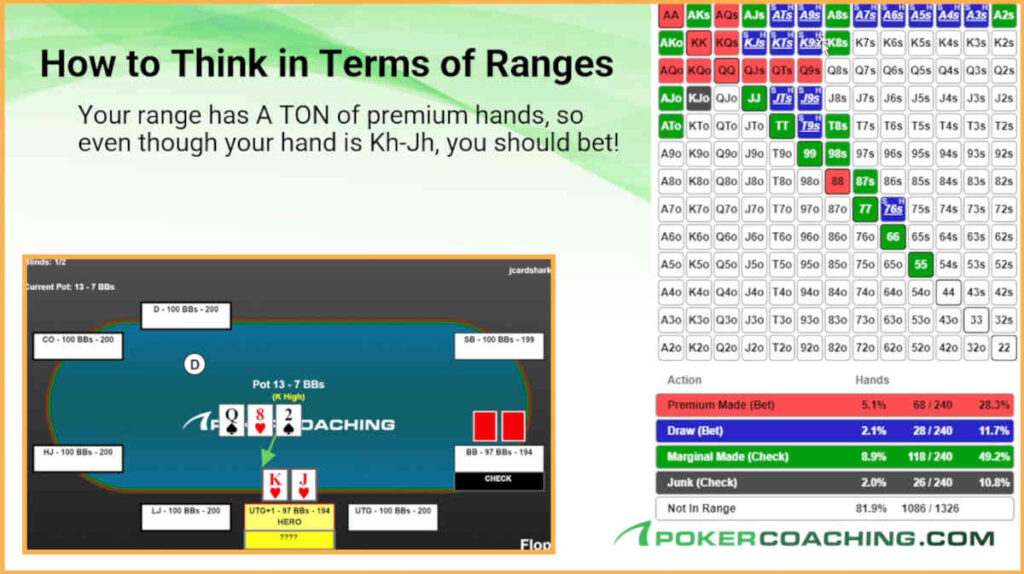
So, since our hand is in the second category, we fire a continuation bet of $4, the opponent calls, and the turn comes the J♣. Once more, the big blind checks.
It’s time to categorize our hand again, and, clearly, the category has changed. By pairing our jack, we now have a marginal made hand. If we bet and they call, they’ll have a lot of solid draws that we’re not a huge favorite against, some Qx holdings that we are losing to, and maybe some hands that we are still ahead of.
So, checking back is the best play here.
This is also a good moment to emphasize how our range narrows as the hand progresses. With every action, portions of the range are removed. When we bet on the flop, a certain portion of our overall range was removed. By checking back on the turn, we are eliminating another segment of hands, i.e., the hands that would continue betting.
After we check back, the river comes the 3♥ and the opponent now takes the betting lead, firing out for $13.
Should you call or fold? To decide, we can use the same logic and apply it to their range. The graph below shows all the hands they’re likely to have arrived to the river, given the action in the hand.
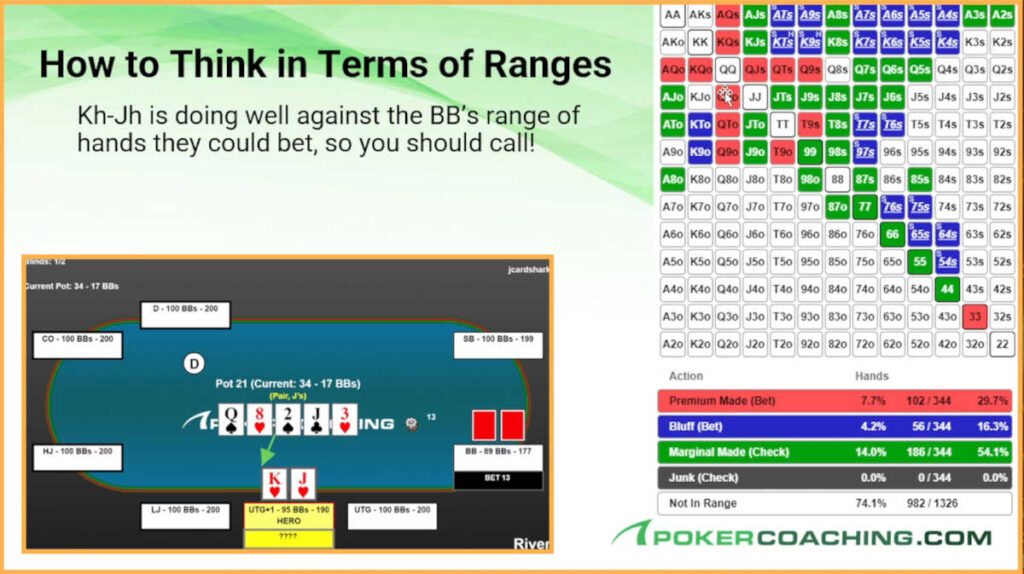
As you can see, there are some AQ holdings, as well as some weaker queens in there, which we lose to. However, there are also many draws that bricked, and that will look to bet on this river.
We are getting pretty good pot odds, as we need to call $13 to win the pot of $47. This means that we need around 28% equity to call the bet.
Assuming the opponent’s range we assumed is accurate, we can take the total percentage they are betting, which is 46% of the hands. Then we take the amount they are bluffing, which is 16.3%, and divide it by 47%, and that equals 34%. This is thus an easy call, as we only need to win 28%.
Of course, sometimes players will show up with some hands that are not in this range. Some of your opponents may be betting thinly for value with hands like AJ. Maybe they never bluff on the river and only bet for value.
Knowing these specifics can help you shape the range against particular opponents and then apply that knowledge to determine the correct action.
However, when playing against someone that we don’t know much about, there is no need to start leveling based on very limited information. We begin by assigning them logical ranges, and that logic makes it for an easy call in this spot.
In this particular scenario, the opponent showed down 7♠5♠ for a busted flush draw, so we scooped the pot. On a different day, they’ll have a queen, and we lose, but that’s not important, as long as our range assessment is correct. In the long run, it will yield positive results.