Image courtesy of the World Poker Tour
One way to increase your win rate in poker is by making adjustments against opponents based on limited information. It is possible to figure out a player’s tendencies and what they’re likely to do in the future based on just one or two hands.
Of course, this won’t be 100% correct all the time, but if you pay attention to the right things, more often than not, your assumptions will be correct.
To master exploits, you first need strong technical foundations. From there, logic-based and exploitative work will help you adjust strategies and increase your win rates.
You can’t do any of this if you’re not paying attention, though. To make big adjustments in important spots, you have to be committed to avoiding distractions and keeping an eye out for things like general reads, bet-sizing tells, what hands they are showing down, etc.
Also, get rid of your ego. You must have confidence and not worry about occasionally looking silly. When trying to exploit your opponents, you’ll be wrong sometimes, but as long as you are putting in the work away from the tables and making logical adjustments at the tables, you’ll get better at it.
Example #1 – Playing Against an Emotional Player
Let’s start with an example of a 60-year-old player who is clearly emotional. In a $1/$3 game, they open to $10 from the hijack and the big blind calls. The flop comes K♠10♠6♥. The big blind checks, and the HJ bets $10 (half-pot).
The big blind calls, and the turn comes 5♣. The big blind check-calls their $20 turn bet.
The river is the 9♠ and the big blind leads for $50. The hijack snap-calls with Q♥10♥, a pretty bad bluff-catcher, and the big blind shows A♠5♠. After the hand is over, the hijack grumbles and complains about getting outdrawn.
There is a lot you can extrapolate about this player. This may or may not be 100% accurate, but we have some reads to work with:
- They really don’t like to get outdrawn.
- They want to charge draws, even with mediocre hands.
- Their bet sizing is probably reflective of their hand strength.
- Their turn betting range seems linear rather than polar, which means their check-back range will likely be weak.
- They might be inelastic to bet sizing, i.e., they’ll call with the hands they want to call with, regardless of how big the bet is.
So, how do you make exploitative adjustments for this particular player type? Here are some of the things you can do:
- When they check back on the turn and the board doesn’t change on the river, you can bluff with pretty much everything.
- Because they bet flop and turn too wide, we get to raise for thinner value against them, especially when they use small bets, indicating that they don’t love their hand too much.
- If they bet the flop and turn, don’t lead into them as a bluff.
So, let’s say you find yourself up against that same player, defending against their raise in the big blind with A♠5♠ and the flop comes Q♠J♠8♥. You check, and they bet half-pot ($10) once more.
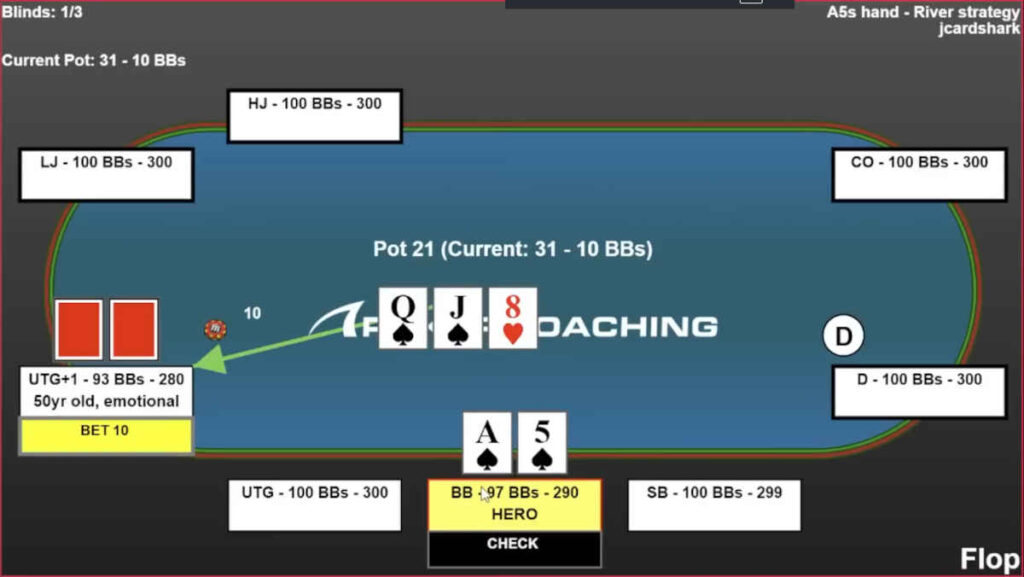
Both calling and raising are reasonable options in this spot. We decide to call and see the turn of 7♣. We check, and this time they check back.
If our assumption that they’ll bet on the turn with a wide range of hands, including queens, jacks, eights, pocket tens, and nines, is correct, we know that when they check back, they probably don’t have much. So, if the board doesn’t change on the river, we should be betting.
In this instance, the river comes the 3♣, which is a perfect bluffing card. In terms of sizing, we should probably go for around 60% of the pot, which should be enough to fold their ace-highs and low pocket pairs.
Example #2 – Young Satellite Winner in a Tournament
Let’s now look at a different player type, a young satellite winner opening 2.5x from an early position, starting with 50 big blinds.
The big blind makes the call, and the flop comes K♠9♥4♥. The big blind checks, and the preflop raiser c-bets for three big blinds. Their opponent calls, and the turn comes the A♠. The big blind check-calls a five-big-blind bet.
On the river 9♠, the action checks through, and the EP raiser shows down A♣K♣ to win the pot against the big blind’s A♥10♥. So, what can we extrapolate from this hand about the young player?
- They are unlikely to go for thin value on the river (checking back top two pair).
- They are likely capping turn and river sizes, not using big bets when they should (on dynamic boards like this one).
- This player cares more about getting some value than full value (preoccupied about getting called rather than the total value their bet is generating in the long run).
- Playing tight and straightforward, looking not to go broke.
- They probably don’t have a deep understanding of ranges and see certain cards as much scarier than they really are (the 9♠ pairing the board and bringing in the backdoor flush).
This is a lot of information to work with, and here are some things we can do to exploit this player type:
- When they bet turn and river, we should be over-folding as they are likely to be value-heavy.
- Try to put this player at risk – they will not want to lose their entire stack.
- Bluff way more often on the runouts where the flopped nuts gets weaker.
Let’s look at an example. We are in the big blind with K♠Q♠ against this player, and they are in the small blind.
They limp, we raise it to 3,000 (500/1,000 blinds), and they call. The flop comes Q♣9♥4♦. They check, we bet one-third pot, and they call. The turn is the 8♠; they check, and we bet again for 15,000.
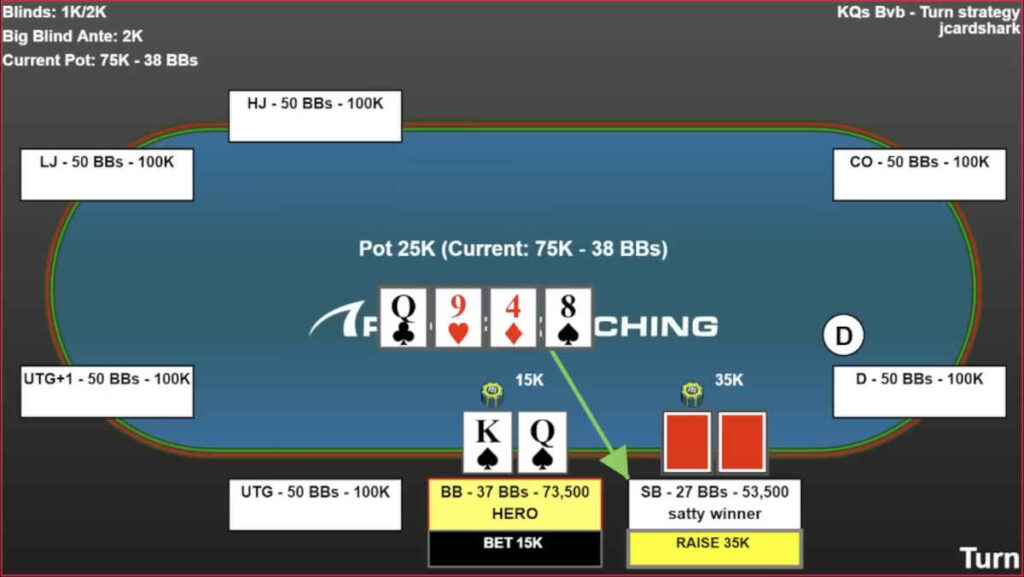
The small blind now check-raises to $35,000. That’s not great. The hand went from being very good to a marginal bluff catcher. If our read is correct, this player is not raising with many (if any) weaker value hands, and they are not running a bluff in a spot where we can easily have many strong hands.
So, all this information makes it an easy fold, even though we are never folding this hand in the GTO world. We can go against the GTO when we know we are facing a player who doesn’t want to go broke and who will not go for full value unless they have the nuts (or very close to it).
Example #3 – A Maniac Player in a Cash Game
For our third player type, we’ll take an extremely loose and aggressive cash game player. They are on the button and, facing a $10 open from the hijack, they 3-bet to $30. The hijack calls, and the flop comes K♠J♥3♦.
The hijack check calls $25 flop continuation bet and calls $75 once more on the 2♠ turn.
The river comes the 5♦, and after the hijack checks for the third time, the button player moves all-in for $170 effective. The hijack snap-calls with pocket jacks for a flopped set, showing the willingness to slow-play (but not slow-roll) their big hands.
The hijack, on the other hand, shows down 10♣6♣. This tells us a few things about this player:
- They probably like to play way too many hands preflop, and they prefer to play them aggressively.
- They likely overvalue the positional advantage.
- This player type is happy to bluff and fire three barrels after the flop, which doesn’t happen all that often at small stakes.
And here are some adjustments you can make against this rare type of LAG maniac:
- Be prepared to hero-call them with any decent hand.
- Play your premium hands passively to trap them.
- Let them do the betting and induce them to put their stack in the middle.
This particular player type can be tricky because they’ll put you in some difficult spots, but, as I underlined in the introduction, you have to trust your reads and go with them. More often than not, this will be the correct play, and, in the long run, this confidence will significantly boost your win rate.