Online cash games at $1/$2 and lower are booming, and these games represent an excellent way to build your bankroll, provided you play better than the opposition.
To do this, you’ll need a few very important GTO principles and some strong exploits that you’ll be able to use over and over.
In this article, I’ll cover three such exploits:
- How to value bet more efficiently
- How to adjust your bet sizing to max exploit your opponents
- Why you should fold early & often facing large bets
#1 Value Bet Relentlessly
A lot of money in poker is made by value betting often and focusing on getting paid when you are ahead. Too many players try to play like a GTO solver, or they use fancy bets to entice opponents to do something crazy.
However, in an online environment, where you don’t know your opponents, these are not optimal approaches, and they can be a waste of time and money.
The answer is quite simple – you should value bet relentlessly, over and over!
Say we raise to $5 from the HJ with K♥J♠, the big blind calls, and the flop comes K♠Q♥8♦. The big blind checks, and we will always c-bet on this flop. We bet $7, and they call.
The turn is the Q♦, and the opponent checks. You could be behind here, but you could also be up against a weaker king, an eight, or a draw. So, you should bet for value.
We bet $15, and the opponent calls.
The river is 2♠; the opponent checks. Again, you could be beat, but you have the best hand a lot because most players will raise a queen on the turn. We need to come up with a sizing that the opponent will likely call with a hand like a king or a pair of eights, and $30 is just about right.
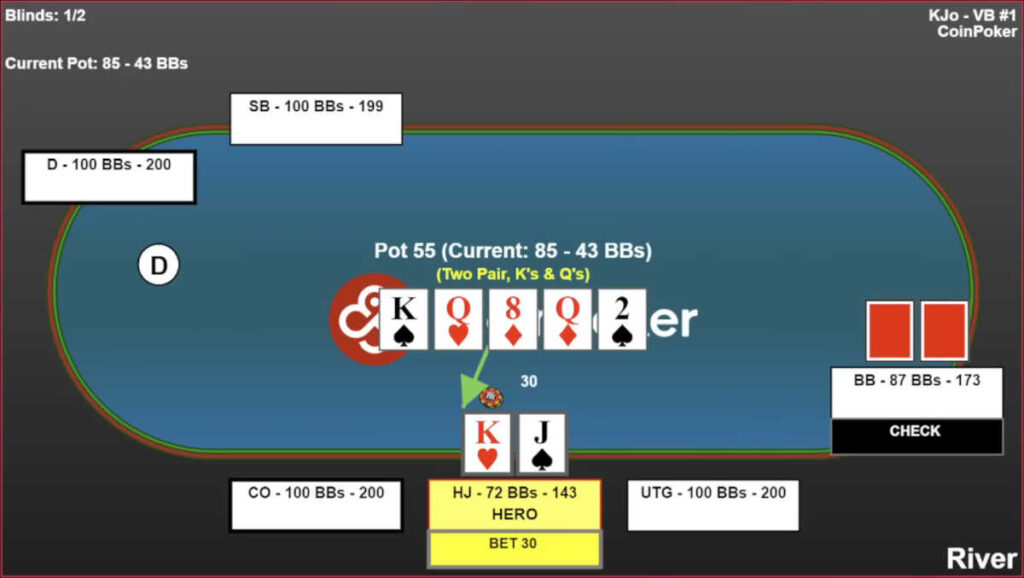
Here, we end up betting $30, and they call with K♦5♦, allowing us to scoop a nice pot.
Many players are reluctant to bet on the turn because they are afraid of getting raised. However, you shouldn’t worry about this too much. If you bet and get raised on this turn, you can simply fold your hand because most people will not check-raise here unless they have trip queens.
#2 Size Up Your Bluffs & Size Down Your Value Hands
This particular strategy has helped me consistently crush small stakes games over the last ten years. It is a very simple, yet extremely effective approach.
- When you want your opponent to fold, bet larger – often a lot larger.
- When you want them to call, bet a little smaller than you think you should.
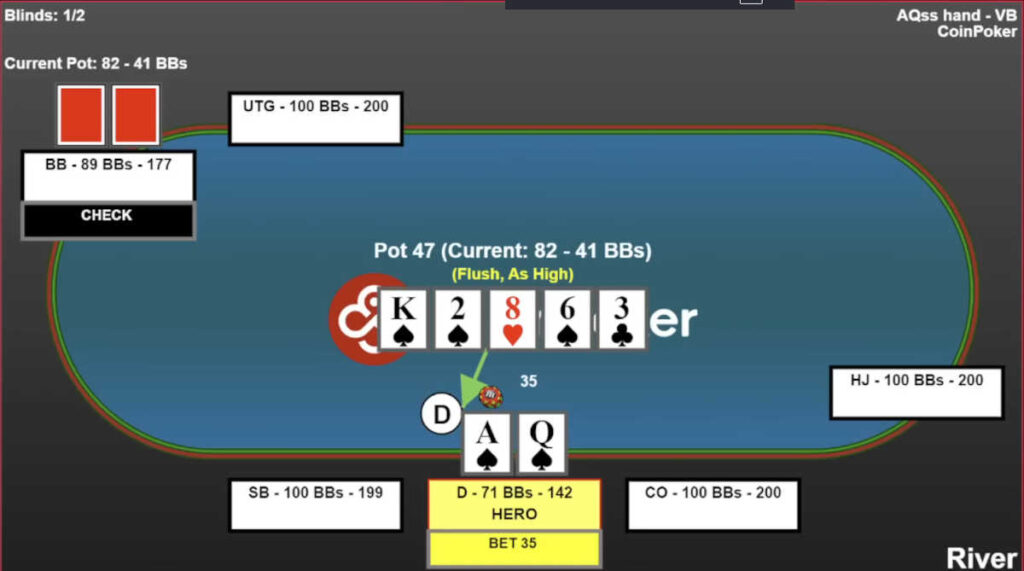
We have A♠Q♠ and raise to $6 from the button. The big blind calls and the flop comes K♠2♠8♥. They check – call our $4 bet.
The turn is the 6♠, completing the flush. We want to bet a medium size in this scenario to get called by a king or an eight, not just on the turn, but also on the river. If we start blasting right now, most players will fold a majority of hands.
So, we bet $13, and they call, going to the 3♣ river. In the GTO world, we want to play a huge pot with a huge hand, but here, we want to exploit opponents and what they do incorrectly.
We want to bet a size they can call with a king or an eight, but we don’t want to make it too small, either, where your bet looks like a missclick. So, something like $35 works perfectly in this scenario.
Most players will not fold to a two-thirds pot bet, and here, they end up calling with K♥7♦.
But what about the opposite scenario?
We open from the button with A♠8♣, the big blind calls, and the flop comes K♠10♣4♠. The opponent checks, we c-bet for $4, and they call.
The turn is the 2♠. The opponent checks, and we have an ace-high flush draw that lacks showdown value, so it’s a great hand to keep bluffing. We bet $15 into $21 and the opponent calls once more.
The river is the 7♦ and the opponent checks. This time around, we don’t want to get called, so it’s a good spot to blast and make it something like two times the pot. Most players will not call when you bet $100 into $50 unless they have at least two pair.
Of course, if you do bet $100 and someone ends up calling you with just a pair of tens, you should put a note on that player. Don’t try to bluff them and instead, bet huge against them when you have the nuts and exploit their tendency to hero call.
#3 Fold Early & Often Against Large Bets
Most small-stakes opponents will choose a bet size that matches their hand strength. With big hands and strong draws, they’ll bet big; with medium-strength holdings, they’ll usually bet smaller.
This means that we need to drastically over-fold against big bets on early betting rounds with hands that don’t have much potential to improve.
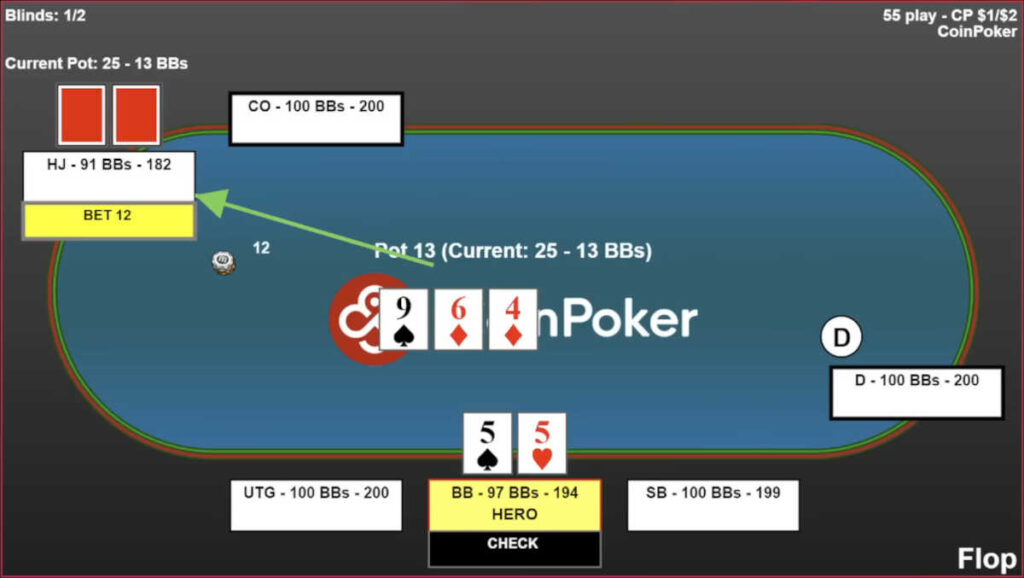
For example, the HJ raises, and we call in the big blind with 5♠5♥. The flop comes 9♠6♦4♦. We check, and the opponent bets $12 into $13.
Normally, this is an okay hand to continue with if they wagered $4 or even $7. However, facing a large, pot-sized bet, we should just fold.
Or, we raise to $5 from UTG with J♠J♦. The button calls, and the flop comes K♦Q♥6♣. We decide to check, and the opponent bets $7 into $13.
In the GTO world, we can’t just fold this hand on the flop. However, since we don’t have many great ways to improve, and even if we do improve, we can end up with the second-best hand, over-folding in this spot is perfectly fine.
This may sound too nitty in theory, but this is exactly how you go about crushing your opponents in small-stakes games by not giving them value in marginal spots and extracting the maximum value in the situations where you’re likely to be ahead.