
Image courtesy of the World Poker Tour
There are so many players out there who complain about losing with the Big Slick and feel they don’t know how to play ace-king correctly.
Some go as far as to say that it’s one of their most unprofitable hands.
The reality, of course, is that ace-king is one of the most profitable hands in Texas Hold’em, and if you’re losing money with it, you are probably making blunders that are making it difficult to win in the long run. This is especially true for small-stakes games because AK makes the best top pair/top kicker combo, which is very profitable.
However, it also makes quite a few marginal made hands with ace-high, and these can be very unprofitable if you overplay them.
So, in this article, we’ll look at three of the biggest mistakes that I see people consistently make with ace-king and talk about what you can do to fix them.
#1 Stop Getting It All In Preflop When Deep-Stacked
Let’s first discuss situations when we are playing very deep-stacked, around 100 big blinds effective. Below are two GTO charts that we’ll use to analyze these scenarios.
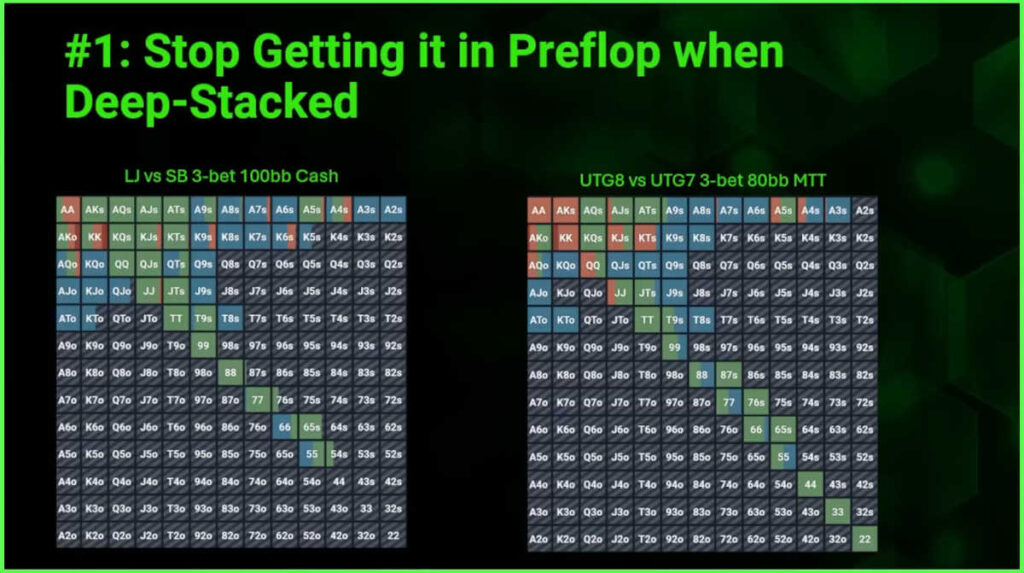
The first chart shows a 100 big blind cash game scenario where we open from the lojack and the small blind re-raises. As you can see on the chart, AK suited only ever calls here (no 3-bets), and the off-suit variation calls about 50% of the time and 3-bets about 50%.
We are not automatically 3-betting with AK, looking to get it in here. This is because our initial raising range is already pretty tight, and the small blind’s re-raising range, if they are any good, should be fairly narrow.
By just calling, we are keeping their range somewhat wide and seeing the flop in position; by re-raising, we are forcing the opponent to only continue with the top of their range (i.e., aces, kings, queens, ace-king), and we are not in a good shape against that range.
The long and short of it is that we’d rather play a small to medium-sized pot with a big edge than a large pot with a small or no edge whatsoever.
The second chart shows a tournament situation where we open from under the gun, 80 big blinds deep, and the player to our immediate left re-raises. Ace-king continues as just a call here over two-thirds of the time because, once more, if we 3-bet, what hands do we expect to be up against if more money goes into the pot?
This strategy applies to a few other hands that many players like to re-raise with almost automatically, such as pocket queens, jacks, tens, or AQs.
#2 Stop Overplaying Ace-King After the Flop
Ace-king is a premium poker hand in most situations, but you have to be quick to adapt when you miss the flop, i.e., you don’t flop a pair or a straight or a flush draw.
In these situations, AK will often be good if the pot stays small, but almost never if it blows up.
Let’s say we raise with A♠K♠ playing 40 big blinds deep and the big blind calls. The flop comes 6♠5♦3♦ and the action checks to you.
On this texture, you are happy to check back, because the board favors the caller’s range, and they will check-raise you quite often if you bet. Plus, even if they just call, it’s not a very comfortable position to be in.
In our example, the player decides to continuation bet small, which could be justified if you’re playing against very weak and straightforward opponents that always fold if they don’t connect with the flop. However, the big blind goes for a check-raise.
This is an uncomfortable spot in general, but if you believe your opponent to be on a weak-tight side, that should give you even more reason to fold. Against stronger players, who are capable of doing this as a bluff, you have more incentive to stick around.
In our example, the player calls, and the turn brings the J♠, giving them a flush draw. They call another bet from the opponent and arrive at the river of the K♦. The big blind moves all-in.
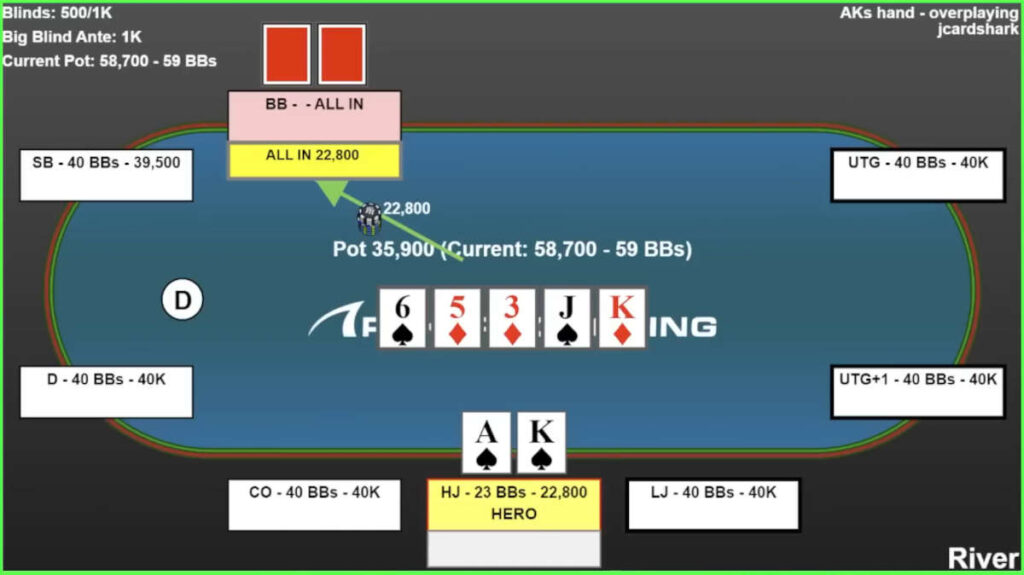
Many players believe this is a must-call once you improve to a top pair, but that’s very much a mistake.
Unless your opponent is an absolute maniac, you simply have to fold. You have to think about what type of hand plays this way. There are three-of-a-kind hands, straights, and flushes, and that’s pretty much it. Most players don’t have random bluffs here, especially seeing how you could easily have a flush on this river.
#3 Don’t Be Afraid to Go for Max Value
When they do make a premium hand postflop with ace-king, many players are afraid they won’t get paid. So, to ensure they get some value, they default to small bets. This is wrong.
With your best hands, you want to make big bets. If you want ace-king to be one of your most profitable hands (as it should be), you have to go for the max value when you make monsters.
For example, playing $1/$2, we raise it to $6 with A♠K♠ and the big blind calls. The flop comes A♥10♣2♠ and, after the big blind checks, the hero bets just $3.
Right off the bat, this is a spot where we want to bet bigger. We will have many aces here that want to get money in the middle and some gutshot straight draws that don’t mind if the opponent folds. So, betting something like $10 here is perfectly reasonable.
As a side note, at low stakes, many players will call with the same hands whether you bet $3 or $10 (they shouldn’t, but they do), so there is no reason not to bet bigger when you have a strong hand.
The opponent calls the small bet and the turn comes the 6♠, adding a flush draw to our top pair/top kicker. When they check on the turn, this is a time to bet big.
In this hand, the hero bets $10, which may seem like a decent-sized bet, but we can (and should) go significantly larger. On that note, if you’re playing live, make sure you know your poker chip colors when assembling those big bets.
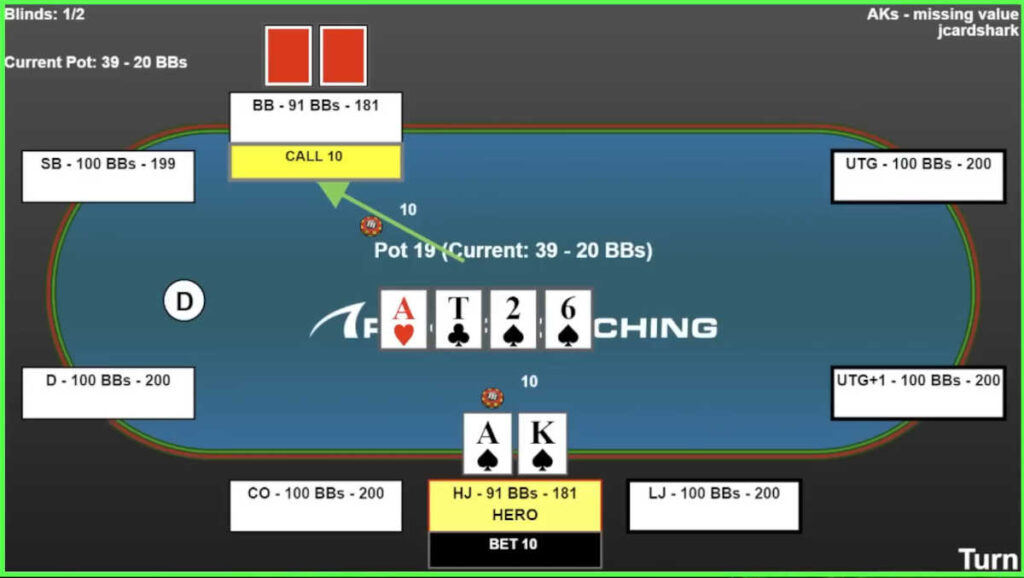
The big blind calls the $10 bet, and the river comes the 4♠, completing the flush and giving us the effective nuts. With $39 in the middle, we want to be betting at least the pot, but going for an overbet and making it something like $60 or even $80 is an even better approach.
If your opponent is very tight and they always fold to big bets, you can go smaller, but still make it at least pot-sized. This is a great spot to use a big sizing, as we still have hands like QJ that we want to be able to bluff with on the river.
In this particular case, the hero bets $25, and the opponent calls with A-4, a two-pair hand that would have certainly called off a much larger bet.
To summarize, if you fix these three mistakes, it will be basically impossible to lose with AK, and it will almost certainly become one of your most profitable hands. Of course, you’ll still lose some pots along the way, but, in the long run, your Big Slicks will show significant profit.


