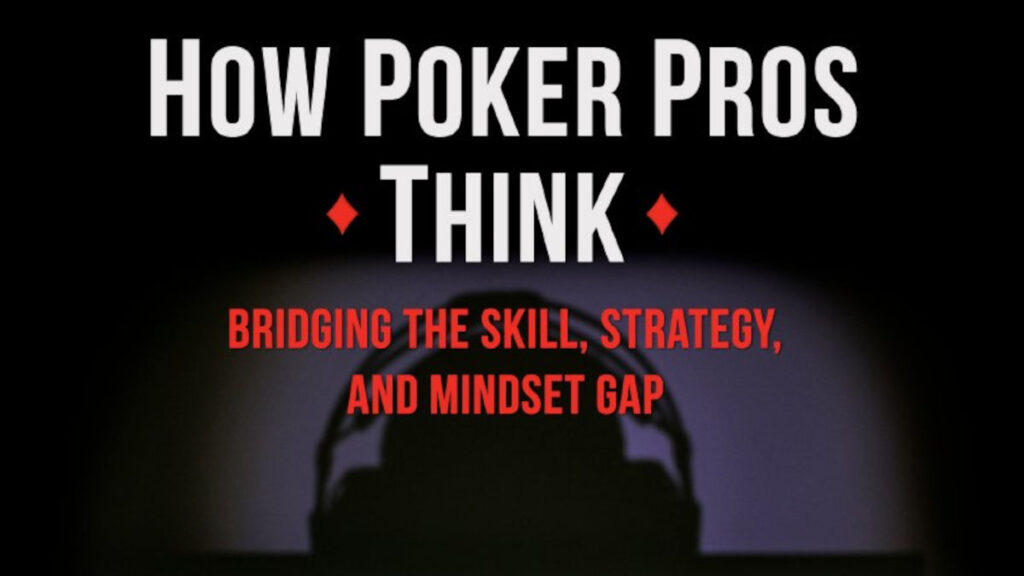
Dara O’Kearney and Barry Carter have built a reputation for books that treat poker as a thinking person’s pursuit, and How Pros Think leans into that idea harder than anything they’ve released before.
The guiding thread running through the whole thing is simple: the difference between an amateur and a professional isn’t a secret betting line or a magic bluff. It’s a way of processing decisions. That single idea reframes the entire amateur-to-pro journey, and for most players today, that journey doesn’t begin in a Vegas card room. It begins on a laptop screen, one hand at a time.
That shift toward online play is exactly why the book feels so timely. Grinding through thousands of hands a week is how modern players build the pattern recognition the authors describe, and that volume is only possible in the virtual felt. For anyone planning to log those hands seriously, understanding what to look for in a real-money poker room matters just as much as studying ranges.
A good room review weighs traffic so games actually run, the bonus structures that stretch a starting bankroll, dependable payout handling, and the legality picture that changes from one state to the next. Those practical details decide where a developing player can realistically put in the reps — and How Pros Think is, at its core, a book about reps and how to think through them.
The Core Idea: Decisions Over Outcomes
The book hammers one point from page one: pros judge themselves on the quality of their decisions, not the result of a single hand. Amateurs do the opposite. They shove with a flush draw, hit it, and file the memory away as proof they played it right. O’Kearney and Barry Carter argue that this outcome-based thinking is the biggest wall between a casual player and a consistent winner.
Online poker happens to be the perfect laboratory for unlearning that habit. When the hand histories are all logged and the sample sizes climb into the tens of thousands, a player can finally see the gap between short-term luck and long-term edge.
A live player might play forty hands an hour at a WSOP side event. An online grinder sees that in a single orbit across four tables. The data piles up fast, and the authors insist that’s where real improvement lives.
Volume, Variance, and the Virtual Felt
Revisiting the guiding idea: thinking like a pro means making peace with variance, and nothing teaches that lesson faster than online volume. The book spends real time on the emotional math of downswings — the stretches where correct decisions keep losing and the temptation to abandon a solid strategy becomes almost unbearable.
There’s a well-known BBC piece on how a poker win reshaped thinking that captures this tension beautifully, describing how a big score forced the writer to confront how much of life runs on uncertainty rather than control. O’Kearney and Carter work from the same premise.
A player who internalizes variance stops tilting after a cooler and starts asking a better question: was the decision sound regardless of the river card? Online, where the pace is relentless and the next hand is always two seconds away, that mental discipline isn’t optional. It’s survival.
Building a Study Routine That Actually Sticks
The amateur-to-pro leap also comes down to work ethic, and here the book gets refreshingly honest. Talent gets romanticized in poker media — the WPT final table hero reads, the Triton high-roller hero call — but How Pros Think argues that the real engine is unglamorous: reviewing hands, tagging leaks, and running the same spots through a solver until the patterns feel automatic.
Academic work backs this up. A study on elite online poker performance examined what separates the small cluster of long-term winners from the field in a game most people associate with losing money. The findings line up neatly with the authors’ thesis: the top performers treat the game as a discipline, pairing analytical rigor with emotional control.
They don’t just play more. They study smarter, and they do it with the kind of consistency most players reserve for their day jobs. Online tools — tracking software, equity calculators, hand databases — make that routine possible for anyone willing to put in the time.
From Micro-Stakes Grind to Pro Mindset
The last stretch of the journey, the one the book builds toward, is the quiet transformation of identity. A player stops thinking like someone hoping to get lucky and starts thinking like someone managing a long-term investment. Bankroll management, table selection, knowing when to quit a session — these feel like boring housekeeping to beginners, but they’re the scaffolding every professional stands on.
Online play makes that transition accessible in a way the live circuit never could. Someone can start at micro-stakes, work through the thousands of hands the book keeps pointing to, and climb without ever buying a plane ticket. The felt is always open. The sample size is always growing. And the central idea — that pros win by thinking better, not by running hotter — gets tested every single session.
That’s the real takeaway from How Pros Think. The amateur-to-pro road isn’t paved with hero calls or lucky suckouts. It’s paved with better decisions, repeated often enough to become second nature, and online poker simply offers the fastest, most measurable way to walk it. For readers chasing that leap, O’Kearney and Carter have handed over the map. The grinding is up to everyone else.