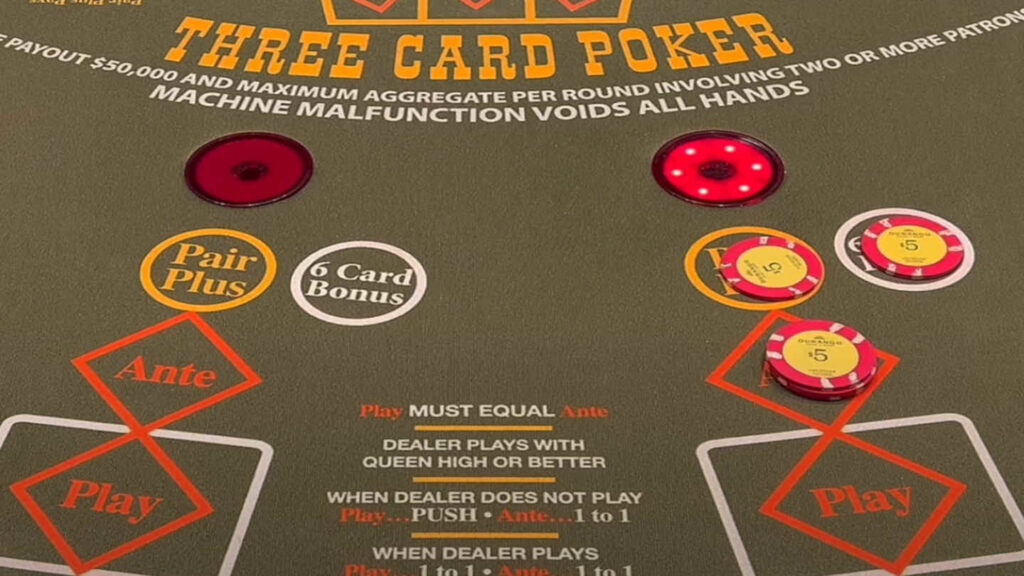
Three Card Poker is a poker variant played with a standard 52-card deck. Unlike traditional poker formats such as Texas Hold’em, this version pits you against the dealer exclusively. A standard Three Card Poker table can accommodate up to 8 players, including the dealer.
The game consists of two primary components, the Ante-Play wager and the Pair Plus side bet. In the Ante-Play portion, you place an initial bet to receive three cards. After viewing your hand, you must either fold, forfeiting your ante, or play by matching your initial wager.
The Pair Plus bet is an independent wager that pays out based on the rank of your hand, regardless of the dealer’s cards.
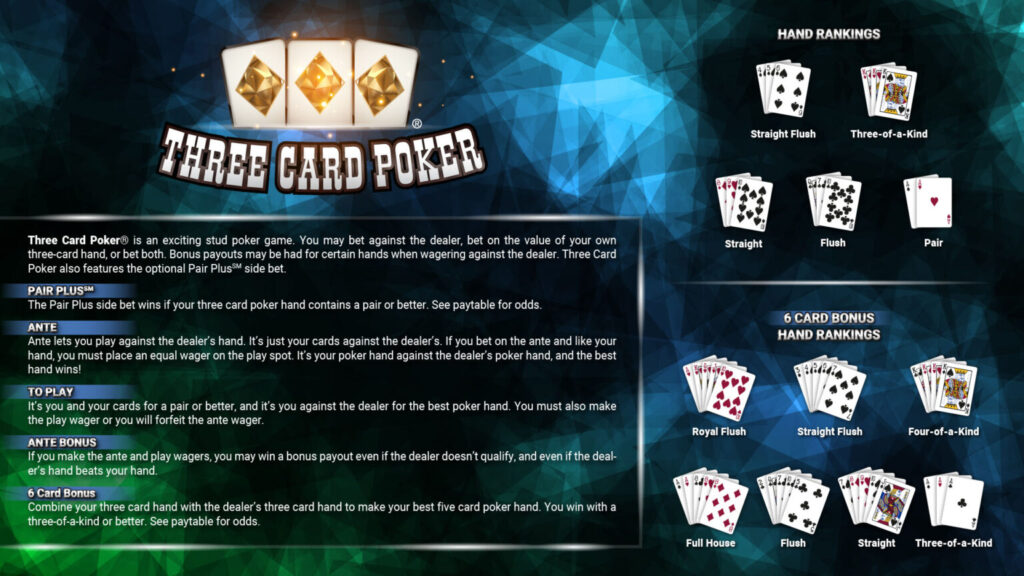
Three Card Poker Hand Rankings
In Three Card Poker, hand rankings differ from those in traditional five-card poker because of the probabilities of three-card combinations. The biggest shift is that a Straight is statistically harder to achieve than a Flush with only three cards and is therefore a stronger hand in Three Card Poker hand rankings.
The highest possible hand is the Straight Flush, which consists of three cards of the same suit in numerical sequence. The second-strongest hand is a Three of a Kind, which is made from three cards of equal rank. This is followed by a Straight, then a Flush.
Below the Flush is the Pair, consisting of two cards of the same rank and one unrelated kicker card. If a hand contains none of the aforementioned combinations, its value is determined by the High Card. When comparing two High Card hands, the highest individual card wins. If those are equal, the second-highest is compared, and then the third.
How to Play Three Card Poker – A Step-by-Step Guide
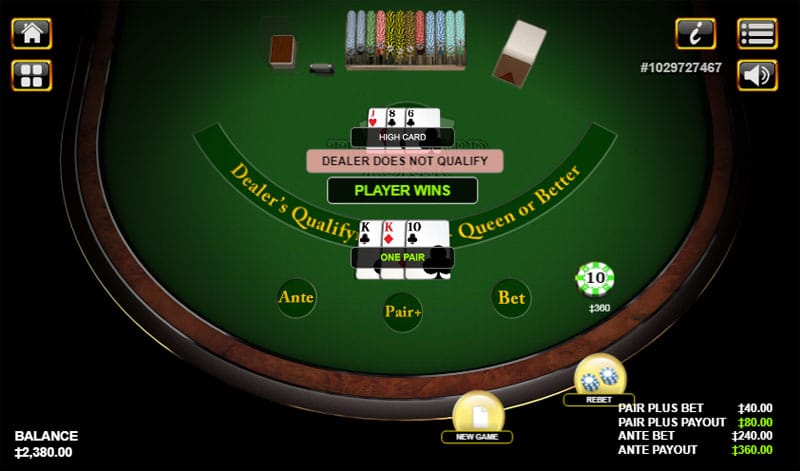
Because there are no community cards or draws, the game relies on a direct comparison between the player’s three cards and the dealer’s three cards. Here’s a quick guide on how a standard round of Three Card Poker plays from the initial wager to the final payout:
- Placing Initial Bets – Before any cards are dealt, you must place your opening wagers. You can place an Ante bet or a Pair Plus bet. While you can play both simultaneously, the Ante is required if you wish to participate in the competitive portion of the round.
- The Deal – Once all bets are placed, the dealer distributes three cards face down to each player and three cards face down to the house.
- The Player’s Decision – After examining your hand, you must decide if it is strong enough to challenge the dealer. If you fold, you forfeit your Ante bet and the round ends for you. If you wish to continue, you must place a Play bet equal to your original Ante.
- The Dealer’s Reveal – The dealer turns over their three cards. For the round to proceed to a full comparison, the dealer must qualify with their hand. If the dealer does not qualify, the Play bet is returned as a push, and the Ante is paid out at 1:1, regardless of your hand’s strength.
- The Showdown and Resolution – If your hand is higher, both your Ante and Play bets are paid out at 1:1. If the dealer’s hand is higher, the house collects both bets. In the event of an exact tie, both the Ante and Play bets result in a push and are returned to you.
The Dealer Qualification Rule
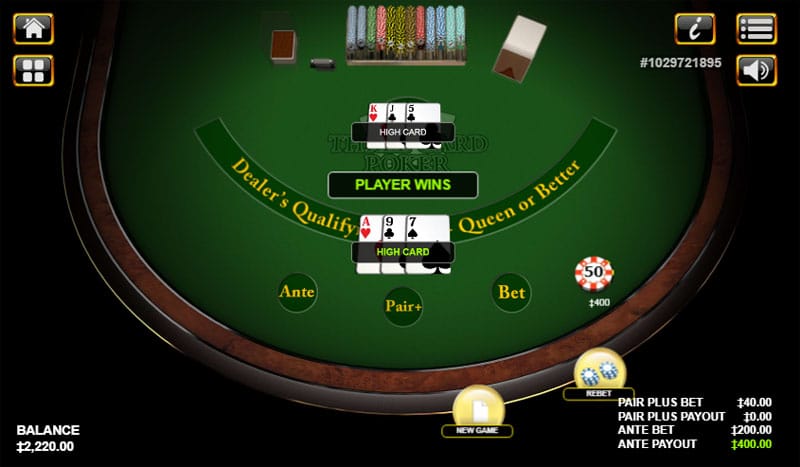
Much like Ultimate Texas Hold’em, Three Card Poker sets specific rules on the minimum hand value the dealer must hold to qualify for full action against the player. Specifically, in this game, the dealer must have at least a Queen-high hand.
If the dealer fails to qualify, the competitive phase between the two hands is effectively cancelled. In this scenario, your Play bet is returned as a push, meaning no money is won or lost on that specific wager. The Ante bet is paid out at 1:1, regardless of whether your hand was actually stronger than the dealer’s.
If the dealer qualifies with a Queen or better, the game proceeds to a standard showdown. The dealer’s three cards are compared directly to your three cards using the game’s hand rankings, which we outlined above.
Payout Tables
While the Ante and Play bets both pay 1:1, the payouts for the Ante Bonus bet and Pair Plus bets are slightly more comprehensive, as they depend on the strength of your hand.
Ante Bonus Payouts
The Ante Bonus side bet is an independent bet that only focuses on the strength of your hand and pays out irrespective of whether the dealer qualifies or wins the hand. It only pays for three possible hands, offering the following payouts:
| Hand | Payout |
| Straight Flush | 5 to 1 |
| Three of a Kind | 4 to 1 |
| Straight | 1 to 1 |
Pair Plus Payouts
Like the Ante Bonus bet, the Pair Plus side bet also pays out regardless of whether you beat the dealer. Moreover, this side bet offers even more rewarding payouts than the previous one. Here’s a closer table overview of all of the Pair Plus payouts:
| Hand | Payout |
| Straight Flush | 40 to 1 |
| Three of a Kind | 30 to 1 |
| Straight | 6 to 1 |
| Flush | 3 to 1 |
| Pair | 1 to 1 |
Three Card Poker House Edge
The house edge in Three Card Poker is not a fixed number, but rather a variable figure that depends on which bets you place and the specific payout tables used by the casino. For the primary Ante-Play game, the house edge is typically around 3.37% when you follow an optimal strategy.
Additionally, the Pair Plus side bet carries its own independent house edge, which is noticeably higher than the Ante-Play portion. While the house edge for this bet can also vary between casinos, it is usually around 7.2%, making it a poor long-term bet choice
Common Variations
While the core gameplay of Three Card Poker remains consistent, some casinos have introduced variations in the betting structure and payout tables to offer players more options.
For instance, some venues offer a side bet called the 6 Card Bonus. This bet pays out for the best f-card poker hand you can make while using your three cards and the dealer’s three cards. This can be an extremely rewarding side bet, as the payout for a hand can be upwards of 1,000:1.
Additionally, many modern tables also include Progressive Jackpots or Envy Bonuses. In these versions, you can place an additional small side bet (sometimes as low as $1) to qualify for a massive, accumulating jackpot. The progressive jackpot is triggered by specific high-ranking hands.
Conclusion – Is Three Card Poker a Game of Skill or Chance?
With everything we’ve outlined above, it is safe to say that Three Card Poker is a game of limited decision-making just like Ultimate Texas Hold’em or 4 Card Poker. While it does involve some skill, it leans heavily toward luck. The element of chance is dominant because you have no control over the cards dealt. The outcome of the Pair Plus bet and the initial three-card hand is entirely dependent on the luck of the draw.
The only skill element is the Play vs. Fold decision. Although the cards are random, the choice to forfeit the hand or double the investment requires a basic understanding of the game.
Considering this, it is essential to approach the game with a focus on responsible play. By wagering only what you can afford to lose and treating the game as entertainment, you can ensure the experience remains enjoyable.