
Image courtesy of World Poker Tour
While many players don’t really like the idea of managing their poker bankrolls, this practice is essential for long term success. Winning in poker boils down to three main things:
- Finding the games you can beat.
- Play a lot of hours in the games in which you have an edge.
- Keep a proper bankroll.
When it comes to your bankroll, it’s crucial that you don’t treat it as an ATM, spending money every time you win big. Taking money out of your bankroll will slow your progression, preventing you from moving up the stakes and/or increasing your risk of ruin.
In this article, I’ll provide some guidelines for how to figure out what kind of bankroll you need for No Limit Hold’em cash games and tournaments, two of the most popular formats out there. However, before we get to the main topic, there is one important thing to underline.
If you are playing in games that you don’t have an edge in, no amount of bankroll management will help you. You can’t force your way through it, either, by doubling the stakes and hoping to get lucky. By playing in games where you’re an underdog, you’re setting yourself up for failure.
Bankroll Requirements for Cash Games
I’ve already covered three main requirements for winning in poker. The image below puts all these things together, telling you what kind of bankroll you need, depending on your expected win rate. The numbers were done for $1/$2 games, but you can multiply dollar amounts by 2.5 if you’re playing $2/$5 or by 5 if you’re a $5/$10 player.
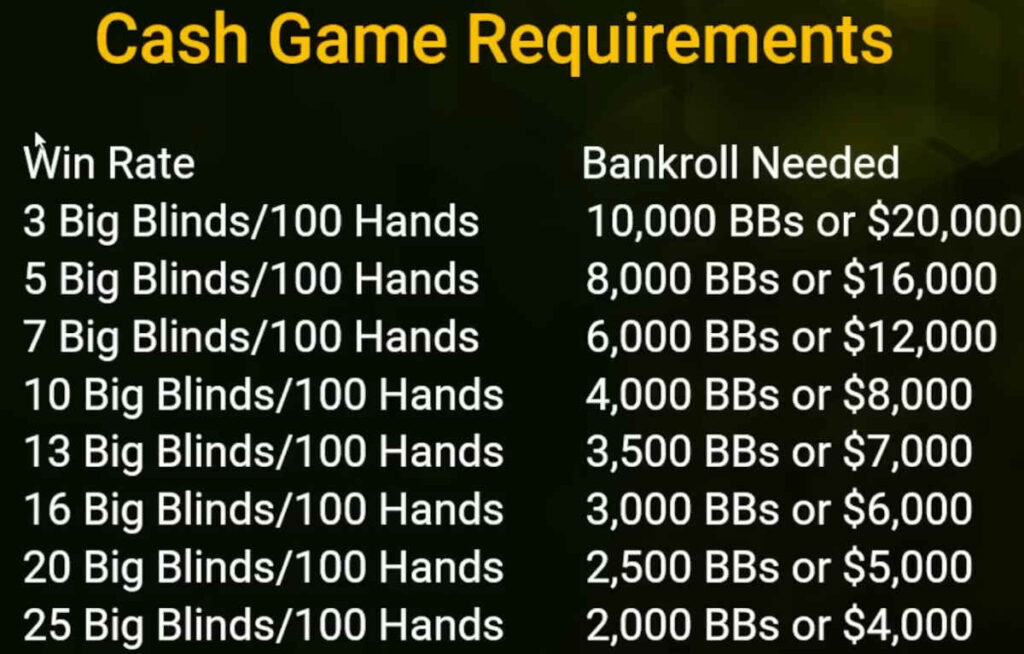
So, looking at the picture, you can see that, if you’re only winning around three big blinds per 100 hands, you’ll need a big bankroll of 10,000 big blinds ($20,000). This may sound like a huge amount of money for $1/$2, but it’s the reality: if you have a tiny edge, you’ll need a lot of money to handle the variance.
At around 13 big blinds per 100, which is what many solid professionals are doing, you’ll need only around $7,000 (3,500 big blinds). As you get better (or find softer games), if you can get to the point where you’re winning 25 big blinds per 100, which is a really big win rate that the best live cash game players have, you can get away with having just 2,000 big blinds.
The question that I get a lot is, what if I don’t have enough money in my bankroll? In that case, you should probably play smaller stakes online, win, and get to the point where you can comfortably play the games you want to play live with a proper bankroll.
This is not what many players like to hear, but poker is a great way to get rich slowly. You simply need to have some restraint and discipline.
Bankroll Requirements for Tournaments
Cash games don’t have that much variance attached to them. Tournaments, on the other hand, are a completely different type of animal.
If you’re playing tournaments with 1,000 people, you can expect to win one in a thousand, maybe one in 500, if you’re really good. No matter what, if you’re regularly playing tournaments, there will be big downswings.
So, how do you figure out a proper bankroll for tournament poker? It revolves around two factors: the number of players in the field and your Return on Investment (ROI). We’ll talk a bit more about ROI in a moment, but, for now, we’ll presume 30% ROI, which is what most solid players have.

For tournaments with 45 players, which describes small, local events, you’ll be all set with around 70 buy-ins. If the buy-in is $100, that means you still need $7,000, as you’ll still experience some significant downswings even in these small fields.
As you venture into larger-field events like WSOP and WPT, you’ll need much more money to withstand the variance. For tournaments with 1,200 players, you should have 3,000 buy-ins, and there are almost no players who are properly bankrolled for these events.
This is okay, as long as you are being reasonable about it and only occasionally venture into these big fields that aren’t way above your usual buy-in level. If you normally play $100 tournaments, it’s fine to try your luck in a few $300 or $400 events with massive fields, but you shouldn’t go above that.
Figuring Out Your ROI
If you want to find success in poker, you absolutely have to keep track of your results. This is the only way to determine if you have an edge in the games you play and what that edge actually looks like.
In tournaments, that number is expressed as ROI (Return on Investment), and it is calculated by taking your total profit over a sample of games and dividing it by the total amount of buy-ins.
So, if you play 100 tournaments with an average buy-in of $115 and cash for $15,000, your profit will be $3,500. Divide that number by the total amount of buy-ins, which is $11,500, to get your ROI – 30% in this particular example.
Of course, your ROI will fluctuate based on the average skill level of your opponents, total number of players, tournament structure, and other factors.
Additionally, it’s very hard, and sometimes even impossible, to have a positive ROI in tournaments with very high rake, which is often the case for small local events (i.e., a $60 buy-in, where $20 goes toward the rake).
Bankroll Management Tips
In some circumstances, it’s possible to keep a smaller bankroll than what is suggested in the above guidelines.
- You consistently add funds to your bankroll – you have a job, and you aren’t trying to be a pro player. If you can add $500 to your bankroll every month, you don’t necessarily need to have an entire amount available to you. If you have $2,000 to start with and can add $500 every month, you have an effective bankroll of $8,000.
- You’re willing to quickly move down – if you have 50 buy-ins for tournaments with 90 players at an expected ROI of 30%, you may not be bankrolled properly, but you can give it a shot as long as you’re willing to drop down to lower stakes if things don’t pan out.
- You only play in soft games – these are getting harder and harder to find, but your edge will be much bigger in really soft games, which means you can get away with having a smaller bankroll. Try to play during nights and weekends and look for tournaments with many satellite qualifiers.
It’s also important to underline that, just because a game exists, it doesn’t mean you have to play it. If you usually play $100 tournaments and there is a yearly $2,200 event coming up at your local casino, that one is not for you. Your bankroll simply can’t support it, and that’s perfectly fine.
The simple fact of the matter is, if you consistently play games you’re not properly bankrolled for, you’re gambling, and putting yourself at a serious risk of losing.
Find the game you can beat, play it a lot and keep a proper bankroll. Do these things, and you will succeed in poker in the long run!