
Image courtesy of World Poker Tour
Days of continuation betting small almost every single time and having people drastically over-fold are long gone. Most players today are more studied, realizing they can’t fold to small c-bets all the time, and they also have more check-raises in their arsenals.
So, to be successful, you need to play closer to a fundamentally strong strategy against people who, for the most part, play a solid game themselves.
In this article, we’ll explore the idea of using large c-bets, focusing on the types of hands and situations that lend themselves to putting maximum pressure on your opponents. Before we jump into it, there are two main principles to consider here:
The better the board is for your range, the more often you should c-bet; in other words, when the board favors your range, you should continuation bet more frequently.
The bigger the nut advantage, the larger your c-bet sizing should be; the more nutted hands you have in your range, the more comfortable you should be using big continuation bets.
#1 C-Betting Big on Dynamic Boards
The first type of situation where you should be inclined to use large c-bets is on dynamic boards. In these spots, things can change quite significantly with the turn card, so you want to bet big right away.
Let’s look at an example.
We have J♠9♠ in an early position, playing 40 big blinds deep, and we go for a raise of 2,200 (500/1,000 blinds). The big blind calls, and the flop comes 8♣7♠3♦.
On this board, there are no straights available, and there is only one logical two pair combo for the big blind opponent. Our range, on the other hand, contains all the over-pairs to the board.
Since the board texture will change significantly on many different turn cards, we want to bet big on the flop. At this stack depth, in situations where we do have an over-pair, or even a strong top pair like A-8, we are pretty happy to get all the chips in the middle if the big blind goes for a check-raise.
Betting right around the size of the pot is a good way to go. Our range consists mostly of over-pairs and better, and some draws, but this texture doesn’t lend itself to many logical draws. So, facing a large bet, the opponent will fold a lot, whereas if we were to use a smaller sizing, they’d be inclined to call with a wider range, and perhaps even check-shove.
#2 Utilizing Big C-Bets When Playing Deep-Stacked
When playing deep-stacked poker, you want to utilize large continuation bets so that you put yourself in a spot where you can get stacks in the middle by the river. In many situations, you’re simply losing value by clinging to smaller sizes.
For example, you’re playing $2/$5 100 big blinds deep (and this definitely applies to deeper stacks, too), and make it $15 from the lojack with J♥10♥. The big blind calls and you proceed to see the flop of A♥Q♠7♣.
Once the opponent checks, we can go for a big c-bet because we have a big range advantage here. There are many two-pair and better hands we could have, plus a few gutshot combos.
So, we bet a pot, and the big blind calls. After they call this large bet, we’ll have to reconsider our strategy on different turns, because the call indicates some top pairs and some queens. However, in this instance, we hit our miracle K♠, giving us the absolute nuts.
This is the time to go massive once the opponent checks. We can get away with betting over the size of the pot, like $110 into $96. Although this looks very strong, our range still contains some bluffs, primarily hands like 10♠9♠, 10♠8♠, and 9♠8♠.
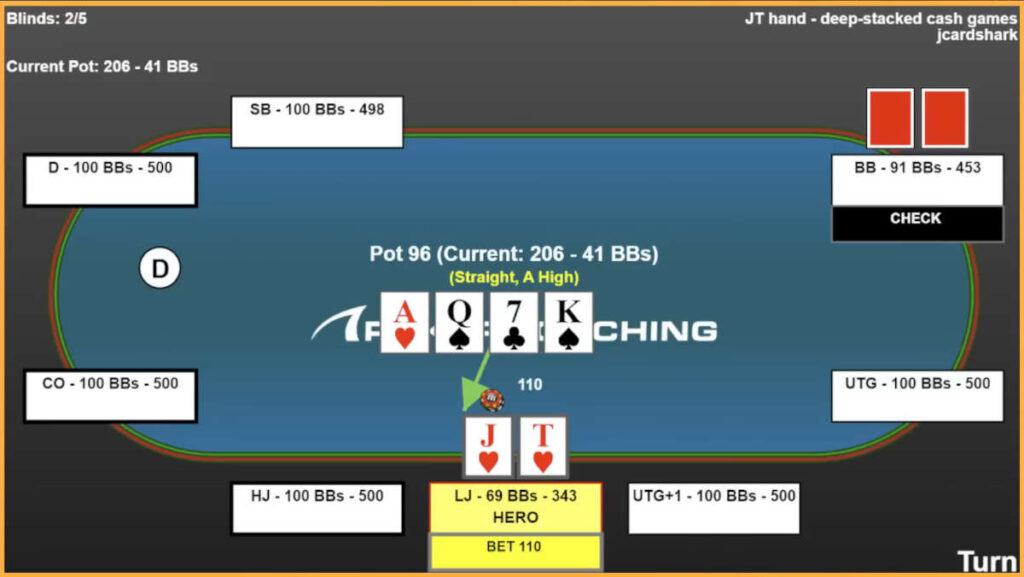
The opponent calls once again, and by this point, we can conclude that their range consists of many two pair combos as well as some pair plus flush draw combinations.
The river comes the 5♣, which means we still have the nuts. This is the spot where we’ll be jamming once they check, looking for max value. It’s important to realize that we can get away with a river jam, because strong hands in the opponent’s range will still call quite often, while the weaker ones that they arrived at this river with will likely fold to a smaller, two-thirds pot bet anyway.
If we were to use smaller, more standard sizes here, by the river, we’d be looking at the pot of around $120 and around $400 behind, making it much harder to play for stacks.
#3 – Use Massive C-Bets to Exploit Calling Stations
There are some players who always feel like you’re trying to get the best of them and will call you down super-light. This is especially true if you have an aggressive image yourself.
Against these players, you pretty much need to forget about the balance. Take your value hands and play them like the nuts to extract as much money as possible, and stop trying to bluff these types of opponents.
Use large sizes to make the pot as big as possible and make them pay by the river.
For example, you have 6♠6♣ playing 40 big blind deep, and you make a standard 2.2x open from the hijack. The big blind, who you know is a calling station, defends. Your plan is simple; if you flop a set, you’ll be going for max value. Otherwise, there is no point in putting too much money in the middle against a player who doesn’t like to fold.
This time, you get lucky, and the flop comes Q♠J♠6♦. With your set, you can bet around 4,000 into the pot of 6,000. On the turn of 2♦, you bet again, for 10,000. We don’t need to go too big with our bets, because we can easily get to a spot where we can naturally shove on the river.
The river comes 7♣, and we can now easily shove for the remaining 24 big blinds, fully expecting to get looked up by all top pair hands, and maybe even some weaker holdings.
So, to recap, use large c-bet sizes on dynamic boards when playing with deep stacks, and against players who hate folding. Of course, sometimes two or three of these things will come together in the same hand, and that will be the perfect time to pounce, putting your opponents in difficult spots and extracting maximum value.