Image courtesy of World Poker Tour
Playing straight and flush draws is one aspect of the game that many players struggle with. And, to be completely fair, these are some of the more difficult hands and situations to manage.
However, when played correctly, these draws can be quite profitable, even though you’ll miss fairly often.
Before we dig into three hacks to help you play these hands perfectly, it’s important to note that not all draws have the same value. Draws to the best possible straight, even when it’s a gutshot, are pretty good, and so is a nut flush draw. Drawing to a low flush, on the other hand, isn’t nearly as good.
You can significantly improve your results in these scenarios by observing three major rules, namely:
- Raise more often when facing a small bet.
- Raise more often when playing out of position.
- Don’t raise too often with high equity draws that would have to fold to a re-raise.
We will now look into each of these individual aspects, explaining them in more detail and offering some examples to bring the point home.
#1 Raise More Often Against Small Bets
Generally speaking, smaller bets indicate a merged range of sorts, consisting of medium-strength hands, such as a top pair with a weak kicker or a middle pair.
Against this range, you want to raise frequently, as you’ll be able to put a lot of pressure on your opponent.
Example
We are playing 40 big blinds effective. A player in the LJ position raises, and we call from the big blind. The flop comes 8♠4♥2♠, and we check to the aggressor.
The LJ continuation bets for just 1.5 big blinds.
In this spot, we should be raising about 22% of the time. This includes hands like J8 and better for value (fully ready to get our chips in the middle), as well as some additional lower eights with backdoor equity.
Then, there are gutshots like 76, 75, 65, many flush draws like K9s, K6s, JTs, as well as some pretty junky hands, such as As9x, JsTx, Js9x, etc.
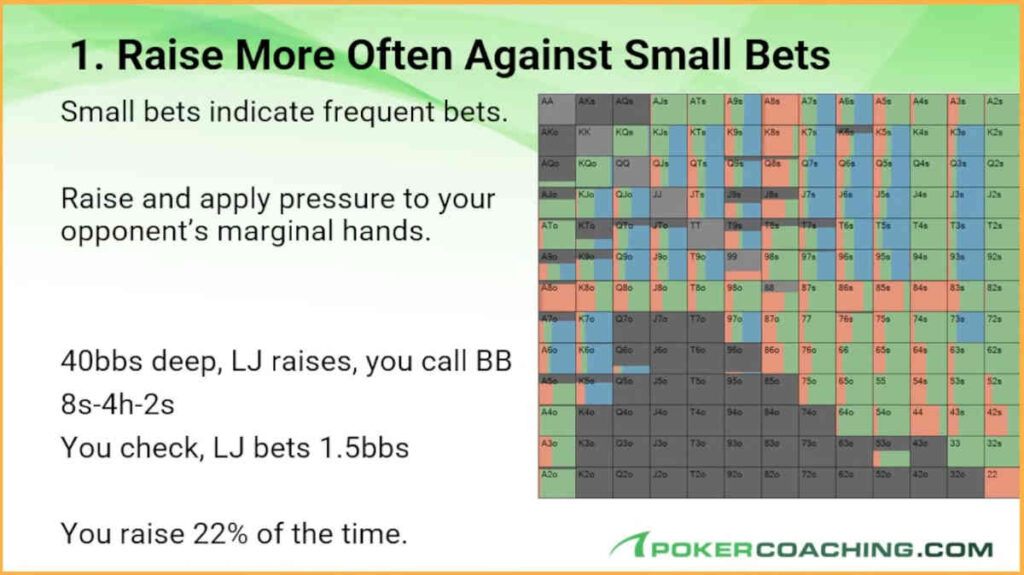
This is a pretty mixed strategy, which you can make a bit easier on yourself by choosing some hands that you’ll always raise with (like 76) and then calling with the rest, like 75 and 65. While this is not GTO-approved, it’s way easier to remember and implement, and will get you to the correct percentage.
It’s also worth noting that we are not just blindly raising with all of our flush draws here. Playing that way would make it too easy for the opponent, as they’d know that, if a spade hits on the turn, and you didn’t raise the flop, you never have a flush.
Our strategy changes significantly if our opponent chooses to go for a pot-sized continuation bet. This sizing indicates a much more polarized range, so we are only raising about 6%: our best top pairs (A8, maybe K8), and not nearly as many draws. In fact, some gutshots you should just fold facing this bet.
Against a large continuation bet, we are only raising with hands that we are happy to stack off with or hands that we can easily fold without giving up a lot of equity.
#2 Raise More Playing Out of Position
When you’re in position, it’s much easier to realize your equity. Out of position, things are much trickier. If you check-call the flop, for example, and the turn goes check-check, the situation is much more favorable for your opponent on the river.
If you check, they can check back or bet for value. If you bet, it’s much easier for them to call, knowing they’re closing the action.
Thus, in these spots, you have to rely on fold equity much more, which means raising more often.
Example
We are playing 40 big blinds deep. The lojack raises, we defend from the big blind, and the flop comes A♠7♥6♦. After we check, the LJ player c-bets for 1.5 big blinds.
Facing this small bet, we are supposed to raise about 18% of our entire range. This includes our best top pair hands and better, and a combination of solid draws and weak hands with backdoor potential.
Looking at the same scenario, but playing in position, i.e., facing a LJ raise on the button, we are raising far less often. Considering the fact that they’ll c-bet at a much lower frequency out of position to begin with, we are only raising around 8%.
There are very few draws that raise in this spot. Since we know the opponent’s range is pretty polarized, we don’t want to raise and kill our positional advantage by giving them an opportunity to shove.
#3 Do Not Raise Fold High Equity Draws
Finally, when you have a draw that has a fair bit of equity, you should be less inclined to raise. For example, if you have a hand that’s going to win 28% by the river, you don’t want to raise and open the door for your opponent to shove, forcing you to fold as you’re not getting good enough odds.
So, we are instead raising with very good draws that we’re happy to get it in with and some junky hands that we can easily release facing aggression.
Example
Once again, we have a 40bb scenario where the LJ player raises, we call from the big blind, and the flop comes 6♠3♠2♥. After we check, they continuation bet for 3.5 big blinds.
First off, their range in this spot is pretty polarized to begin with, as this is the type of flop they shouldn’t be betting at a high frequency.
On the other hand, the board smashes our defense range, so we can raise quite a bit. In addition to our strong hands, we have a number of combinations containing 75, 65, 65, 55, etc. These are made hands with potential to improve (pair + draw).

Outside of these hands, however, we are not raising with many naked fives or fours, unless we also have a flush draw to accompany them.
So, we are raising very high equity draws that we are happy to go with, plus some weak hands (such as As8x, As7x, Qs9x), as we can easily fold these holdings if the opponent comes over the top. All other solid draws, facing this polarized bet, are better off as calls. That way, we get to realize our equity instead of being forced out.