
Image courtesy of World Poker Tour
One question I often get from the players, especially those relatively new to the game, is: how can you know when it is a good time to bluff?
This is an important question because, if you want to be a big winner, you need to know how and when to bluff efficiently.
If you only wait for good hands to cooler your opponents, you’ll be a small winner at best, even at lower stakes. You’ll struggle to have a big win rate even against bad players if you never bluff.
So, in this article, I’ll give you a blueprint for bluffing that you can use to guide your decisions in different spots, and especially on the river. Before we dig in, here are a few key terms you’ll need to know:
- Auto-calls are hands that your opponents will always call with, without any thinking, i.e., hands that are never folding.
- Auto-folds are hands that will fold without much thinking, i.e., busted draws, maybe a bottom pair, and sometimes even stronger, depending on the situation.
- Blockers are relevant cards in your hand that prevent or lessen the likelihood of your opponent having a certain combo. For example, if you have the A♠ on a three-spade board, you know they can’t have the flush.
Bluffing Decision Flowchart
With these key terms out of the way, we can move on to the main part of this article, which is the bluffing decision flowchart. This chart is designed to guide you through the decision process and help you figure out if you should bluff in a certain spot and what sizing to use when the answer is yes.
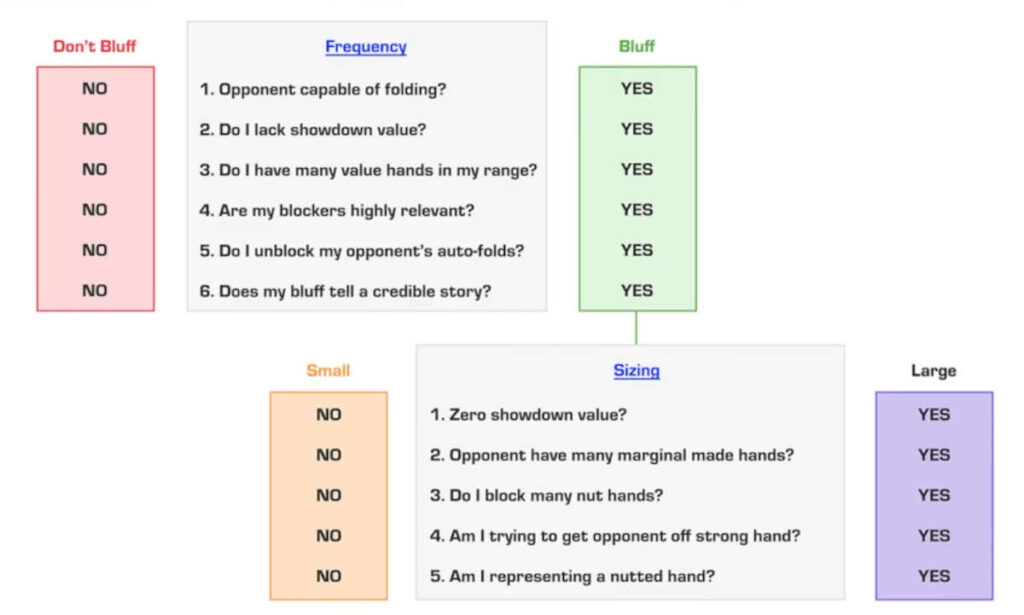
To Bluff or Not to Bluff?
The first chart will help you decide whether you should be bluffing in a particular spot by considering several key aspects:
- Is my opponent capable of folding? Will they fold a bottom pair or ace-high? If the answer is no, you probably shouldn’t be bluffing.
- Do you lack showdown value? If you check the river, can you win? If you can win by showing down your hand (i.e., a bottom pair or even an ace-high), you should be less inclined to bluff.
- Do you have many value hands in your range that you’d logically play in this way? If your line makes sense, your bluff will have a higher chance of success.
- Are my blockers highly relevant? Are you holding any cards that prevent your opponent from holding the nuts? If you do, you can bluff more frequently.
- Do you unblock your opponent’s auto-folds? Are you holding some of the cards that your opponent would auto-fold to a bet?
- Does my bluff tell a credible story?
All these factors are important, but the first one is certainly crucial. If you know your opponent hates folding, you should be way less inclined to try to bluff them. After that, go through the list in your head, and if you answer “yes” to most questions, it is probably a good bluffing spot.
Sizing Your Bluffs
Once you decide that a spot is right for bluffing, the next thing you need to figure out is how big you should bet.
In the GTO world, most hands use mixed frequencies to keep things balanced. For purposes of this article, I’ve tried to simplify things a bit. Once you internalize core concepts, you can move on to more complex strategies.
When deciding on your bet size, you can use a similar process, answering a few basic questions:
- Do you have no showdown value at all? If your hand has no showdown value whatsoever, you should be inclined to bet bigger and discourage your opponent from making a hero call with a hand like ace or king-high.
- Does the opponent have a lot of made marginal hands you are trying to fold, like middle pairs? When this is the case, you want to bet bigger and make it harder for them to call. When you believe they have a very strong hand or nothing, you should utilize smaller sizing.
- Are you blocking many nut hands? If you are blocking the nuts, you should bet bigger, as you can represent the nuts yourself.
- Are you trying to get the opponent off a strong hand, like top pair or two pair? You need to bet big.
- Finally, are you representing a nutted hand yourself? If that’s the case, go big.
A Hand Example
Let’s now look at a hand example and try to apply this logic to decide whether bluffing makes sense and how to figure out the correct sizing.
You’re on the button before the flop and make it 3bb with 7♣5♣. The big blind, who you know is a weak-tight player, makes the call, and you go to the flop of 10♦9♦4♥.
They check, you c-bet for one-third of the pot, and they call. The turn is the 9♠, and the action checks through.
The river comes the 6♣, and the big blind checks once more. Let’s apply the logic we explained earlier to decide if a bluff is warranted here.
- First of all, we know this is a weak-tight player, so they are capable of folding, which means they tick the most important box.
- We definitely lack showdown value with 7-high.
- We don’t really have many strong hands in our range.
- Opponent’s auto-folds on this board are hands like KJ, KQ, QJ, J8, maybe Q8, and missed diamonds. We don’t have any of those cards, which means we don’t hold any of the hands that our opponent will fold. We should bluff much less often with a hand like K♦Q♦.
- Finally, our bluff tells somewhat of a credible story, although this depends a lot on how the opponent perceives us.
So, we have enough reasons to bluff here, as we are against an opponent capable of folding, lacking showdown value, and not blocking any of their auto-folds.
But what sizing should we use?
Again, we have no showdown value, and the opponent will have some marginal made hands. However, we also don’t block any nutted hands, and we’re not really trying to represent the nuts ourselves. Our line signals a hand like a ten or a pair of eights in the hole.
When we put all these factors together, this seems like a good spot to use a small sizing. You should never bet under 50% of the pot on the river, so that’s the perfect size in this scenario. While they’ll sometimes call against this sizing, more often than not, you’ll pick up the pot.