Image courtesy of the World Poker Tour
As stacks get deeper and deeper, you should change and adjust your strategy. There are three main, high-level reasons for this.
First of all, the position becomes increasingly important. With deeper stacks, equity realization shifts significantly more toward the in-position player. In the simplest of terms, the player in position gets much more control over when they want or do not want to play a big pot.
Secondly, when playing deep, the nut advantage will have a bigger influence on your overall strategy. If you make the nuts, you can play for a lot of money. Simultaneously, the ability to make the nuts on different turns and rivers goes up in value.
Finally, your stack-off threshold, which is the amount of equity you need to get all-in, gets higher as well. This is another reason why you want to play more hands that have the potential to make the nuts, and why many off-suit hands, like KJ, for example, go down in value.
In this article, we’ll address several important strategic adjustments that are all driven by these three considerations, allowing you to create an efficient and profitable game plan for deep-stacked play.
Understanding Changes to Your Stack-Off Threshold
The stack-off threshold is a point where your hand is strong enough that you’re happy to get all the money in the middle.
If you start with 200 big blinds and the flop comes pretty much anything, there won’t be many situations where you’ll be happy to get all-in unless you have the nuts or maybe the second nuts.
This is much different than playing, say 20 big blinds, where you’ll be more than happy to risk your stack with a top pair and a solid kicker, like with K♥9♥ on a K♣7♦2♦ flop.
Given the same scenario and playing 200 big blinds deep, K♥9♥ is a marginal hand that we want to proceed very cautiously with, and we are most certainly not looking to stack off with it.
With all this in mind, there are several main adjustments that take place at deeper stacks:
- Your c-bet and check-raise frequency goes way down on boards where you lack a nut advantage.
- In situations where the board is likely to change significantly on future streets, controlling the size of the pot with c-bet shifts and more passive strategies becomes essential.
- The “cost” or risk of re-opening the action on the river becomes much higher when you are in position, especially if the opponent can have the nuts and put in a very large raise.
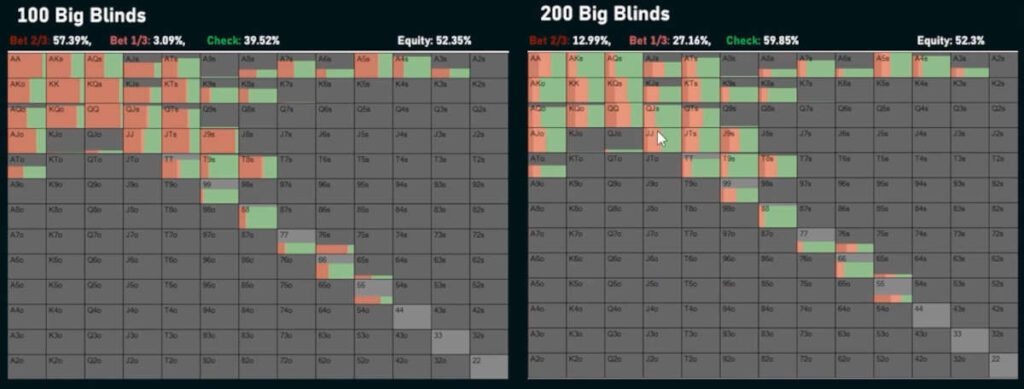
Let’s look at an example. The button opens, the big blind defends, and the flop comes 10♦8♣6♥. The two graphs below show how our GTO strategies differ when playing 100 vs. 200 big blinds deep, after the big blind checks on the flop.
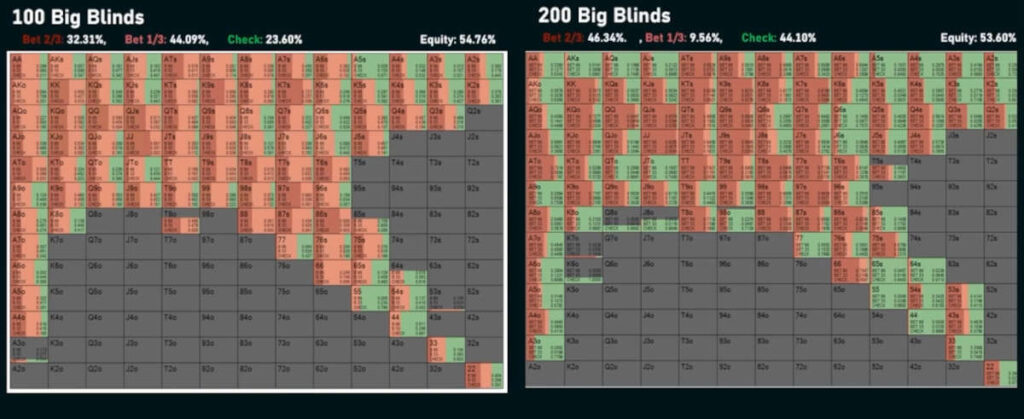
One particularly important thing to notice is that we’re checking back far more often when playing 200 big blinds deep in this spot.
Many of our medium-strength hands are betting on this board when 100 big blinds deep, but checking when playing 200 big blinds. For example, hands like !6 and J6 are checking back almost 100% of the time, 200 big blinds deep, while betting about half the time at 100 big blinds.
Even hands like pocket aces aren’t betting as often when deep-stacked. Pocket aces are likely good, so they don’t need protection, but if you get raised, you’re not loving it.
So, the main takeaway is that, in situations like this, you end up betting far less often.
The ‘Cost’ of Reopening River Action
When you reach the river in position, and it’s checked to you, you can always check back and realize 100% of your equity. If, however, you decide to bet, the ‘cost’ of that action is that you’re reopening the action, creating a situation where you’ll sometimes get check-raised and forced to fold and relinquish your equity.
As stacks get deeper, this cost gets higher and higher, as the OOP player gets to raise huge and make you fold more often. So, for this reason, you want your hand to have more equity on the river to profitably value bet on the river.
In the same vein, you’ll want to look out for players who value bet too thinly on the river and look for opportunities to check-raise.
Let’s look at an example.
Playing 250 big blinds deep, we make a standard 3x open from the hijack holding K♥Q♥ and only the big blind calls. The flop comes K♠J♠7♥. After they check, we continuation bet for just over half the pot and get called.
We get to the turn of 5♦. After they check, we will want to continue betting on this pretty dynamic board, and we can bet big – a full pot. If we get raised, that’s not good news, but in this case, the big blind just calls.
The river is the 8♦ and the big blind player checks once again.
In this spot, if we were shallower, we would be reasonably happy to bet again and go for value. However, as deep as we are, if we bet, the opponent can go for a massive raise and put us in a really difficult situation.
For this reason, you absolutely cannot value bet on this river when playing 250 big blinds deep unless you know your opponent is just a calling station, not capable of making big river moves. Against good players, though, you just have to check it back.
Pushing Equity With Deep Stacks
Often, I hear players say: “I didn’t think my hand was worth three streets of value, so I checked the turn.” This may get you by in some scenarios, but it’s not a sound strategy.
Instead, you should utilize the bet/bet/check line, in particular in the spots where:
- You want to clean up equity – make your opponents fold hands with a reasonable amount of equity.
- You won’t get raised often, as you have a lot of nuts in your range.
- You are looking to prevent opponents from realizing their EV by betting on the river when the turn checks through.
Let’s again look at an example. The button raises, the big blind calls, and the flop comes J♠7♠6♥. The big blind check-calls a four big blind continuation bet, and we get to the turn of 5♦.
When the big blind checks, the button should be betting with a lot of poker hands that can improve to the nuts, such as flush draws and hands containing a nine or an eight.
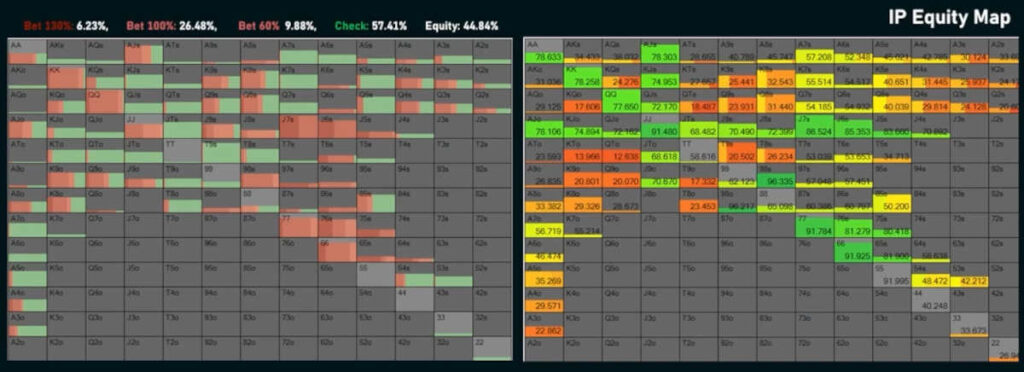
As you can see, hands like J9 and J8 are betting a ton here. On the other hand, holdings like KJ and QJ, which are better hands at the moment, are not betting because these hands will never improve to a straight on the river.
The same goes for hands like K8 and Q8, where hands like QT are not betting. Also, hands containing a six are betting almost every time. The opponent’s range contains a lot of random over-cards that are just going to fold, and we’re pretty much never getting raised, as we can have sets and straights.
Facing a bet on this turn, the opponent should be folding a lot: many hands containing a six, a great number of high-card hands, etc. So, by betting on this turn, we are folding many hands with quite a bit of equity.
If we bet the turn and the opponent calls, and the river comes 10♥, many hands that were pushing on the turn are now checking back (random sixes, J9, J8).
Increased Value of Position
As stacks get deeper, position gets more valuable. In position, you get to decide if you wish to put in one more bet, and, when you’re deep-stacked, these bets can be gigantic.
So, how does this influence your overall strategy?
From out of position, there are almost no boards where you should bet every single time, because the opponent can raise your flop bet, bet the turn, and blast the river. So, you have to check a lot of the time.
Also, you’ll want to size up your big bets both in and out of position. When playing deeper stacked, you’ll be using overbets on both turns and rivers. This means betting like 120% or 150% of the pot on the turn.
If you want to use a more complex strategy, you can add a third flop bet size, i.e. 33%, 66%, and 100% of the pot. You’ll particularly want to use the big sizing when in position and on boards where you have a large nut advantage.
Playing 3-Bet Pots With Deep Stacks
As we’ve just discussed, with deeper stacks, being the one who gets to put in the last bet (using a large sizing) is extremely valuable.
Similar concepts apply to 3-bet pots, but any leaks in these spots cost you even more, as pots start to get even bigger. This means that we should be checking far more often.
When playing with shallower stacks, it’s quite common to 3-bet from the small blind and then continue betting on the flop at a high frequency. When you are 100 big blind deeps, it can’t be that bad.
However, at 200+ big blinds, it can often be a serious blunder.
When it comes to developing turn strategies, equity realization is key. In shallow scenarios, you’re often using your low-equity hands as bluffs when playing 100 big blinds, in spots where you’re likely to get jammed on.
When you don’t expect to get jammed on, i.e., when you’re playing something like 300 big blinds deep, your bluffs should have a lot of equity. You don’t want to be bet-folding in these spots, but you won’t have to, as your opponent will not be shoving in deep situations.
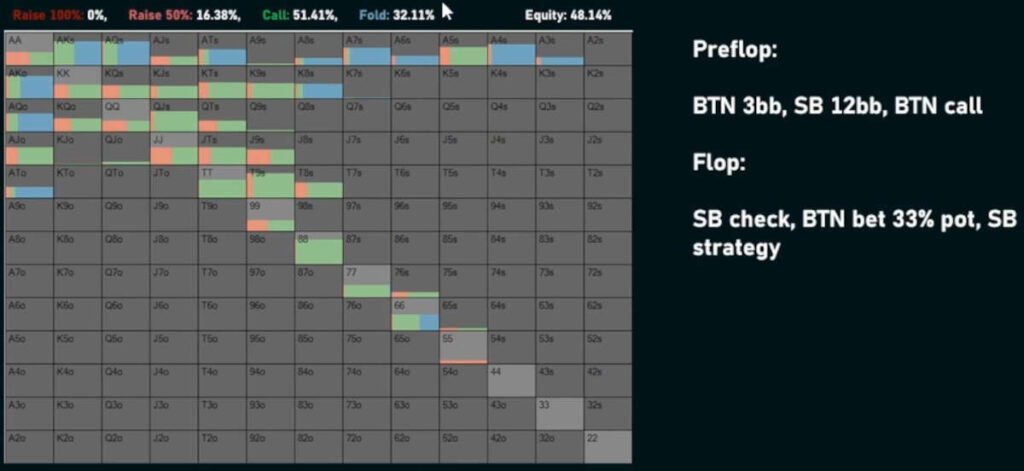
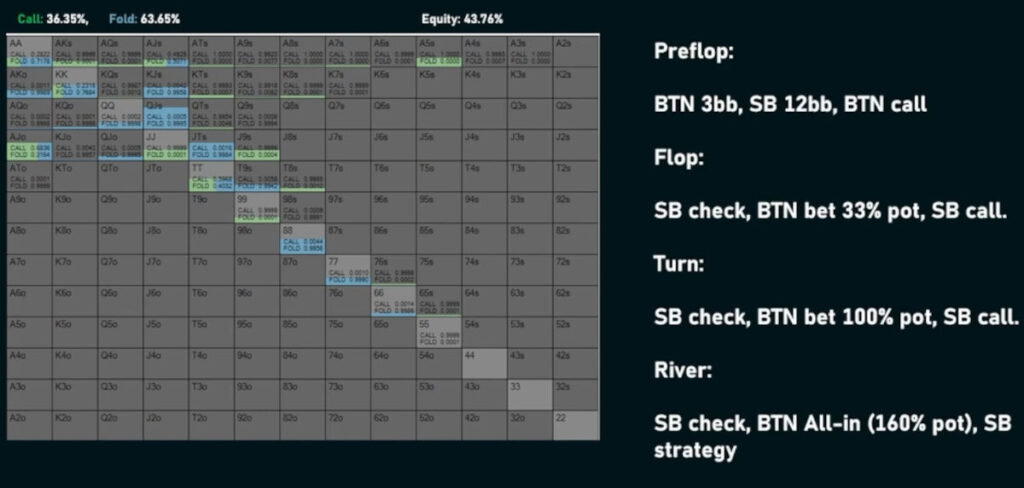
Here’s an example of this. The small blind 3-bets against the button’s open, the button calls, and the flop comes J♦9♦5♥.
The picture below shows how our strategy from the small blind differs when playing 100 big blinds deep vs. 200 big blinds.
In 100 big blind scenarios, we are betting around 60% of the time. However, at the stack depth of 200 big blinds, we are only betting around 40% and checking 60% of the time.
Essentially, since we are not in a position where we can easily get all of our money in on the flop, we need to protect our checking range.
After we check and the button bets 33% of the pot, we are calling just over half of the time and raising around 16%. Hands that we are raising with are overpairs and sets, as well as some flush and straight draws.
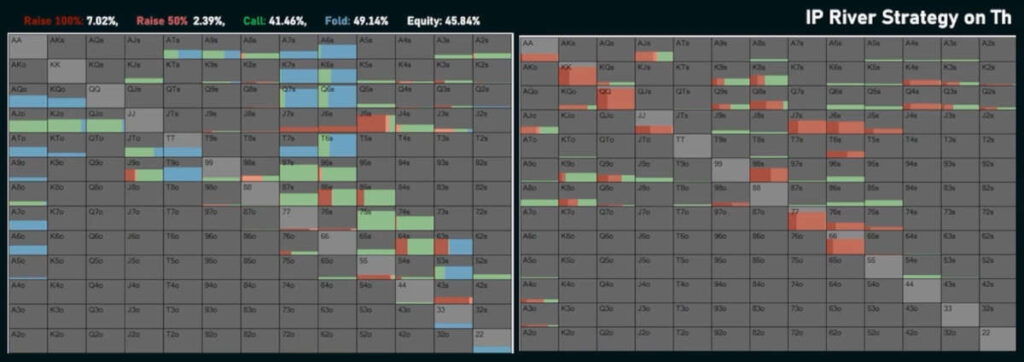
The picture below shows the equity for the out-of-position player across all the different turn cards (after calling the flop bet) vs. their expected value (EV), i.e., how much of their equity they are actually going to realize.
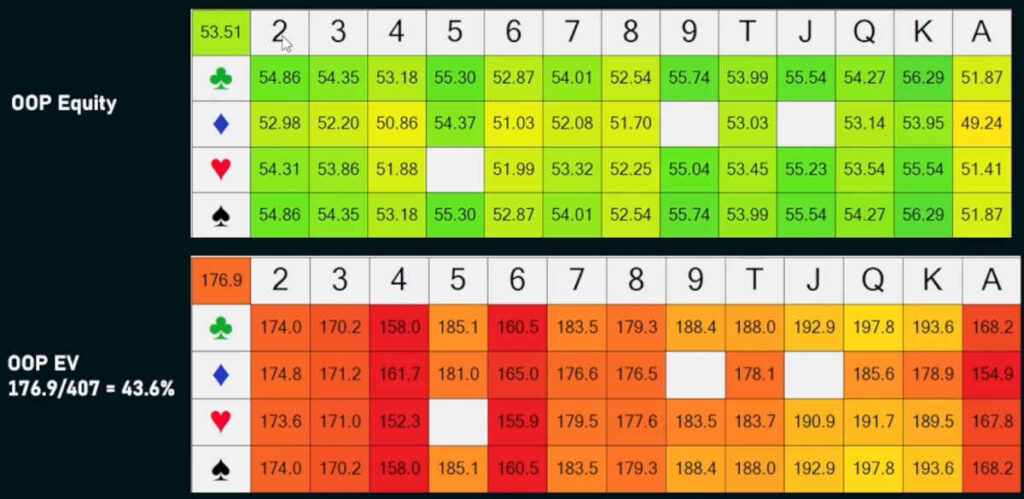
You’ll notice that the difference between actual equity (53%) and the EV (43%) is around 10%, showing you just how valuable the position is in this spot, even if our range is pretty strong and decently well protected.
To continue with our example, let’s say the small blind calls the flop bet, and the turn comes 4♦ (J♦9♦5♥4♦). After the small blind checks, the button bets 100% of the pot, as this is where they’ll start applying a lot of pressure.
This is the reason why we’re under-realizing our equity from out of position. At this point, we are folding our nines, gutshots are getting out of the way, tens and other pairs with no diamond have to fold.
If we call, we’ll get to the river with pretty good equity, but, once again, our EV will be significantly smaller:
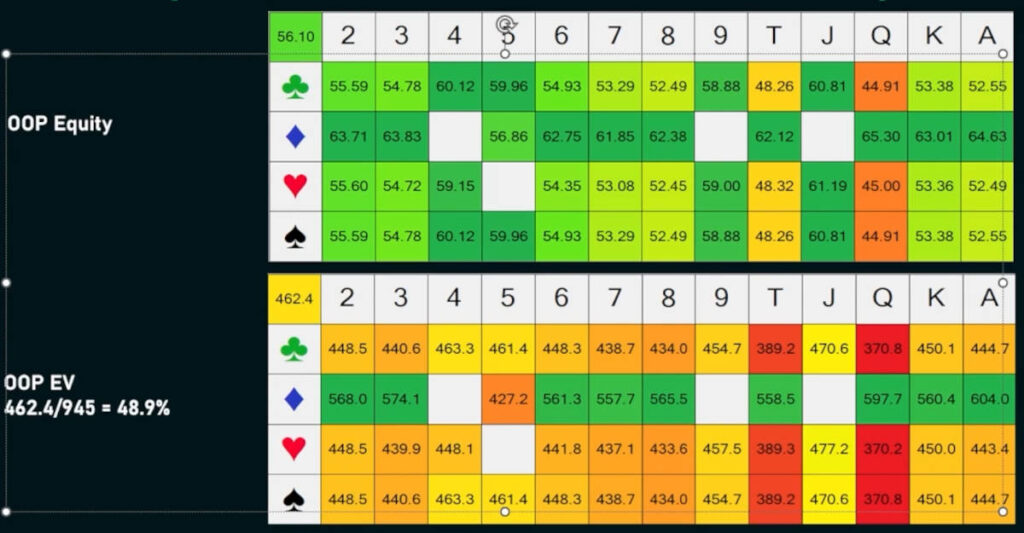
On a river like 2♣, which doesn’t really change that much, the small blind checks and the button moves all in. We have to fold a bunch of stuff, including many overpairs and top pairs. That’s not great, but it’s what you have to do in these scenarios.
Many players don’t find these adjustments when playing with deep stacks, and it ends up costing them a lot of money over the long run. If you want to be a crusher, you need to understand and implement these strategies in your own game, and also exploit those opponents who fail to adjust properly.