
Image courtesy of PokerGO Tour
As a tournament player, you’ll find yourself in many situations where you need to be aware of some crucial concepts so that you don’t torch money on the bubble.
Just for those who might be new to poker, the bubble is when you are one person or a small number of players away from the money in a tournament, where you can reasonably hand out and get in the money.
Sometimes, this is the correct strategy, and sometimes you should be doing things other than holding on to your stack.
However, one very important point right at the start is that you should avoid going broke at all costs. There is nothing glamorous about busting just before the money – free equity is nice, and there is no reason to turn it down.
Don’t Go Broke on the Bubble
As you approach getting into money or when there is a pay jump coming up, you should avoid taking substantial risks that can result in you busting the tournament.
If a pay jump is from $150 to something like $155 or $160, you shouldn’t really worry about it. However, if you’re going from $150 to $250, it’s a different situation.
You need to be aware of the payout structure and factor it into your decisions.
You really want to avoid going broke when you have a comfortable stack and can get into money or pick up a payout jump or two with almost no risk.
At the same time, in your usual No Limit Hold’em tournament (i.e., a typical freezeout and not a mystery bounty or something along those lines), you shouldn’t be too tight to the point where you blind out.
I’ve seen players make some crazy folds over the years, just because they didn’t want to bust before making the money. While cashing is nice, it’s not some great success. Sometimes, you simply need to get in the battle and make sure you maintain a healthy stack that will put you in a good spot to possibly win the whole thing.
Your strategy will greatly depend on the payout structure. In flatter structures, you should tighten up more. In tournaments that are top-heavy, you should be willing to take more risks, as the bulk of the money is reserved for the top few spots.
For a simple example of how ICM works in final table spots, check out the Final Table Adjustments article.
Remaining Stacks Matter
All the stacks remaining in the tournament matter, which is why it’s not easy to give simple starting hand charts for bubble play.
For example, let’s say the average stack on the bubble is 25 big blinds, and you have only five big blinds. This is perfectly fine if there are 300 players remaining and 299 make the money. If you just sit around and fold, someone, at some table, will eventually go broke, and you can easily sneak into the money.
It’s also fine if you have five big blinds and there are five other players with just one or two big blinds. You can sit tight and collect your free cash.
However, if there are nine players remaining with 20 big blinds and you are the short stack, it’s unlikely that anyone will go broke before you. In this spot, you’ll usually need to take a calculated risk to try and double up. Sometimes this will work, and sometimes you’ll bust, but at least you’ll give yourself a real chance.
Understanding Risk Premium
When you face a bet for all or most of your chips when there are payout implications, you need more than the normal required amount of equity based on the pot odds to call, and sometimes you need a lot more.
When you call and lose, you are out or nearly out, and when you win, you don’t double your equity.
Thus, you want to play cautiously when you are at risk in somewhat marginal spots, and in Texas Hold’em, many spots are fairly marginal.
You can also flip this script. When you are a bigger stack, you can put your opponents at risk, which means they’ll often have to play overly cautiously against you.
Your total equity in situations with payout implications is the normal chip EV needed + an additional amount of risk premium.
Risk Premium Matrix
It’s often impossible to say exactly what your risk premium is in any given spot because of all the different reasons we’ve mentioned, but these are some rough guidelines, especially for when you are at a final table and facing an all-in or an almost all-in bet.
| Big Stack | Medium Stack | Small Stack | |
| Big Stack | 18% – 35% | 6% – 8% | 2% – 4% |
| Medium Stack | 13% – 20% | 10% – 20% | 5% – 7% |
| Short Stack | 9% – 15% | 8% – 10% | 7% – 10% |
Let’s look at an example to explain these numbers a bit.
On the bubble, with no obvious tiny stacks, everyone folds to the big stack with 40bb in the small blind. You have 10bb in the big blind. Which hands should your opponent go all-in with, and which hands should you call with?
The big stack can and should shove with their entire range, because you have a huge amount of risk premium and need an additional 9% to 15% equity to call.
However, in many scenarios, you might need substantially more equity. This depends on the number of players remaining to the bubble, the number of short stacks, whether other short stacks are overly active and likely to bust, etc.
If, on the other hand, you’re the only short stack, you may only need 9% or less, because you’re likely to go broke next.
For the purposes of breaking things further down, let’s assume you need 12%, which is somewhere in the middle.
If you’re calling nine big blinds to win 21, you need to realize 42.8% without payout implications. If we add the payout implications (another 12%), you now need 54.8%. But, since you want to profit (not just break even), you need a little bit more, so let’s say 56%.
If your opponent is shoving any two cards, which hands have 56% equity? To know this, you do need to study quite a bit – unfortunately, poker is hard. But on the chart below, you can see the hands that have that 56% equity, such as pocket pairs 44+, all suited aces, A4o+, K6s+, K8o+, etc.
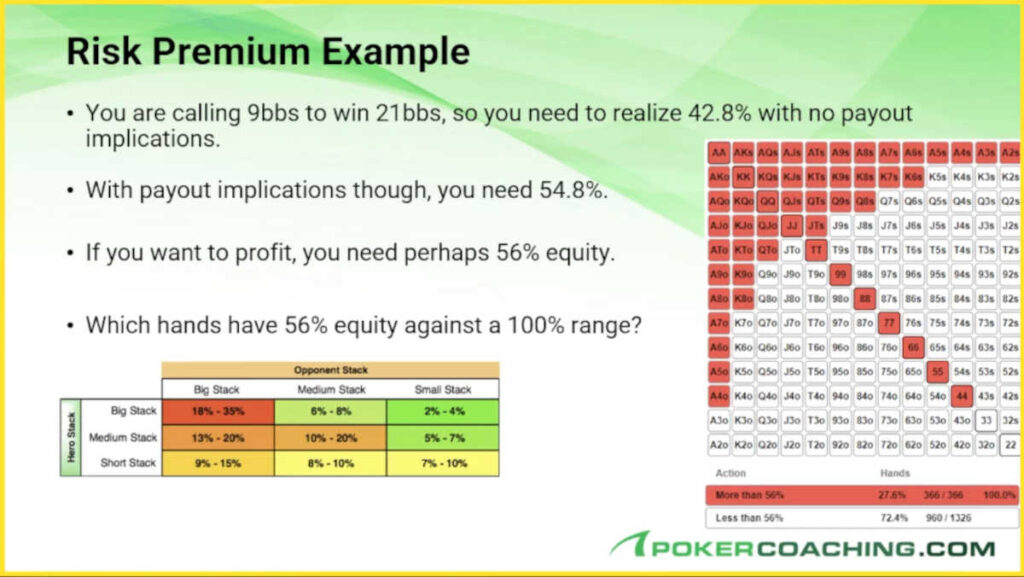
It is a pretty tight range, and if there are shorter stacks and you are likely to make money, you need to be even tighter. This may seem counterintuitive against an opponent who is shoving with their entire range, but that’s how math breaks down.
Not Everyone Is Aware of ICM
Not all players in a tournament care about payouts. Some players haven’t studied ICM well; others play only for the win. And some others care way too much about getting into money.
Your opponents’ strategy will really matter. If they don’t particularly care about ICM and are too loose, you’ll need to tighten up. If they are playing way too tight and want to make money at all costs, you should loosen up – and sometimes, you’ll be able to take this to an extreme.
In general, a larger stack can apply pressure to everyone and should be raising a lot first in, 3-betting medium stacks, calling a lot in position, and leading the flop when the board is good for their range.
As a medium stack, you can apply pressure to other medium and short stacks, but avoid big stacks, and tighten up if they are on your left. If a big stack is not taking advantage of their position, this can give you an opportunity to start acting as a big stack yourself and open up your play.
Short stacks should apply pressure to other short stacks, but, beyond that, try to stay out of trouble and secure the cash.
You need to use some logic to figure out these scenarios. Even with stacks relatively equal, you might want to play aggressively against one player and tighten up against another. It’s important to zone in and understand what your opponents are doing and tailor your strategy accordingly.