
The rail did not disappear when poker moved online. It changed shape. Instead of standing behind a chair, players now gather around posts, streams, Telegram alerts, and private channels that tell them what is worth watching next. The table still matters most, but the conversation around the table has become direct, more mobile, and easier to miss if you only look at public feeds.
That shift fits a pattern in digital behavior. A Frontiers in Psychology study on social media marketing and engagement behavior found that social media activity can influence both engagement intention and engagement behavior, which helps explain why poker brands care about smaller signals than a public like. A channel join, a comment, a saved post, or a return visit can show deeper sustained attention than scrolling.
Where Updates Meet the Actual Game

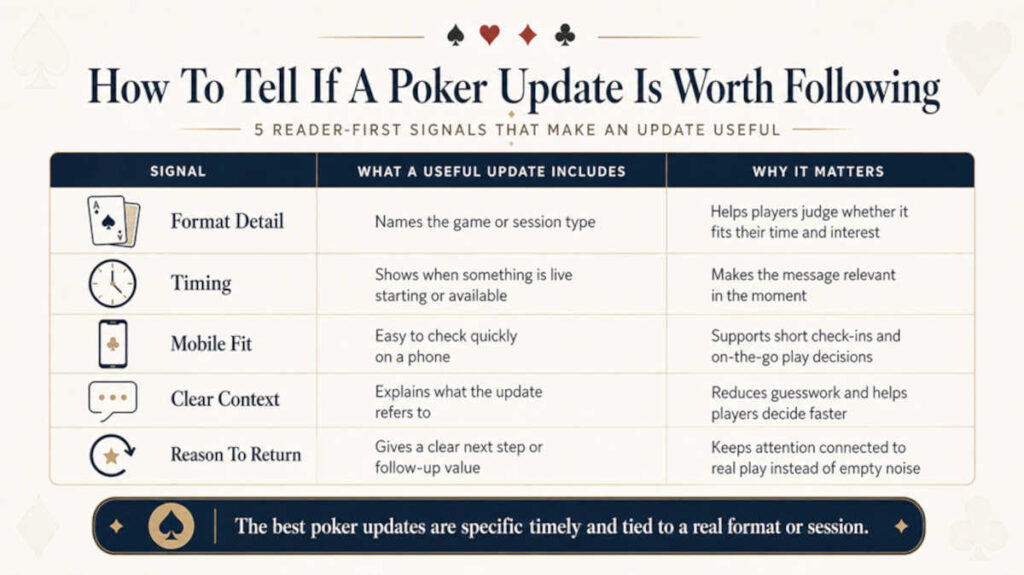
A private channel only becomes useful when it points back to a real poker context. Updates make more sense when players know what kind of action, format, or session rhythm they are following. In that sense, mobile access gives Telegram-style communication a clearer job: it connects the message to the next playable moment.
In particular, this page on mobile poker in Australia is a relevant example because it describes poker access through smartphones and tablets, with mobile cash games, jackpot sit-and-gos, tournaments, video poker, and Zone Poker presented as available formats.
That matters because an Aussie player reading a short update is not only reacting to a post. They may be thinking about whether they have time for a quick format, whether a tournament window fits their evening, or whether Zone Poker matches their attention span.
Mobile poker becomes part of that routine: see the signal, understand the format, then decide whether the moment fits. This post shows that public-to-private movement in a simple way. It does not need to promise every follower a specific outcome. Its value is in showing how iGaming brands keep poker-adjacent updates closer to people who already want them.
The New Rail Has a Different Rhythm
Poker communication used to gather around visible moments: a big pot, a final table, a known player entering the room, a stream going live. Private channels make the same instinct quieter but faster. A good Telegram update can act like a tap on the shoulder. Something is happening. A format is active. A post is worth checking.
The strongest channels avoid turning every message into noise. They work because the audience already understands the subject and wants fewer steps between interest and context. That is why the language around private poker spaces should stay precise.
Telegram is not the table. Instagram is not the room. These spaces sit around the play experience, carrying signals that help followers decide where to look, when to return, and what poker moment is being discussed.
Why Private Does Not Mean Hidden
Private channels can sound secretive, but their practical role is simpler. They create a smaller room for people who have already shown interest. That makes them useful for poker because the game has many moments that matter only to the people already paying attention.
A reminder about a poker stream may mean little to a casual scroller, but it can matter to someone who follows a player, format, or event. A content drop can pass by unnoticed in a public feed, while a direct channel gives it a clearer path to people who are likely to care.
This is why poker’s new rail feels different from ordinary social media. It is not only about broadcasting. It is about continuity. Public posts introduce the moment. Private channels carry the follow-up. Mobile access gives the update somewhere to land. Together, they form a loop that fits how many players move between watching, reading, checking, and playing on the same device.
The Rail Is Now in the Player’s Pocket
Poker has always had a social edge. Even the most technical player still watches table flow, personalities, timing, and atmosphere. Online, those cues are spread across more surfaces, so the rail becomes a network of signals, rather than a physical crowd.
That is why Telegram and other private channels feel natural in modern poker. They shorten the distance between interest and update without asking every message to carry the whole story.
The player can see a public post, follow a channel, read the next note, then connect it back to the formats or events they understand. Research on customer engagement in social media marketing describes engagement as cognitive, emotional, and behavioral, and poker’s new rail works because it touches all three: attention, interest, and the small action of coming back.
The Overlooked Value Is Permission
The overlooked value of a private channel is permission. Public feeds are built for discovery, while direct spaces are built for people who are already engaged. That changes the tone of poker updates. A useful channel does not need constant volume; it needs clear timing, recognizable context, and enough restraint to make each message feel worth opening.
For players, that can make the wider poker ecosystem easier to follow. They can separate casual browsing from the updates they actually asked to receive, which makes the rail feel less scattered and more intentional.