The week he decided to become an ACRPoker pro, Alex Foxen didn’t have anything to wear.
He was in Montenegro for the Triton Invitational, one of the toughest tournaments on the planet, and the partnership had just come together. No patch, no branded shirt, nothing with the logo on it.
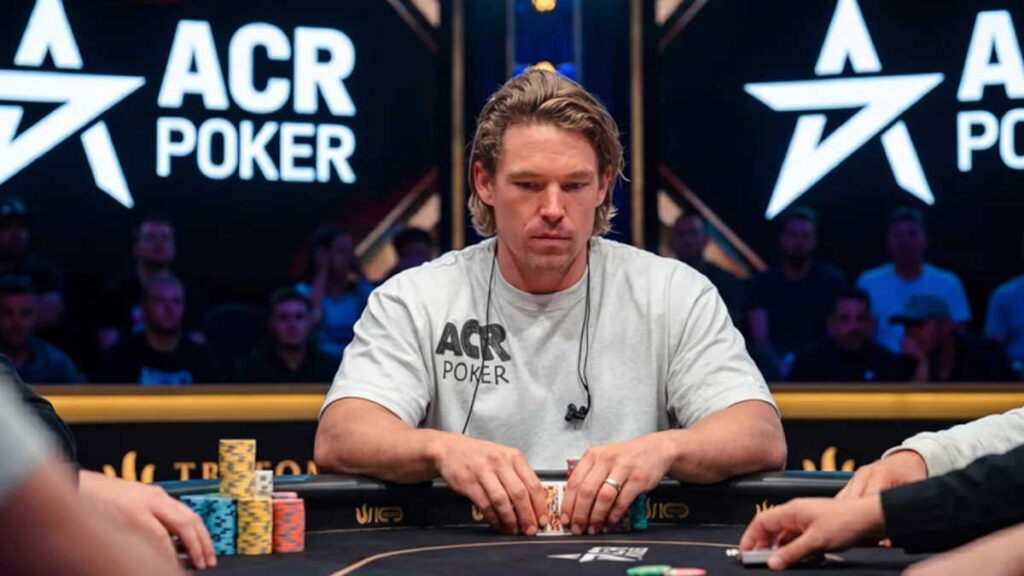
So he did what he has done his whole career when the situation called for it. He improvised. With his wife Kristen, he drew the ACRPoker logo by hand, made a shirt out of it, and then walked into the Invitational wearing it.
Phil Nagy posted the photo. “Seeing that picture of Foxen with ACR on his shirt really hits home,” the ACRPoker CEO wrote. “That’s who we are. We get things done, even if we’re not always the prettiest or the most polished. We’ve been here for 25 years, and we’re going to be here for another 20.”
There is something fitting about that being the first image of the deal. Foxen spent more than a decade as one of the best tournament players alive without ever signing with an operator. When he finally did, he announced it in a shirt he made himself.
From the Gridiron
Before the felt, there was football. Foxen played tight end at Boston College in the ACC, then graduated from the business school in 2014 and went straight into poker with little detour.
He says he always knew where he was headed.
I kind of always knew that poker was it for me,” he says. I felt that I had the ability and the willingness to work, and that once I set my mind to something, it would work out.
Plenty of former athletes have made the same jump, and Foxen has a clear theory about why. The work ethic carries over. The persistence carries over. What changes is the shape it takes.
In football, you work harder, push more, and out-grit your opponent. In poker, you have to know when to surrender, and be more like water than rock.
That last line is worth sitting with, because it is the opposite of how most people picture a competitor built by contact sports. The instinct football reward is to lower your shoulder and drive through.
Poker punishes that instinct constantly. Foxen figured out early that the grit was still required, but that at a poker table, it looks like flexibility rather than force.
The Cost of Being the Best, Twice
Foxen is a two-time Global Poker Index Player of the Year, back to back, a run almost no one in the game has matched. Awards like that are built on a brutal amount of volume, the kind that eats calendars and wears players down.
Ask him what it costs, and he mostly shrugs at the premise.
It definitely takes up a lot of my life. But there are very few things I would rather be doing than playing a poker tournament. From that standpoint, it never feels like real work to me. Any great accomplishment requires sacrifice.
He does treat the body like it matters, though, because he thinks it does. His game-day routine reads like an athlete’s. He wakes up, gets some sun, meditates, gets a workout in, and puts on music for the ride to the venue.
I believe my body and mind are interconnected, and improving one improves the other. Endurance is a major part of poker.
Playing the Person You Love
Foxen and Kristen are, by most measures, the most successful couple poker has ever produced. Kristen is a multiple bracelet winner in her own right, and the two of them have combined for a stack of titles and tens of millions in earnings.
Which raises an obvious and slightly uncomfortable question: what happens when the two best players you know are married, and the tournament puts you at the same table?
According to Foxen, not much.
We just play the hands as they come, he explains. We’re both professionals and we understand the nature of the game, so we try not to put any extra weight on the hands we play against each other.
They have even met heads-up with a trophy on the line. He refuses to treat it as some loaded rivalry moment.
The last time we played heads-up was just a fun celebration. We’re both always rooting for each other.
Why ACRPoker, and Why Now
For a player who could have signed almost anywhere at almost any point, the interesting question is not that he signed, but that he waited this long. His answer comes down to one word.
ACRPoker is authentic. The team is truly interested in what’s best for online poker and the players. That’s why I feel so aligned with the ethos there, and happy to represent the company.
It helped that Nagy was already a friend, and that the timing finally lined up. It also helped that he wasn’t walking in alone. Foxen joined the roster alongside Chance Kornuth and Chris Hunichen, two players he already knew well.
He has worked with Kornuth through Chip Leader Coaching for years.
It’s awesome to have good friends and partners be part of the team, he says. We’re all excited about co-representing this site together.
The Solver Heretic
Here is where Foxen gets interesting for anyone grinding to improve. Ask him for a piece of conventional poker wisdom he thinks is wrong, and he goes straight at the thing most of the modern game is built on.
Basically everything that comes out of solvers.
He is not dismissing the study. He is dismissing the way players treat solver output as scripture, memorizing outputs and applying them like law, regardless of who is in the pot or what is happening at the table.
Decisions are situational, and the right decision is an ever-moving target. Rigidity is the enemy of performance.
It is the same idea as the water line from earlier, pointed at strategy instead of temperament. The player who insists on being rock gets exploited. The player who adapts, who reads the specific spot in front of him rather than the memorized average, is the one who keeps winning.
Coming from a two-time Player of the Year, it is a useful reminder that the highest level of the game is still played by feel as much as by chart.
Five Years Out
For all the intensity, Foxen’s vision of the future is refreshingly plain. No empire, no reinvention. Just more of what already works, and a bigger family around it.
I just want to keep doing what I’m doing. I’m looking forward to having kids and growing my family, and I want to keep giving my best at the tables.
The kid who used to lower his shoulder on a football field turned out to be at his best when he learned to bend!