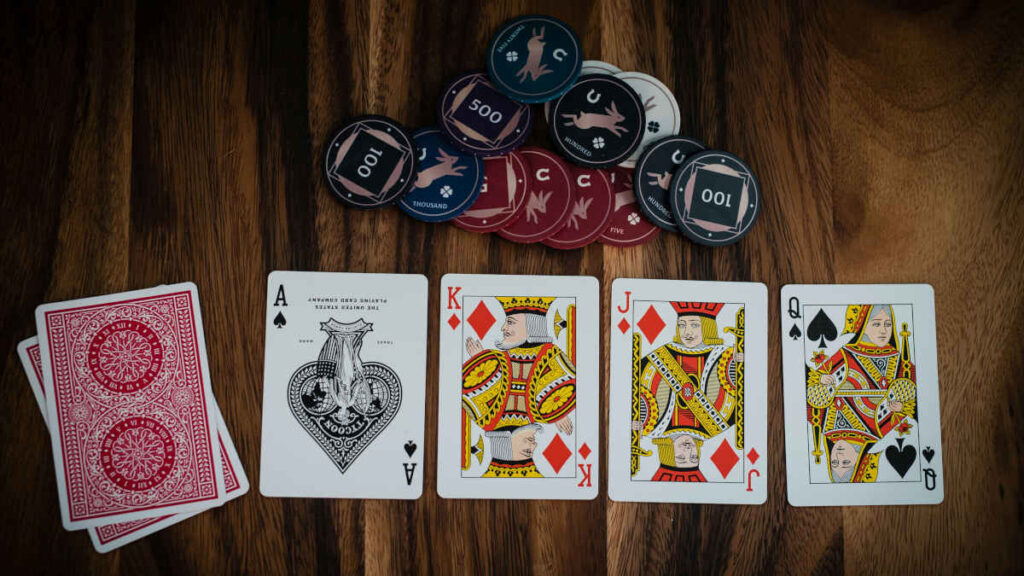
The turn was the 9♣ on a board of K♠8♦7♠, and the player in seat three at a six-max table, holding K♦8♣4♥2♦ for the top two pair, bet the pot into three opponents.
In Hold’em that’s a value bet. This was Pot-Limit Omaha, and two of the three had him beaten already, one with a set of kings and one with jack-ten for a made straight.
Seat three had been playing Hold’em ten minutes earlier. Because online poker game varieties sit one tab apart, he’d moved across mid-session, and his Hold’em sense of what a strong hand seemingly came with him.
Six Hands in Every Four Cards
A Hold’em hand is one two-card combination. An Omaha hand holds six of them, and there are 270,725 four-card starting hands against Hold’em’s 1,326.
More combinations means more ways to connect, so the big pre-flop edges you know from Hold’em compress. Aces against kings is about 82/18 before the flop in Hold’em.
In PLO, aces with unconnected side cards against kings with unconnected side cards run closer to 70/30, and bare aces against double-suited, connected kings drop under 60/40. The range construction that serves you in Hold’em is the wrong starting point.
The two-card rule is the other structural change. Omaha requires exactly two cards from your hand and three from the board. A spade in your hand with four spades on the board is a flush in Hold’em and nothing in Omaha, because you need two spades.
Four of a kind on the board is usually a chopped pot in Hold’em, decided at most by a kicker; in Omaha it’s three of the four plus your two best cards, and any pocket pair makes a full house.
Top Two Pair After the Flop
Seat three’s top two pair is a good hand in Hold’em because the hands that beat it are uncommon.
In Omaha, with six combinations per player and three or four players seeing a flop, somebody usually holds a set, a wrap, or a flush draw on any coordinated board.
A top pair, two pair, and naked over-pairs become reverse-implied-odds hands, winning small pots when the table missed and losing large ones when it didn’t.
A draw gets judged on its nut outs. A wrap is a straight draw with nine or more outs, and the count that matters is how many of them make the nuts. J-T-9-3 on an 8-7-2 rainbow board has 13 outs and every one of them is the nut straight.
9-8-7-3 on J-T-2 also has 13 outs, and only the three sevens make the nuts; the queens, nines and eights make straights that lose to the higher end.
Kevin Haney’s guideline for loose, multiway low-stakes games, set out in Card Player in March, is to want around 13 nut outs before committing to a big bet on the flop, and the bottom wrap above has three.
Non-nut flush draws carry the lesson over: drawing to the king-high flush when the ace-high draw is out there is how you hit and still pay off.
Where the Old Habits Still Work
Moving across means re-learning what a strong hand is, so that top two is a trap and a nut wrap with the nut flush draw is the hand to play for stacks.
The old habits hold for a street on a dry rainbow board like K-7-2, where an overpair is briefly as strong as it was in Hold’em.
The 2025 Main Event champion Michael Mizrachi won the $10,000 PLO Championship at this summer’s World Series through a field of 836, showing that some players are truly masters of both variations.