

Image courtesy of the PokerGO Tour
Many players struggle with finding the right bet size on the flop.
Some will default to always using the same size, be it a pot, half pot, or similar. Others will come up with random amounts.
None of these approaches work, and using wrong bet sizes on different boards can be very costly in the long run. In this article, we’ll discuss several key factors to consider when determining the best size to use and how to correctly incorporate them into your process.
These factors are: nut advantage, range connectivity, stack depth, and board dynamics.
Range Advantage Determines Betting Frequency
Before we move to the main focus of this article, let’s first revisit the concept of range advantage.
In the simplest terms, this is the advantage that one player’s likely range has over the opponent’s likely range on any particular board.
Range advantage is not used as much to determine your bet size, but it is very important for figuring out how often you should or shouldn’t bet.
When a board is not good for you, so that the range advantage is small or non-existent, you should bet less often. If there is a board out where you have a significant range advantage, you should be betting at a higher frequency.
Nut Advantage
Nut advantage is the first factor that helps you determine the size. This concept essentially tells you if you have more premium hands than your opponent, like two pair or better when playing deeper, or a top pair/good kicker and better with shallower stacks.
Generally speaking, when we have a significant nut advantage, we want to use a bigger sizing.
Let’s look at a couple of examples. UTG raises, the big blind calls. In the image below, we see the raising and the calling ranges for both players.
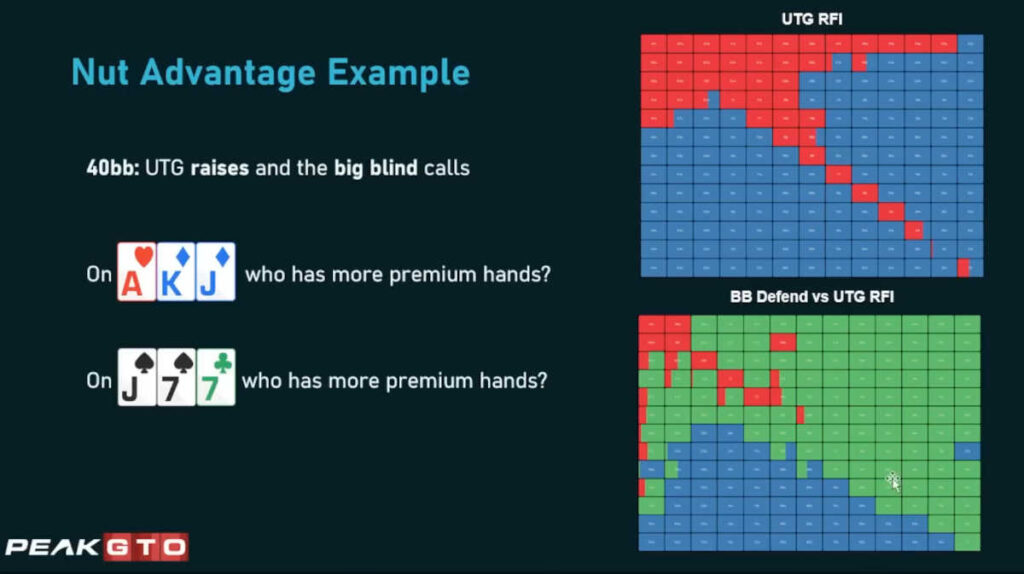
Now, thinking about the concept of nut advantage, what happens on two different flops?
- A♥K♦J♦
- J♠7♠7♣
On the first board, the original raiser has all strong pair and draw combinations; all hands containing a ten or a queen have a straight draw, and then there are some underpairs. So, the raiser clearly has a significant nut advantage in this scenario, leading to larger sizes.
On the second board, the original raiser still has the range advantage, as they have all over-pairs, but the big blind caller has the nut advantage, as they have many suited and even some off-suit sevens. Thus, after the big blind checks, we want to use a smaller continuation bet size.
Range Connectivity
The second thing to look at when deciding what size to use is how strongly a particular board connects with your opponent’s continuing range.
If they connect well with the board, we want to bet bigger. If we expect them to connect poorly, we use smaller sizing.
For example, we raise from UTG, the big blind calls, and the flop comes A♠K♣J♥. This is the spot where we want to bet larger, as the opponent will be continuing with hands containing a pair, as well as hands like Q♥9♥ with immediate and backdoor draws.
However, if the board were to come J♦6♠2♠, we should be using a smaller size, as this is the kind of board where they are continuing with all sorts of weaker hands, such as ace and king-highs.
Let’s look at the situation where the LJ raises, BB calls, and the board comes K♠7♦2♥.
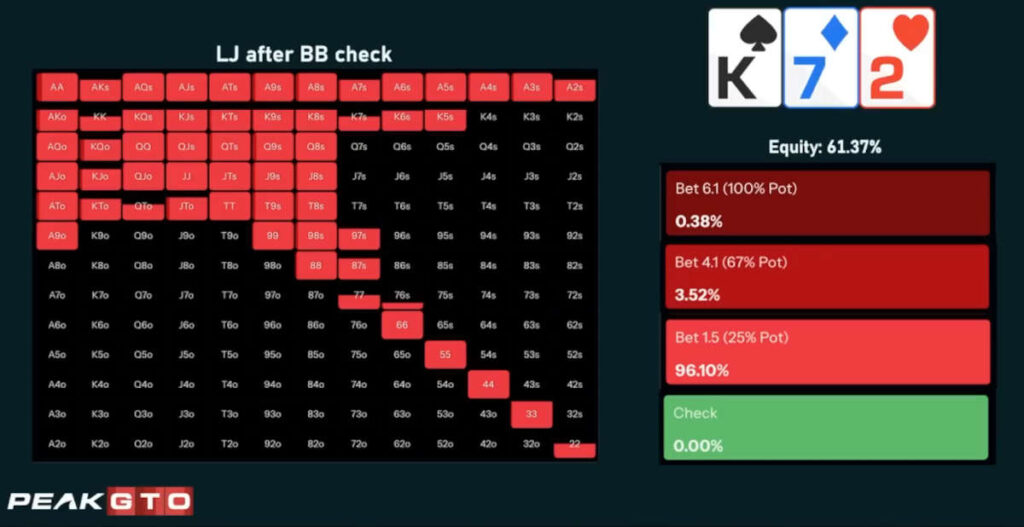
The opponent will not have many good hands here. We have a lot of equity in this spot, which means we’ll bet frequently, and we have the nut advantage with sets, top pairs, and pocket aces. So, given all these factors, we want to bet small on this uncoordinated board.
The important thing to take with you is that these patterns hold true in all sorts of common spots.
You can memorize these general rules, and they will help you when you come across similar boards, allowing you to utilize a strategy that is close to the GTO.
Stack Depth
Stack depth is important as it determines your stack-off threshold. In other words, it defines which hands are strong enough to get all the money in the middle.
Say you have pocket tens on an 8-7-4 board. Would you rather stack off playing 40 or 80 big blinds deep?
At the 40BB stack depth, pocket tens are good enough to play for stacks. At 80BB, it becomes significantly worse. And the deeper you get, the worse it becomes to stack off in this spot.
As you get deeper, the more nutted you need your hands to be to include it into your nut advantage, as we don’t want to be chip dumping into an opponent who’ll only call when they are ahead.
For example, playing 40BB, LJ raises, BB calls, and the flop comes 8♠7♠4♦. After the big blind checks, this is a spot that we are betting somewhat infrequently.
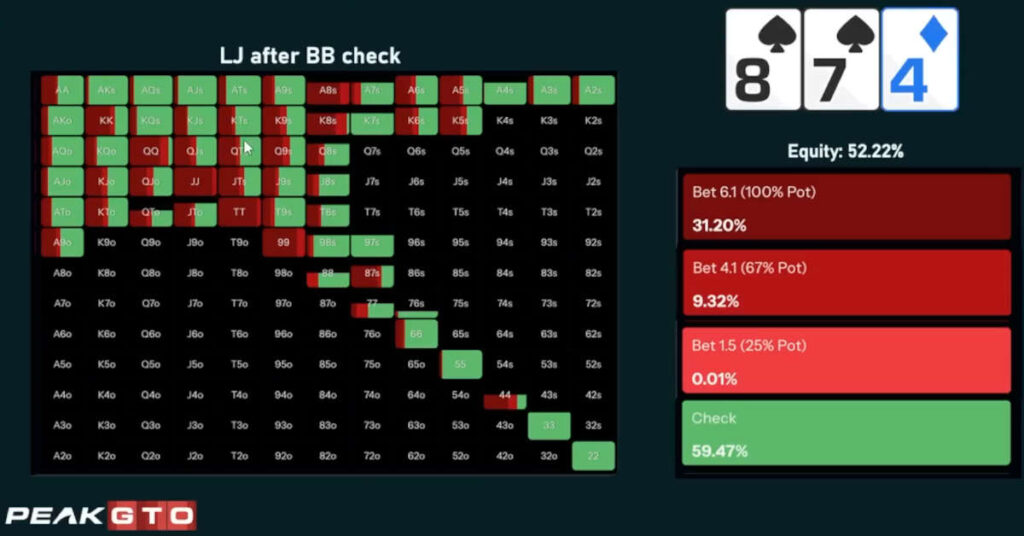
When we do bet, however, we are using a big size, as we are betting our strong hands that are vulnerable to getting outdrawn, such as overpairs, strong eights, and some draws.
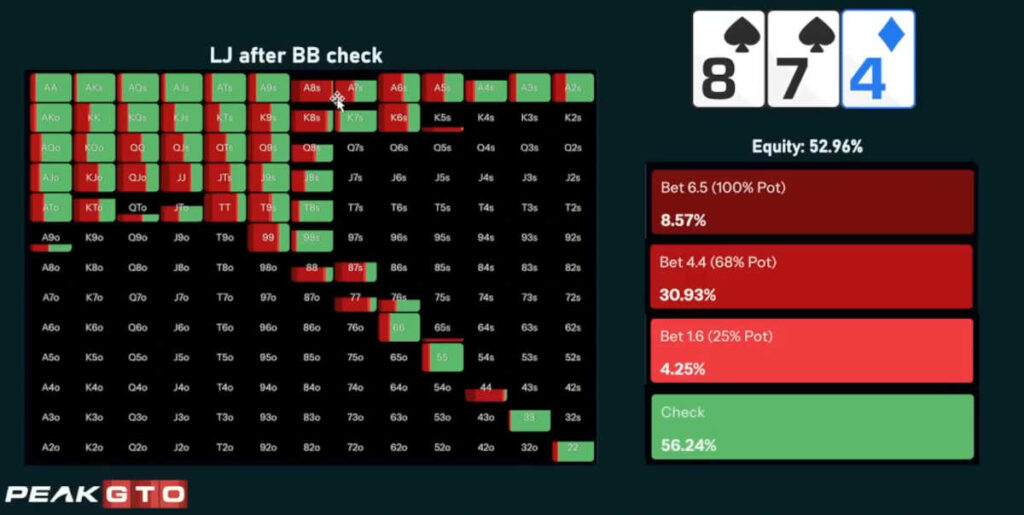
If we change the situation to be 80BB effective, you’ll notice we have to be more cautious, not using the 100% pot size nearly as often and checking back more frequently with hands like QQ, JJ, and TT.
Board Dynamics
The final thing to consider when figuring out the correct bet size is the board dynamics, i.e., how likely is the board to change on future streets so that the current nutted hands are vulnerable to getting outdrawn.
The bigger the likelihood of these hands being outdrawn, the larger we want to bet when holding hands that are almost always good on the flop but are vulnerable to different runouts.
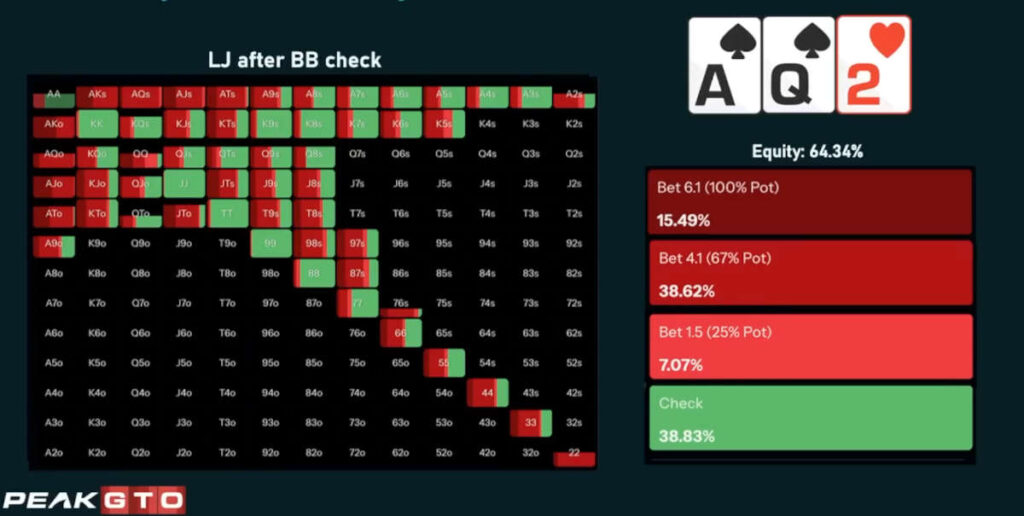
For example, the LJ opens, the big blind calls, and the flop comes A♠Q♠2♥.
After the big blind checks, you’ll notice we are using some pretty big bets. If we have an ace in this spot, it’s almost always good, but it is also very vulnerable to being outdrawn by straights and flushes. Thus, we bet big with hands like AK, AQ, and AJ, as well as hands like JT that benefit from not seeing any additional cards.
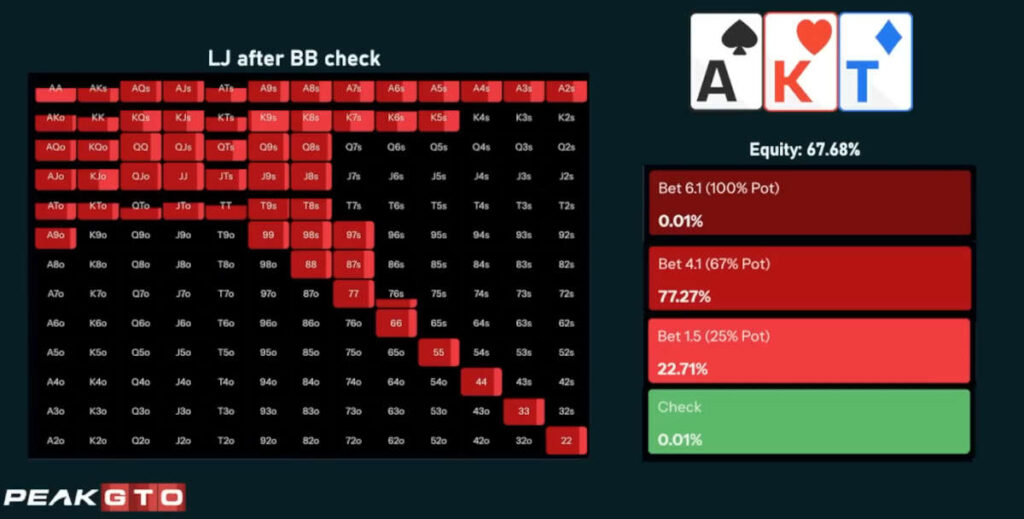
If we look at the board like A♠K♥10♦, we are betting more often, but never using a large size. This is because there is no flush draw, so our strong hands are not nearly as likely to get outdrawn.
This is a lot to take in, but if you keep these four factors in mind every time it comes to a decision about the bet size, it should help you devise a much better strategy in different spots, resulting in your plays being much closer to the GTO approach.


