
Image courtesy of the World Poker Tour
Overbets are one of the most underused weapons in No Limit Texas Hold’em. To excel in the game, you need to master using this weapon both for value and as a bluff.
Remember, the game is called “no limit,” which means we are allowed to use any bet size we want. We are not restricted by the size of the pot, and can bet as much as we feel inclined in any given spot.
Overbets are particularly powerful in situations where you have a significant nut advantage, and the board is dynamic, i.e., somewhat likely to change on later streets. They are particularly useful and powerful on the turn.
A dynamic board is one that contains straight and/or flush draws, but no possible made straights or flushes. For example, a flop like JT8 or one containing three hearts is not dynamic, as it is already possible to have a straight or flush.
A board like J♠10♠2♥, on the other hand, is very dynamic, as it contains possibilities for straights and flushes, but there are no possible made hands yet.
You’ll typically have a large nut advantage when you bet the flop with a polarized range, and the turn doesn’t change the board much (or adds more draws), or when the turn is excellent for your range.
Example #1
The best way to go about this topic is to look at some examples. Say we are in a six-handed cash game, 100 big blinds deep, and open from the LJ position to 2.5bb.
The big blind calls, and the flop comes J♠10♥3♦. The big blind player will check here 100% of the time, and we have to decide how to proceed.
On this particular texture, we are checking a lot, and we are balancing our continuation bets between 25% and 60% of the pot. Hands that want to bet big (60%) are overpairs, some jacks, straight draws, and a few bluffs.
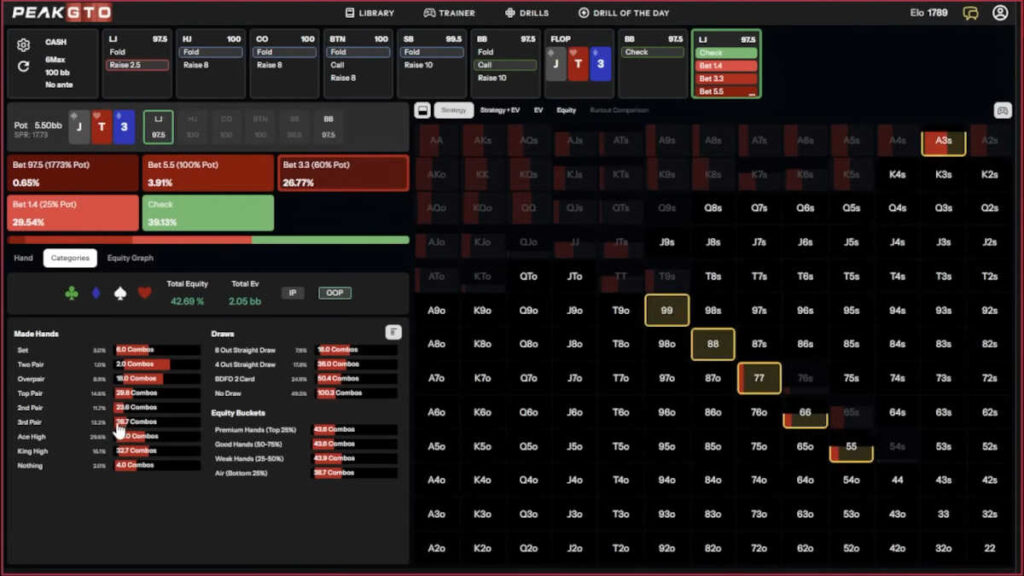
After we bet big, we get called, and the turn brings the 2♠, introducing a flush draw. When the big blind checks, we are checking back a lot, but when we do bet, we’ll be using 150% of the pot sizing (overbet) a lot.
We are betting with a lot of our best hands, such as aces, kings, queens, jacks, AJ, and tens; we are also betting with our draws, and not only flush draws. Hands like A4, A5, and A6, both with and without a spade, can bet here, applying a lot of pressure on the opponent.
By betting big, we are saying we have a lot of good hands that they can’t have (as they didn’t re-raise before the flop), which allows us to include more bluffs in our range.
Example #2
Let’s now look at the situation where the button raises, the big blind calls, and the flop comes 9♥8♥4♦. After the big blind checks, we usually use a big bet size when we do bet – either 100% or 60% of the pot – and we are doing it with our good hands and some draws like gutshots, overcards with backdoor draws, etc.
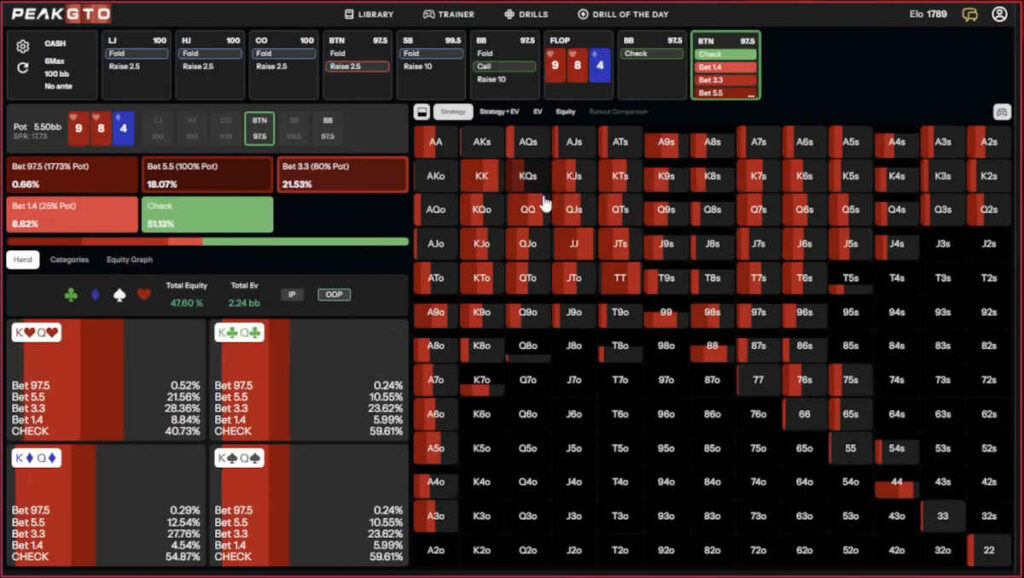
On this flop, we bet 3.3bb, the opponent calls, and the turn comes 3♦, making the board very draw-heavy.
In this spot, we should be using the overbet a lot. 33% of the time, we are betting 150% of the pot. Many cash game and tournament players regularly mess this spot up, which costs them money in the long run.
A board with two flush draws and no made straights will usually result in us betting big.
If the turn was 7♦ instead, we overbet way less often. It is still kind of a dynamic board, but there is now a straight possible with JT, and that hand is in both players’ ranges.
With a card like 7♦ or J♠, we have a similar situation, where we use some overbets, but not a ton.
So, to sum it up, on the boards with two flush draws and one or two straight draws, especially when these are the draws that the opponent can realistically have, and we have a lot of strong made hands, we want to bet big.
Overbetting the River
On the river, we want to overbet using a polarized range that consists of very strong made hands and nothing, where our nothing ideally blocks the opponent’s nuts (for example, holding the Ah on the three-heart board).
In these spots, your opponent’s range is condensed in the middle. They don’t have many nutted hands, and your strong value range beats almost all of their calling hands.
- If you bet the pot, they have to put in one pot-sized bet to win the current pot, your bet, and their bet back (1+1+1), which equals 33%. Thus, you get to have 67% value and 33% bluffs.
- If you bet 200% of the pot, they have to call two pots to win 1 + 2 + 2, which means you get to have around 40% bluffs. With a 300% bet, you can bluff 42.8%.
The bigger you bet, the more bluffs you get to have, allowing you to capture the pot with more hands than you would normally. This is why the best players in the world use overbets on a regular basis.
To bring this point home, let’s continue with our example from earlier. After the flop of 9♥8♥4♦, the turn is the 5♦, and we bet 150% of the pot, 18 big blinds.
Facing this bet, the opponent is supposed to fold 58%, and even some hands containing a nine are starting to fold in the GTO world.
If they call, we’ll be left with 150% of the pot in our stack. Let’s look at different river cards:
A♠ – We have 150% of the pot remaining in our stack, and we are using that sizing a majority of the time when we do bet (roughly 28%). Our equity is generally higher than theirs in the top portion of the range, as we have the nut advantage.
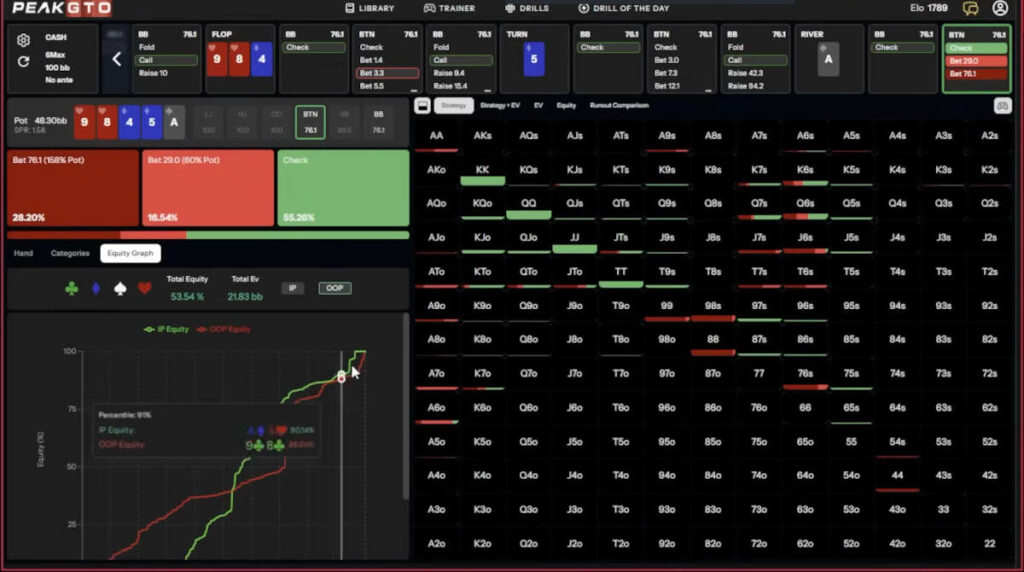
The hands that are betting are straights, sets, two pair, and top pair, i.e., very strong holdings, combined with a little bit of nothing. Our under-pairs, second, and third pairs are not betting in this spot.
But what happens if the river is the 7♥?
After they check, we are not overbetting nearly as often, because the out-of-position player has the nut advantage. This means that we don’t get to bet that often at all, and we can’t use a big sizing very frequently.
To sum it up, overbets are a very powerful weapon that you want to have in your arsenal. While games like Pot Limit Omaha limit your max bet size, No Limit Hold’em allows you to get creative, and, when done right, that creativity can significantly boost your bottom line.


