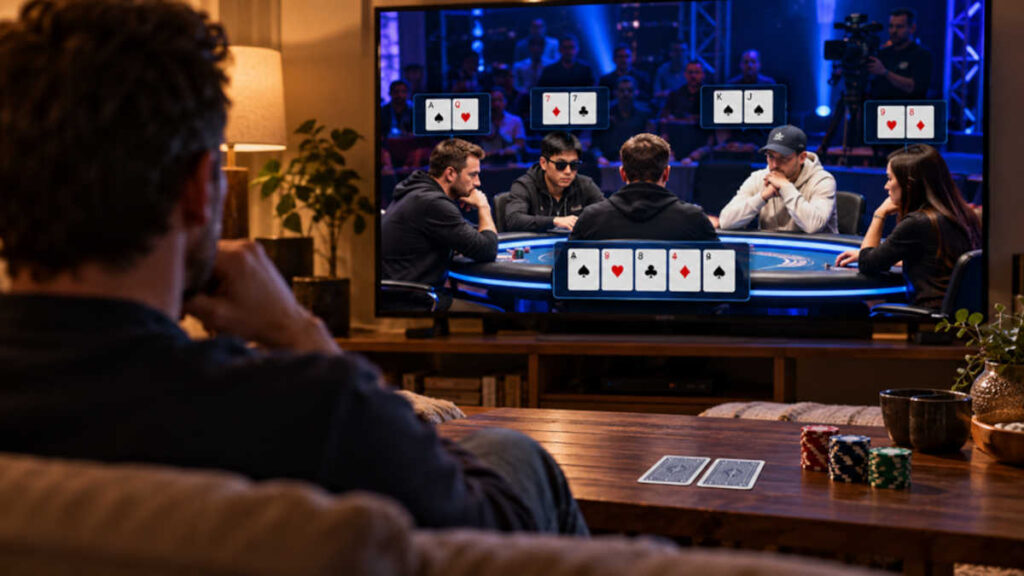
The river bet lands. One player studies the board, checks the opponent’s stack, and settles back into their chair. At home, someone watching the broadcast has already announced the answer.
“Obviously a bluff.”
It is obvious on their screen. Two little card graphics have removed the central difficulty of the decision.
Anyone moving from watching poker to playing against other people, including through social casino and poker site KingWins, discovers how much those graphics change the experience. At the table, you have your own cards, the action, and whatever you have learned about the opponent. The broadcast gives the audience considerably more.
Poker’s return to a familiar television home makes that difference worth revisiting.
ESPN’s Comeback Brings Back the Armchair Player
In March 2026, ESPN announced a multi-year agreement bringing the World Series of Poker Main Event back to its platforms. The plans included more than 100 hours of coverage, edited episodes, and a three-night live television final table in August.
That combination offers two ways of watching poker. Extended coverage gives hands room to develop. Edited television builds a story from the moments that survive the cut.
Both can be entertaining and instructive. Neither automatically reproduces the information available to the person making the decision.
The viewer sees a bluff. The player has to decide how often that opponent would take the same line with a bluff, a strong hand, or something in between.
Those are different tasks.
Knowing the Hand Changes the Question
Suppose the broadcast shows an opponent holding a missed draw. A call now looks like a straightforward act of courage.
Remove the hole-card display and the decision becomes less tidy. Which draws could have arrived at the river this way? Would the opponent bet all of them? What value hands use the same sizing? Does your own hand remove any relevant combinations?
The correct analysis concerns the plausible range at the time. The revealed hand is one member of that range.
A player can make a defensible fold against a range that contains too few bluffs and still be shown a bluff on this occasion. Equally, a loose call can happen to catch the one hand it beats.
Knowing what was held makes the television moment satisfying. It does not settle whether the decision was sound.
The Reveal Rewrites Your Memory
There is another trap after the cards turn over: remembering the outcome as more predictable than it felt beforehand.
A research overview from the Association for Psychological Science, published through EurekAlert, describes hindsight bias as including distorted memories of earlier judgments and a belief that an outcome was foreseeable. It also explains how this can interfere with learning from experience.
That research was not a study of poker broadcasts, but the application is easy to recognize.
Before the reveal, you were unsure. Afterward, the hesitation becomes “I knew he had it.” The detail that supports the result suddenly seems decisive, while the evidence pointing elsewhere fades.
Poker commentary can suffer from the same problem. Once everyone knows the hand, constructing a convincing explanation is much easier than making a prediction was.
A Highlight Has a Selection Process
A clip of a spectacular bluff does not show every occasion on which the same player considered bluffing and declined.
A compilation of hero calls leaves out the ordinary folds. An edited episode cannot preserve every quiet orbit that shaped someone’s impression of the table.
That missing context matters if you use broadcasts as study material. Memorable actions can start to feel more common than they are simply because they are the actions worth showing.
There is nothing wrong with enjoying the spectacle. The mistake is treating its selection of hands as a representative sample of what you should do.
A dramatic play may also depend on a specific opponent, history, or tournament situation. Copying its appearance without those conditions gives you the gesture rather than the reasoning.
Watch Once for the Story, Then Again for the Decision
A useful study exercise is to replay a hand while covering the opponent’s hole cards.
Pause at the important decision. Write down the hands you consider plausible, the price being offered, and the information you would still want.
Choose an action before continuing. Record how confident you are, rather than letting the eventual reveal supply that confidence retrospectively.
Then watch the rest of the hand.
If the result surprises you, ask which assumption needs examining. Perhaps you excluded a hand that belonged in the range. Perhaps the opponent took an unusual line. Perhaps your decision was reasonable, and this happened to be an unfavorable outcome.
You will not always be able to resolve the question from a broadcast. Recognizing that limit is more useful than inventing certainty.
The Uncertainty Is the Game
Hole-card graphics make poker watchable because they let the audience understand what is at stake. They create tension between what the viewer knows and what the player must discover.
They also make it dangerously easy to underestimate the person in the chair.
The next time a televised decision looks obvious, cover the graphics and look again. Keep the bet size, board, and previous action. Take away the answer.
That is much closer to the game the player was actually playing.