
Image courtesy of World Poker Tour
In this article, I bring you my best tips to crush cash games online, in an environment where pretty much everyone plays relatively well.
To win under these circumstances, you must focus on the fundamentals, and the most important aspect of those fundamentals will be your preflop game.
If you make regular mistakes before the flop, no amount of skill after the flop will help you, because you’ll keep spewing bits of equity all the time.
Some of the topics we’ll cover today include which hands to raise first in, how to approach 3-betting in general (often deviating from the GTO strategy), how to increase your aggression with 3-bets, when to fold hands like JJ and AK preflop so you don’t get stacked, and more.
#1 Play Tight Early, Loosen up in Late Positions
A major chunk of your win rate in cash games will come from the button and the cutoff. You won’t be making much money from early positions, and everybody loses money from the blinds.
This means that you want to play a tight and fairly straightforward game from early positions.
The chart below shows the raising range for the lojack position at a six-max table. We are supposed to raise with 55+, all suited aces, AT+. However, small pairs are folding, and, as you can see, many off-suit broadway combos are folding 100% or at least some percentage. Many suited connector combos are pure folds as well.
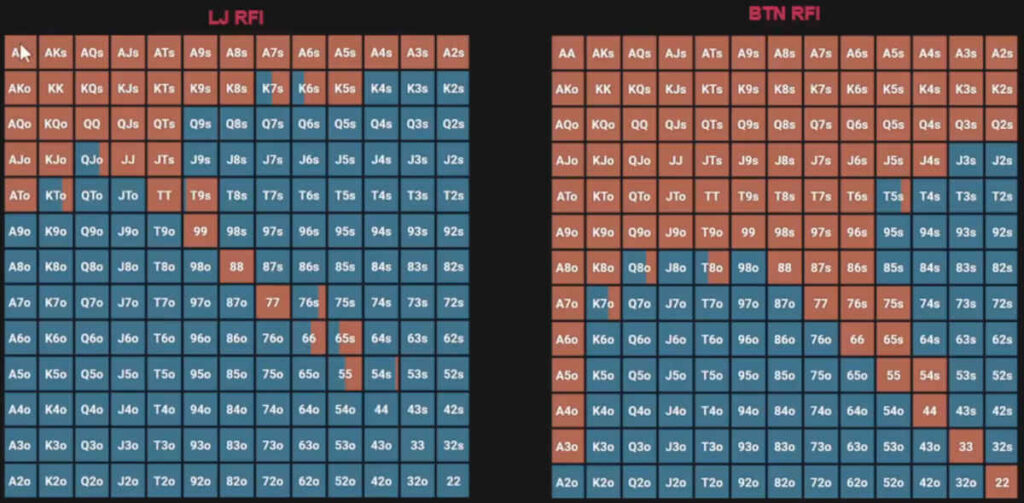
From the button, you get to play a much wider range: any suited hand containing a Q, almost all off-suit aces, suited connectors, some gappers, etc. In this spot, if you know players in the blinds are too tight, you can even expand your raising range.
#2 Use Optimal Raise Sizes
Many players, especially at lower stakes, just click random buttons, making it a min raise or 4x before the flop. However, to set yourself up for success, you want to have a raising strategy that’s fundamentally healthy and solid:
- Raising first in, make it 2.5x, and if there are antes in play, you can go for 2.7 – 3 times the big blind.
- In the small blind, open to 3.5bb as you want to discourage the big blind from calling in position.
- When the small blind limps in, you should make it 3x from the big blind. However, if you know that they always fold to a 4x raise and always call 2.5x, you can adjust accordingly.
When it comes to 3 and 4-betting, these are some good rules to follow:
- When in position, you should typically make it 3.2 – 3.5x the original raise. So, if the original raiser opens to 2.5bb, make it 8bb – this sizing does not give them great odds to call, and you’re not risking too much when they wake up with a strong hand.
- Out of position, make your 3-bets 4 – 5x the original open. Facing a smaller raise, you should go with a bigger sizing; against a larger open, you can default to a smaller (4x) 3-bet.
- When 4-betting, make 2.2 – 2.5x the 3-bet size in position and 2.5x – 2.7x out of position.
- If there is a raise and a call, you can go with the standard 3-bet size described above, plus one amount for each additional caller. So, if the lojack makes it 2.5bb and the button calls, you should go 4x + 1x, so 5×2.5bb.
This math may seem like a lot to memorize, but once you get used to it and start using it, it will become second nature, and you’ll always know roughly what to do, allowing you to focus on things that truly matter.
#3 Exploit Your Opponents by 3-Betting Too Much
In small stakes games on most poker sites, you should be 3-betting more than you’re supposed to according to the GTO strategy, and over-fold when your opponents 4-bet. This is because most players fold way too often to aggression and don’t 4-bet nearly enough.
This allows you to 3-bet wider than normal and comfortably fold when they 4-bet, as their 4-bets will be significantly weighed toward nutted hands.
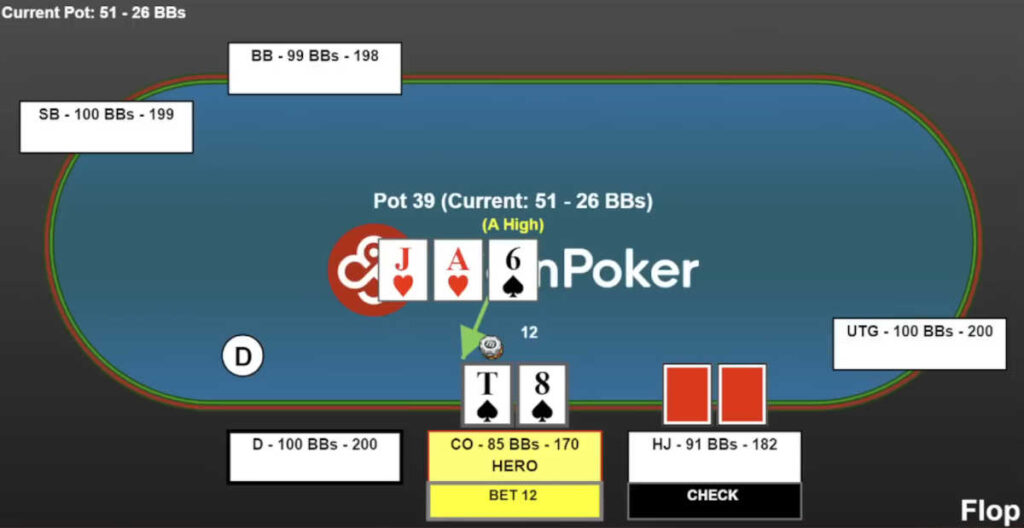
For example, playing $1/$2, the hijack opens to $5. You 3-bet them from the cutoff holding 10♠8♠, and they call. The flop comes A♥J♥6♠.
This is a spot where many players chicken out, but after the opponent checks, this is a great opportunity for a continuation bet. You can c-bet small, and if they don’t connect, they’ll just give up.
#4 Stop Getting Stacked With AK & JJ Preflop
Hands like AK and JJ are perfectly fine to play after the flop for small to medium amounts, but, in low stakes games, if all the money goes in before the flop, you are going to be shown aces, kings, queens, and ace-king a lot.
Both AK and JJ don’t do very well against that range, as we can see from the charts below.
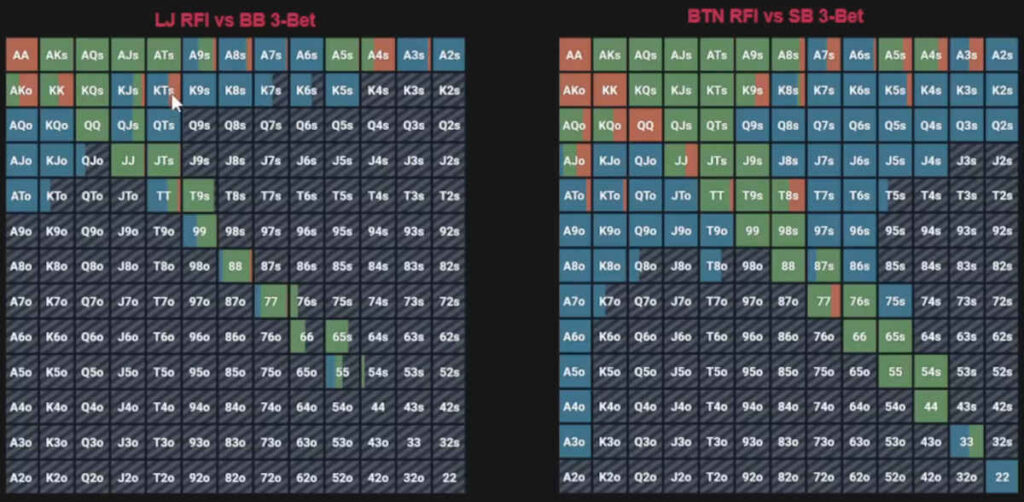
When you raise from the lojack first in and the big blind 3-bets, you can see that hands like aces and kings are happy to 4-bet for value, and then there are a few bluffs containing suited aces and kings. Beyond that, however, we’re not 4-betting all that much at all.
AKo does 4-bet some of the time and, in that scenario, we have to put all the money in if it comes to it, but it’s not an ideal situation. In small stakes games, you can adjust your strategy to just call here.
As you can see, hands like QQ and JJ are happy to call and play in position, instead of trying to get it in before the flop.
In the button vs. small blind scenarios, ranges are wider, but even here, JJ is not 4-betting 100% of the time, and hands like TT and 99 are just calling. AKs doesn’t 4-bet either, as this is a hand that plays very well in position.
Ace-King off does 4-bet because it doesn’t play as well postflop, but if you were to adjust and just call with some of your AKo holdings, that would be perfectly fine.
#5 3-Bet or Fold from the HJ, CO & SB
Finally, you want to stop splashing around and calling from spots where you won’t be in position and / or closing the action. When someone opens, the only spots you want to have a calling range in are the button and the big blind.
From the button, you will always be in position, and from the big blind, you’re closing the action and are guaranteed to see the flop.
If you face a raise and just call from the small blind, the big blind can 3-bet and force you to fold without seeing the flop. If the lojack raises and you call in the hijack, someone else can 3-bet, or the button can just call, and you’ll have to play the rest of the hand out of position.
This is how you leak chips over and over again, and you’ll only end up winning when you flop something decently strong. So, you need a strong 3-bet or fold strategy.
Let’s look at some GTO charts.
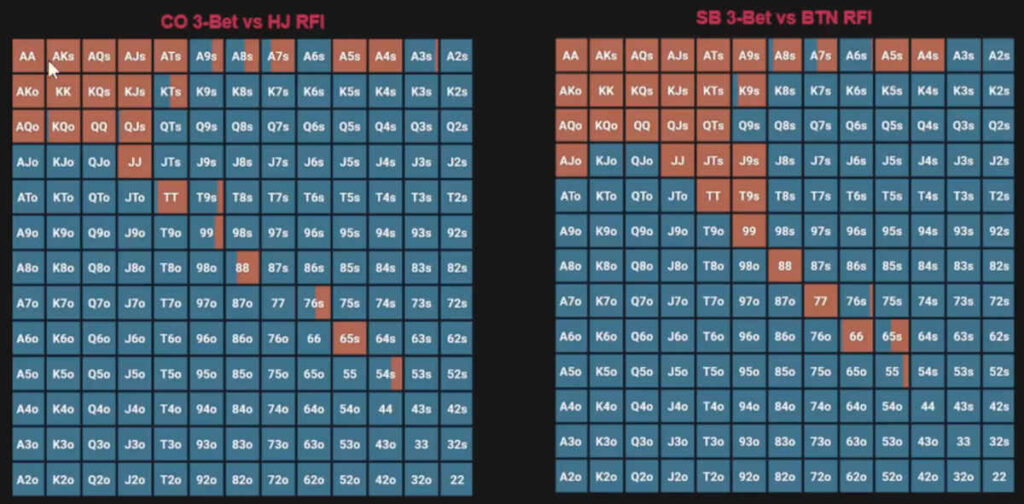
Playing from the cutoff and facing a raise from the hijack, we are 3-betting 88+, ATs+, a few other suited ace combos, KJs+, QJs+, and some suited connectors. Everything else just folds.
You may be surprised to see some of these hands just folding, but the hijack should be raising a strong range to begin with, and there are still players to act behind, and they can wake up with strong hands, so we have to keep that in mind as well.
In most low-stakes games, you should be 3-betting somewhat wider because, as we’ve discussed already, players don’t respond adequately and either call too often or fold too often.
If we look at the small blind range facing a button open, we have to be quite tight. Hands like 22 – 55, A2s, and A3s are just folding to the initial raise. We don’t have a calling range in this spot in most games. The exception would be a game that charges no rake or where there are antes involved, in which case we could have a bit of a calling range in these spots.
Of course, if you know the player on the button will over-fold to a 3-bet, you can go a bit wider, but they’ll always have an incentive to call in position, so don’t go crazy, even if you think they’re on a tighter side.