Two players can both make a straight in Texas Hold’em and still have different strength. That is the part that trips people up. The board can give everyone the same middle cards, but the verdict comes from the highest card in each run. In ace-high straight vs king-high straight spots, the ace is not decoration. It is the ceiling.
That makes this a visual-recognition problem as much as a rules question. A review of visual search behavior in team-sport expertise found that experts and novices often look at the same field differently, with experienced performers extracting task-relevant cues.
Poker has its own version of that: newer players see a big-looking hand, while sharper readers notice the board’s connected ranks first.
The Straight Comparison That Solves the Hand
A straight is 5 consecutive ranks. Poker hand rankings place it above three of a kind and below a flush. Once that is clear, the next layer is comparison. If two players both have a straight, do not ask which hand feels stronger or which player used more hole cards. Name each complete sequence.
A poker setting such as Ignition Poker is a natural place to see these comparisons because its poker page presents formats including cash games, Zone Poker, Sit & Go’s, multi-table tournaments, mystery knockouts, and incognito poker.
The value of looking at Ignition Poker in this context is simple: connected Hold’em boards keep asking the same question in slightly different ways. Which 5 cards actually play? Which straight reaches higher? Which impressive-looking holding becomes secondary once the board is read correctly?
The strongest habit is to treat every shared board as a sentence. Read the ranks in order, complete the possible runs, then compare the top card of each finished straight.
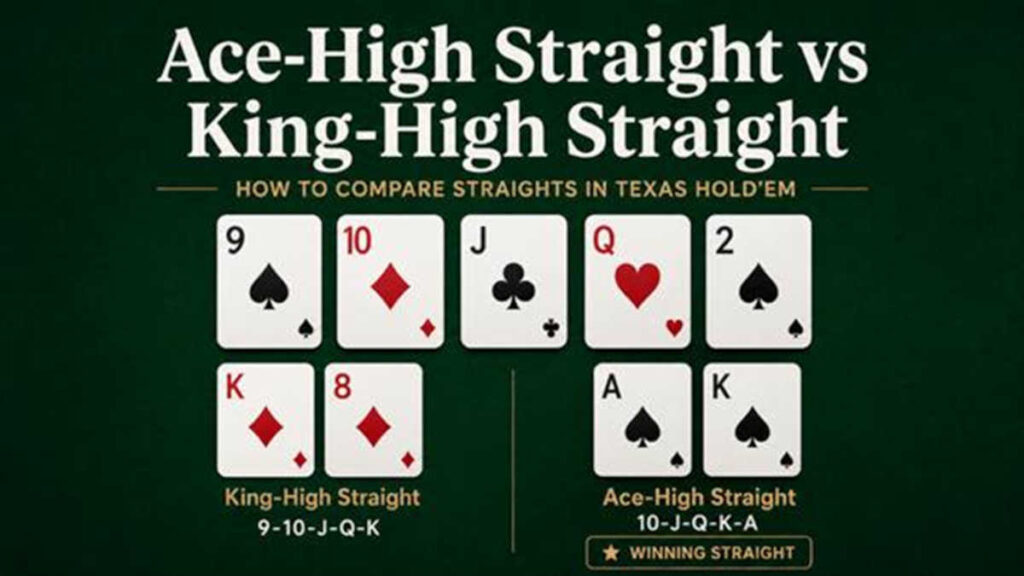
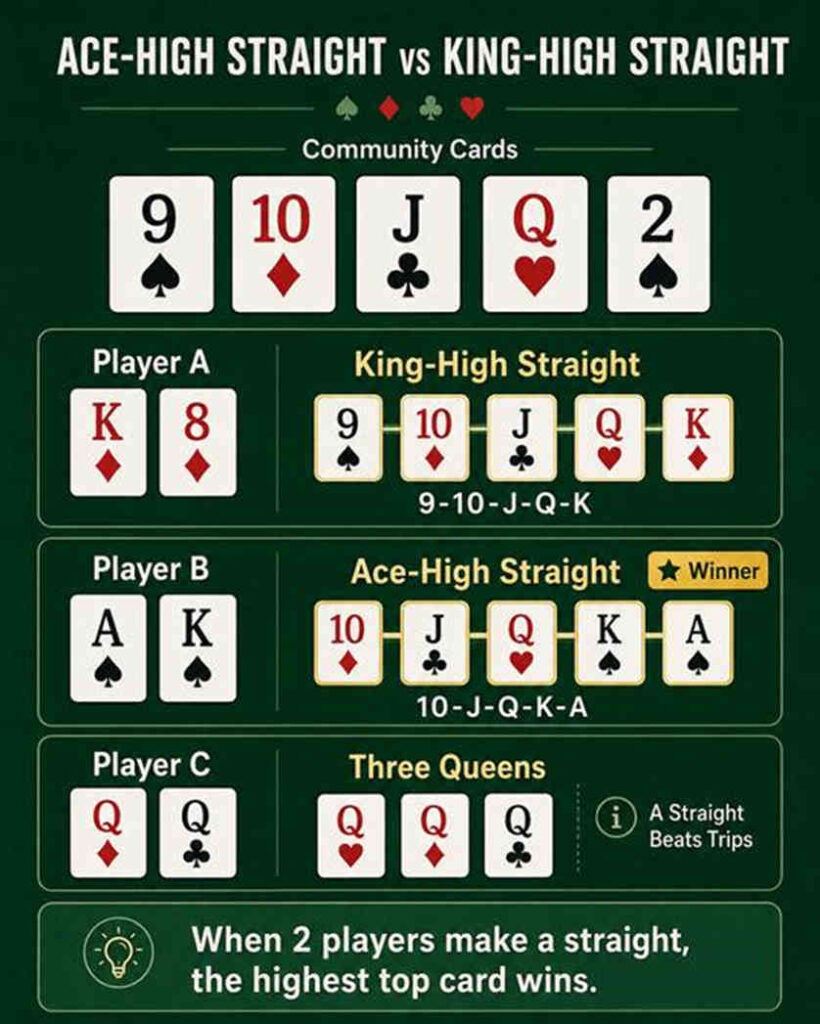
To test that idea without a long lecture, pause on this quick “which hand wins?” poker quiz. The community cards are 9♠10♦J♣Q♥2♠. Player A has K♦8♦, Player B has A♠K♠, and Player C has Q♦Q♣.
Player A makes 9-10-J-Q-K, a king-high straight. B makes 10-J-Q-K-A, an ace-high straight. C has three queens, which is behind any straight. B wins because the ace-high straight is the highest 5-card sequence available in this spot.
You can also see a visual of the same idea below.
Why the Ace Changes Everything
The ace is the most flexible card in straight reading, but it still follows strict logic. It can be low in A-2-3-4-5. It can be high in 10-J-Q-K-A. It cannot wrap as Q-K-A-2-3. In the quiz hand, the ace sits at the top end of Broadway, the highest possible straight.
That is why A and B are not tied. They share 10-J-Q-K as part of their possible run, but A’s straight starts at 9 and ends at K. B’s straight starts at 10 and ends at A. The shared middle cards create the illusion of similarity. The top card removes it.
This is also why suits do not matter here. Player B’s spades do not create a flush because the board does not supply enough spades. Player A’s diamonds do not matter either. Player C’s pocket queens look strong when the board adds Q♥, but three of a kind is still a lower category than a straight. The correct comparison is not dramatic. It is orderly.
Read the Board Before You Admire the Hand
A lot of Hold’em mistakes begin when the hole cards get too much attention. Pocket queens feel substantial. Ace-king looks clean. King-eight looks less elegant.
None of that decides this board. The board itself is doing most of the work because 9-10-J-Q creates an obvious runway for a king and an even higher runway for ace-king.
A simple way to keep the reading clean is to separate category from rank:
- Category: straight beats three of a kind.
- Rank within category: ace-high straight beats king-high straight.
- Irrelevant detail: suits do not decide the hand unless a flush exists.
That small distinction prevents the common error of treating “I have a straight” as the end of the analysis. It is only the beginning. Once more than one straight is possible, the high card in the sequence becomes the deciding detail.
The Real Lesson in a Shared Straight Board
The memorable part of this hand is not just that B wins. It is how little information you need once you know where to look.
Four connected board cards invite straight checks. K♦ gives A a real hand. A♠K♠ gives B the higher version of that same idea. Q♦Q♣ gives C a strong-looking hand that ranks behind both straights.
That is the rhythm worth remembering: category first, sequence second, top card third. If the category is different, the higher category wins. If the category is the same, compare the rank that defines it. With straights, that means the highest card in the 5-card run.
Over time, this stops feeling like arithmetic and starts feeling like pattern recognition. The board presents a shape. Your job is to name it accurately before reacting to the cards in front of you.
If you’re struggling to start with, you can always turn to hand ranking charts; although the human brain has an amazing capacity for memorization, these charts can let you focus on the game.