
Image courtesy of the World Poker Tour
Defending from the blinds is one aspect of poker that many players mess up. In this article, we’ll focus specifically on the big blind position and how to devise a solid defense strategy in different spots, depending on the stack depth and the number of players in the hand.
First of all, you are going to lose money in the big blind. This is simply the fact, and even the best players in the world lose money from the big blind. You have to put money into the pot without seeing the cards and play out of position, so it’s a significant disadvantage you have to overcome.
However, the best players out there know how to minimize their losses and lose only a fraction of their blind, while bad players will lose almost the entire blind, and that difference adds up significantly over a large sample of poker hands.
Many small stakes players make the mistake of folding too often, defending only with their best hands, or, sometimes, defending with any two cards. If you can remove these leaks and actually have a solid defending range, your win rate will increase significantly, and this article will help you do just that.
What Determines How Often You Should Defend?
First things first, how do you decide if a hand is worth defending with? There are several key factors to consider in that process:
- The size of the raise you’re facing – against smaller sizes, you should defend more often. Facing a min-raise, you might only need to call one big blind to win what’s in the pot. If, on the other hand, they go for a big sizing of four, five, or six blinds, you have to be much more selective.
- The range you’re up against – when a player is raising with a lot of hands, like in a button vs. big blind scenario, you can defend substantially wider. Against a tight range, like an open from a UTG player, you must tighten your defense range.
- Pot odds – the better your pot odds, the more often you should defend. If there is an ante in play, like in tournaments, you can defend wider. In cash games, where there are usually no antes, plus there is rake taken out, you need to be tighter.
- Stack depth – although many players get this backward, as you get deeper, you should actually defend less often, primarily because you’ll drastically under-realize your equity.
- The more players are in the pot before the flop, the tighter you should defend.
While the first three items on this list are fairly self-explanatory and something most players are familiar with, the last two are trickier, which is why we’ll focus on them.
The Deeper You Are, the Less Often You Should Defend
So, how does the stack depth influence our big blind defense range? Below are three charts, where the big blind is facing a lojack open, at 60, 30, and 15 big blinds deep.
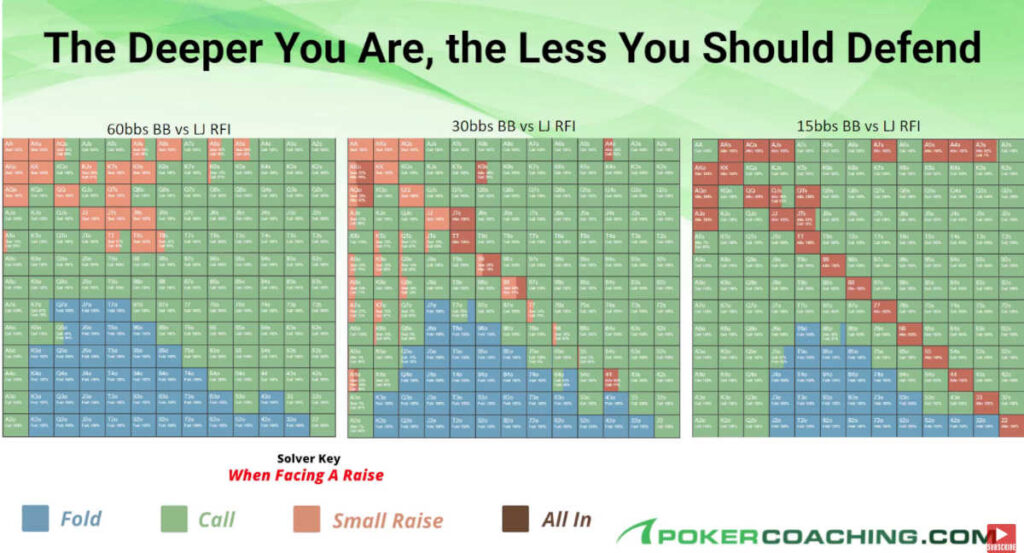
As always, hands marked in blue are the ones we’re folding, the green ones we are calling with, and hands marked in red are the portion of the range we raise. Hands in dark red constitute an all-in 3-bet.
You’ll notice that the blue section of the range, i.e., the hands we’re folding, gets wider as stacks get deeper. This is because, as we get deeper, it becomes more difficult to realize our equity.
Say you call an open with J6 playing 15 big blinds deep. If the flop comes J-7-3, you are more than happy to put your money in the middle. However, at 60 big blinds, if there is a lot of action, your hand is probably in trouble, and if you take a check-call line, there are many different runouts that will make it difficult to continue.
These charts also show that you can definitely still call at 15 big blinds deep, i.e., your options aren’t just to go all in or fold. You are only risking one big blind to win a pot of what’s usually around six or seven blinds, and you’ll have no problems realizing your equity, so it’s a very viable strategy.
The More Multi-Way It Gets, the Less You Should Defend
Let’s now look at some multi-way scenarios where the CO raises, and there is one or two calls in between (i.e., the button calls or the button and the small blind both call).
If you look at the charts below, you’ll notice that, as more players call before the flop, you should fold more of these off-suit hands, like A6. You are going to have huge reverse implied odds and struggle to realize your equity.
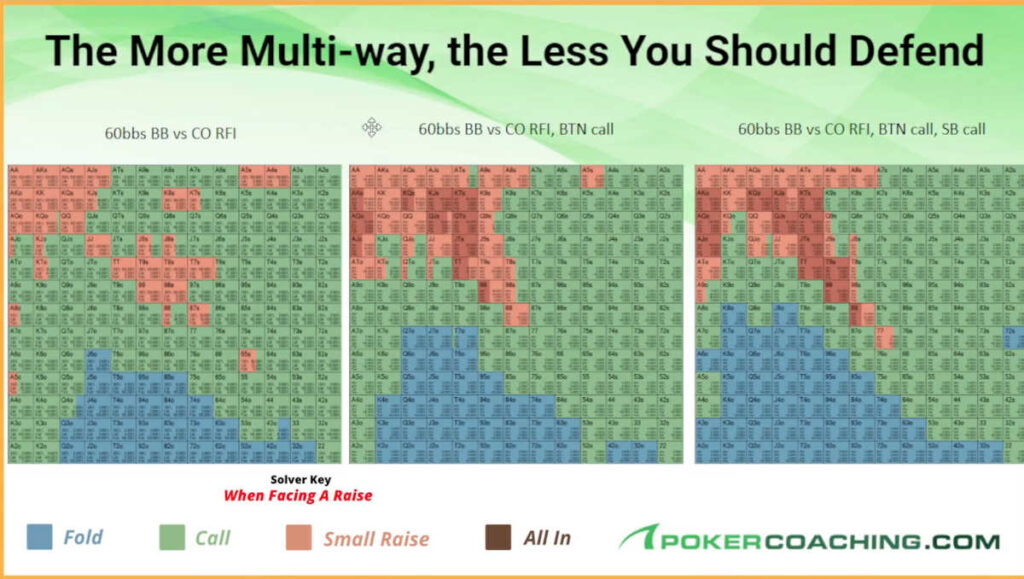
Plus, you’ll also be more likely to be dominated in multi-way scenarios.
It is also worth pointing out that, when facing a raise and a button call, that button’s range usually won’t contain any of the best hands. The same goes for the small blind.
Because these players’ ranges will usually be unprotected in these scenarios, we get to go squeeze with big all-ins (marked in dark red), with hands like AK, AQ, AJ, TT, and 99. These are profitable shoves that help get rid of any equity realization problems.
3-Betting from the Big Blind
One final topic we’ll cover in this article is 3-betting from the big blind. When deciding whether to do it, there are two main factors to consider.
When we are deep stacked, we’ll be using a more linear strategy, using high equity hands that flop well. In these situations, our opponents will often call in position, so we want to have hands with good playability.
With a shallow stack, we resort to a more polarized strategy, where we 3-bet with our best hands for value and relatively weak hands as bluffs. There aren’t many medium-strength hands in this range, as we don’t expect opponents to call a lot.
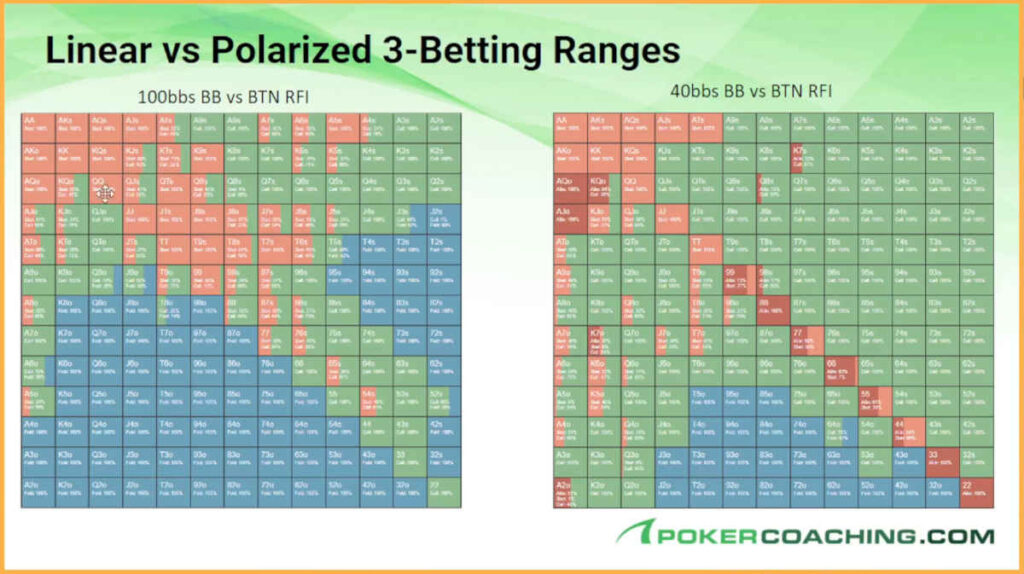
As you can see on the charts above, our strategies at 100 and 40 big blinds are similar when it comes to our strongest holdings. Beyond that, however, they diverge.
At 100 big blinds, we are 3-betting strong suited hands and suited aces, as well as a few blocker bluffs. At 40 big blinds, there is a fair number of bluffs that come from T through K-high weak holdings.
The main takeaway here is that stack depth is a very important factor when deciding what hands to 3-bet with in big blind defense scenarios, and players often make the mistake of ignoring it, which can be a very costly error in the long run.