Image courtesy of the World Poker Tour
You all know the feeling. You’ve been working hard on your game, you feel ready to win, but when you go to play, the cards just don’t cooperate.
You sit down and just don’t get any playable hands whatsoever.
There is no way to magically change the card distribution, but that doesn’t matter. Your goal should never be to win a specific hand or even a particular session, but to make long-term profitable decisions.
In live poker, you’ll typically get to see 30 – 40 hands an hour, and that’s really not a lot. On average, you should be playing around 20% of hands, and it’s quite easy not to get any of those over a span of 60 minutes or even longer.
In a slow game like live poker, you’ll feel card dead a lot, and there are a few things that you can do to combat that feeling and make the best out of the situation you find yourself in.
Tip #1: Fold a Lot
The first and most important thing is not to get impatient, thinking you need to get in there and battle hard to win as many hands as possible.
Check out the graph below, showing the strategy when you have just six big blinds, and everyone folds to you on the button.
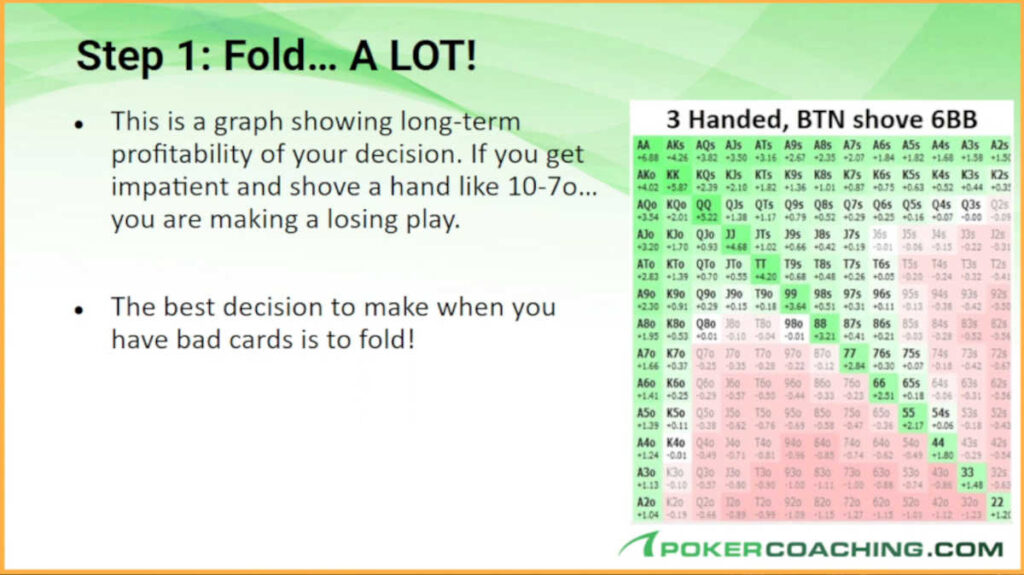
As you can see, there are many marginal hands on there that are close to break even or even losing a little money, and your best play is to actually fold them, despite how short you are.
As you get deeper, this becomes even more important, especially against competent opponents. If you start getting involved with bad hands, you’ll end up with a lot of middle and bottom pairs, and that’s not where you want to be against solid players, as they’ll force you to fold a lot.
So, whatever the card distribution might be on any given session, you should stick to good starting hand charts and follow them closely instead of getting impatient and looking for “creative” ways to get involved.
Tip #2: Understand Your Image
If you’ve been card dead for a while, you’ll likely develop an image of a tight player. This may not be true in all scenarios, but if your opponents have a reason to perceive you as being on the tight side already (your appearance, your demeanor), the fact that you’ve been folding for an hour straight will help reinforce that image.
To understand how to best take advantage of your low VPIP, let’s look at two charts, side by side, playing 40 big blinds deep and facing a HJ open in the CO position.
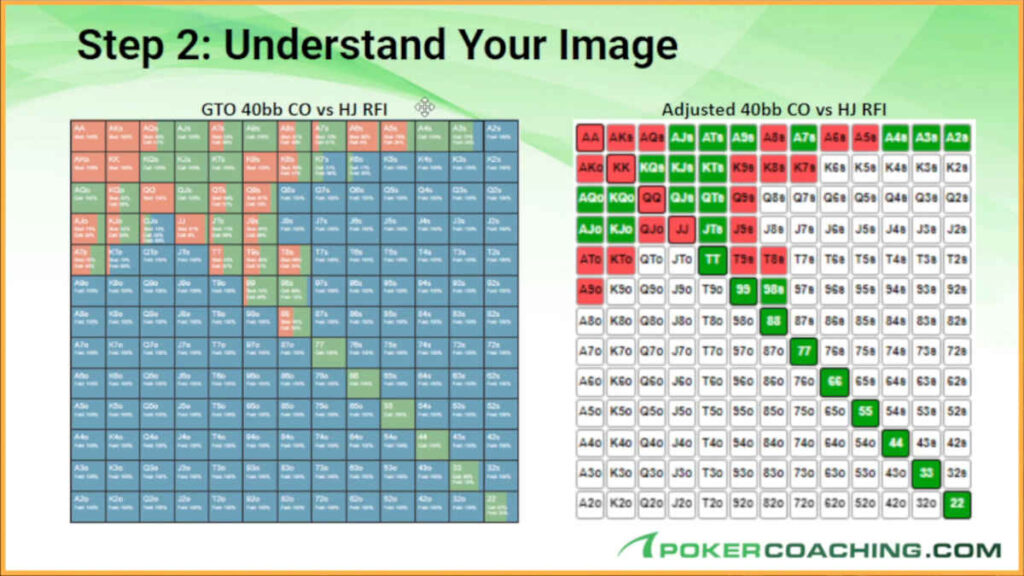
The chart on the left shows GTO ranges in this spot, with hands in red being the ones you should 3-bet with. As you can see, the range includes the best hands that we are happy to 3-bet and get the stacks in the middle with, and some weaker hands that you’ll fold to a shove.
On the right side, we have a chart that shows how you can adjust your 3-betting range if you have a tight image. The value range remains pretty much unchanged, but we have more bluffs, with hands like AJo, ATo, A9o, KJo, etc. Many of these 3-bet some percentage of the time in the GTO world, but, exploitatively, you can 3-bet them all the time.
With this adjustment, we’ll be 3-betting more often than opponents expect, and if they will over-fold, this will result in a bit of equity pushed your way. And, if they are especially tight, you can even start adding some marginal hands that are not on the chart, like K7s, K6s, 76s, etc.
The important thing is to stay reasonable and not overdo it. If you start 3-betting with hands like 74o, you’ll have a substantial preflop disadvantage that you won’t be able to overcome, regardless of your image.
Tip #3: Develop a Strong Mindset
You need to understand that, in poker, a penny saved is a penny earned. Saving your chips by reducing unprofitable plays is just as important as building your stack and taking profitable spots.
If you consistently make plays that lose you money, well, you will lose. Great players don’t worry when they’re card dead because they understand that everyone will get the same cards in the long run.
However, many players are overly concerned about short-term variance.
If you go to a casino for six hours, you may only get to play around 200 poker hands and maybe three big pots. If you lose two of those three, you’ll have a losing session – that’s just how things work. And that variance is exactly what makes the game profitable.
Cards can shift at any point during a session, and you can go from being completely card dead to playing a bunch of hands one after another. When this happens, it’s important to control the adrenaline rush, stay focused, and make the best decisions at each decision point.
So, to sum it up, when cards are not coming your way, you need to stay disciplined, take advantage of your tight image, and not lose your mind trying to win every pot, as this mistake is what torches a lot of less disciplined players’ stacks!