Image courtesy of the World Poker Tour
In today’s lesson, we’ll talk about a topic that some people see as possibly the saddest thing imaginable, and that’s quitting.
Of course, when we talk about quitting at poker, it comes in several different forms, such as:
- Quitting a cash game
- Deciding not to re-enter a tournament
- Quitting your current stakes and moving down
- Quitting the game altogether, for a while – or for good
Every time you decide to do something, be it playing poker, watching a video, or whatever else, you are choosing that particular activity over everything else you could be doing.
As the amount of time you spend on something increases, the amount of happiness you get from it tends to decline.
Of course, this article assumes you approach the game as a professional and care about making money from the game, first and foremost, and that’s the angle from which we’ll address these four different forms of quitting.
#1 When Should You Quit a Cash Game?
The right moment to quit a cash game is usually when the amount of money you expect to win no longer justifies playing.
When you play in a cash game, you win a certain amount of money per hand dealt, both in the short and long term. As a professional, you want to be thinking very strategically, i.e., how much I am making playing at this particular game, sitting in this particular seat.
Some tables will be way more profitable than others, and some seats will be way more profitable – if you have bad players seated to your right.
If you find yourself in a game that is very tough, you should also quit. Unless you are playing purely to get some experience, you will struggle to make any money in a tough setup, because your edge will be almost non-existent.
Finally, if you are playing poorly, you should call it a day. This usually happens as the session gets longer, as you’ll get more tired, but it can also happen because you’re tilted, annoyed, or simply not happy to be there.
If you’re feeling really unhappy, you’re basically grinding out a certain salary while doing something you don’t feel like doing, so, at that point, you need to figure out if it is worth it, or if you’d rather spend the next few hours doing something else.
#2 When You Should Not Re-Enter a Tournament
The number one deciding factor of when not to re-enter a tournament is your ROI. If you expect to have a tiny or negative ROI, re-entering doesn’t make sense.
When you enter a tournament late and you’re not close to the money, your ROI won’t be very high to begin with, plus you have to beat the rake.
So, if your expected ROI is 15% and the rake is 12%, you’re only expecting to make 3%. In a $100 tournament, that’s just $3.
If there are other things that you value more, such as studying the game or simply having a good rest, you should consider doing those instead.
You should also not re-enter a tournament that you’re not properly bankrolled for. For example, in a soft WSOP event, your ROI may be 50%, but if you are buying in very late, that number can drop as low as 5%. This means that you’ll need a substantially higher bankroll to re-enter late than you’d need when buying into this tournament from the start.
Finally, if you expect to play poorly, it’s better to skip re-entering. Maybe you’re on your fourth bullet, and you had your aces cracked several times, or maybe there are other mindset issues. Either way, if you are not feeling it, there is no need to push it.
#3 When to Move Down to Lower Stakes
When is the right moment to drop down in stakes? If you normally play $500 tournaments, when should you go down to $200? Or, if you grind $2/$5, when should you consider dropping to $1/$2?
While many players have problems dropping down in stakes, your ability to move down when needed will help you thrive in the long run. Forget about all the “glory” stories of players who went broke seven times and had to rebuild. You don’t need that in your life.
If you reach a point where you’re no longer properly bankrolled for the games you play normally, it’s time to step down for a while. This is perfectly normal, and I went through this process a few times during my career.
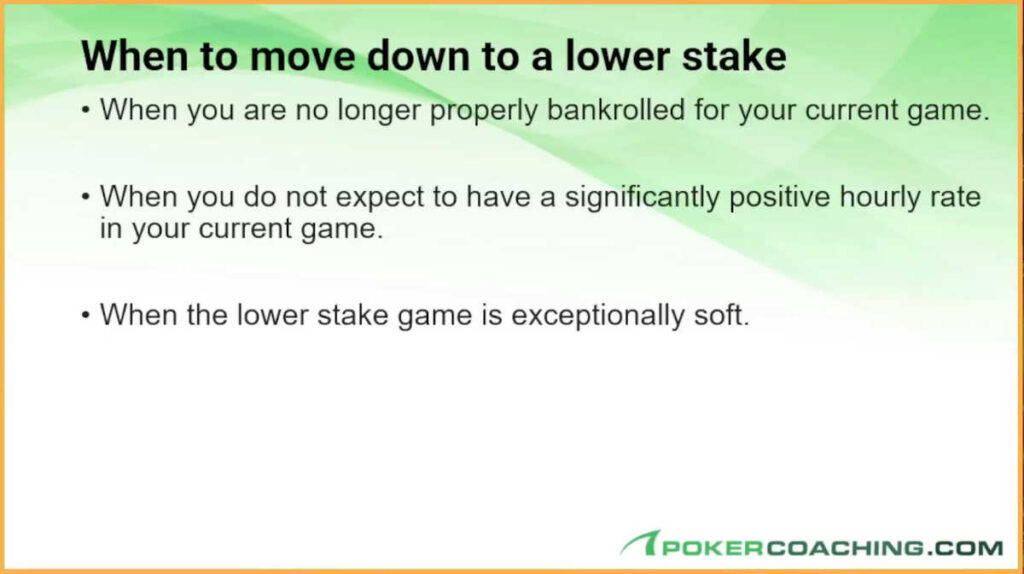
If you’re playing tournaments, be prepared to play some lower stakes or sell some of your action. Your ability to accept the situation and be cool with it will help you in the long run.
Additionally, if you don’t expect a high return in your normal game, you should consider playing lower. Often, you can expect to make more playing at smaller stakes where games are much softer instead of playing higher against a bunch of tough players.
I often say that the winning poker formula isn’t all that complicated: find a game you can beat, play it a lot, and keep a proper bankroll!
#4 When to Quit Playing Poker
This is really a rough decision and the one that most people really struggle with.
If you find yourself in a position where you’re no longer properly bankrolled even for smaller stakes games, it might be a time to quit. Of course, you can and should try moving lower to rebuild, but if that doesn’t work and you go broke, you should at least consider quitting.
There are alternatives, such as staking, and some players take loans, but I definitely wouldn’t suggest taking out any loans to fund your bankroll. Staking isn’t great, as you’re better off keeping all of your profits, but it could work.
If you’re no longer profitable, you should also think about quitting. This happens sometimes, especially in tournaments, and it’s difficult to figure out whether you’re no longer profitable or just on a really bad streak.
However, if you have a solid set of poker stats that tells you that you’re no longer making money, you should try to move down in stakes, and, if that doesn’t help, quitting is probably the right move.
All games get tougher with time, and sometimes they reach the point where you can no longer beat them. You can always take a step back and work on your game for a while.
Quitting poker is also a good decision if you no longer enjoy playing the game. For some players, this isn’t an option, as they don’t have other ways to make money, but if you have alternatives and no longer enjoy it, you should explore other options.
You have to invest time to make money with poker, and every hour you spend at the tables, you could potentially be doing something else that would make you happier.
The simple fact is that time is limited, and you need to spend it wisely. If what you’re doing isn’t teaching you something new, making you a lot of money, or bringing you enjoyment, I’d recommend finding something else.