
Image courtesy of the World Poker Tour
Properly balancing your river range to contain just the right ratio of value bets and bluffs is a fairly intricate matter, but it is one that you have to be aware of, as you’ll be getting to a lot of rivers playing No Limit Texas Hold’em.
If you bet the river with a perfectly polarized range, where your value bets beat all of their realistic hands, and your bluffs always lose to their calls, the opponent will be indifferent with all of their bluff catchers, i.e., all of those in-between hands that make up a decent portion of their range.
To have a balanced range, assuming that you are perfectly polarized, you need a number of combinations in your range that are bluffs equal to how often your opponent needs to win based on the pot odds.
It is important to emphasize that this math only works if you are really perfectly polarized, which means that your value bets actually win when you call. Otherwise, this concept starts to get rather murky.
So, for example, if you bet 50% pot on the river, they have to call 0.5 of the pot to try to win 0.5+0.5+1 = 2, which means they need to win 25% of the time.
With that in mind, your entire river betting range needs to contain 25% bluffs to get to the point where your opponent is indifferent, and that percentage changes the bigger your bet gets.
If you bet pot, you get to have 33% of bluffs in your range, and the larger the bet, the wider the range you can play profitably.
This is exactly why you see some of the top pros betting huge on the river. When you bet 200% of the pot, you get to have as much as 40% of bluffs!
Required Bluff Success Frequency
Many times, you’ll get to the river with a hand that can’t win, and you’ll be thinking about how often you need your opponent to fold for you to bluff profitably in that spot.
The GTO ratios we’ve just covered do not matter if you think your opponent will call or fold too often.
To figure this out, we need to go back to the Medium Defense Frequency (MDF) and adjust our ratio so that we over- or under-bluff.
Some players are calling stations. Once they call on the turn, they’ll never fold on the river, and against them, you should drastically under-bluff or not bluff at all.
Other opponents will call on the turn, but if their hand doesn’t improve, they’ll give up on the river. Against these players, you can bluff more frequently than the GTO suggests.
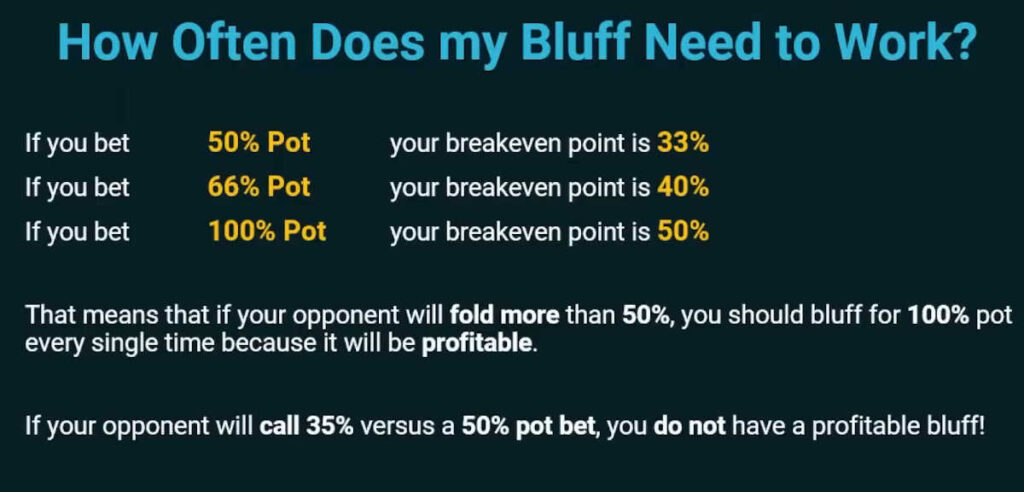
When you are bluffing, if you win more than bet/(bet+pot), your bluff is profitable.
So, if you bet 25% of the pot, you profit immediately if they fold more than 20% of the time, and it’s really hard to defend with 80% of the range on the river. This is why you’ll find that small bets work extremely well against players who don’t understand this concept.
- If you bet 50% pot, you profit when they fold 33%
- If you bet 100%, you profit when they fold 50%.
- If you bet 200% of the pot, you profit if they fold 67%.
Just like small bets, huge river bets can be very effective against some players, especially at lower stakes.
When making a decision, you need to ask yourself if your opponent will fold to a particular sizing. For example, if you believe they’ll fold more than 50% to a full pot bet, you should bluff every single time.
If you know they’ll call any river bet 40% of the time, you should bet as small as possible to give yourself a chance to be as profitable as possible.
Counting Combination
Not all poker hands are equally as likely. There are 16 combinations of every unpaired hand – 12 offsuit and four suited combos.
There are also six combinations of each pocket pair.
So, clearly, there are more combos of unpaired than paired hands, and more offsuit and suited combinations across the board.
The range that your opponent could have changes based on the cards you know exist, whether they’re on the board or in your hand.
Say there is the A♥ on the flop. You automatically know they can’t have any AK combos containing the A♥, which reduces the total number of Ace-King combinations from 16 to 12.
If two aces are out, the number drops to eight. If an ace and a king are out, the total number of AK combos available is nine.
When it comes to pocket pairs, if there is one ace out there, there are only three combos of pocket aces remaining. If two aces are out, there is only one.
This is why you see a lot of the best players using hands like A9o or A5o as potential bluffs. These aren’t good hands, but they know their opponents are half as likely to have pocket aces, and their chance of having a big ace (AK, AQ, AJ) is 75%.
You can use these concepts on the river, too. If you have the A♣ and there are three clubs on the board, you know that the opponent can’t have any nut flushes, which blocks a lot of strong hands.
ICM Math
Independent Chip Model (ICM) considerations come into play in tournaments. When there is a bubble approaching or a pay jump looming, you should generally avoid taking big risks that could bust you, unless they are very obviously profitable.
ICM should help you make profitable plays that win you money, not just chips.
ICM calculates the probability of each player finishing in a particular position in a tournament and multiplies those probabilities by the payouts for each position. It does not take into account skill edge, relative position, increasing blinds, or general tendencies.
So, it has its limitations, but it is important to understand and study, because it comes into play when a lot of money is on the line at the end of the tournament.
Chip EV (cEV) and money EV ($EV) are usually different when there are payout implications. Chips you lose are worth more than the ones you win. If you go broke, you don’t have the potential to chip up and make future pay jumps. When you double your stack, you don’t double your equity.
Because of this, making profitable plays based purely on cEV can actually lose you money in tournaments.
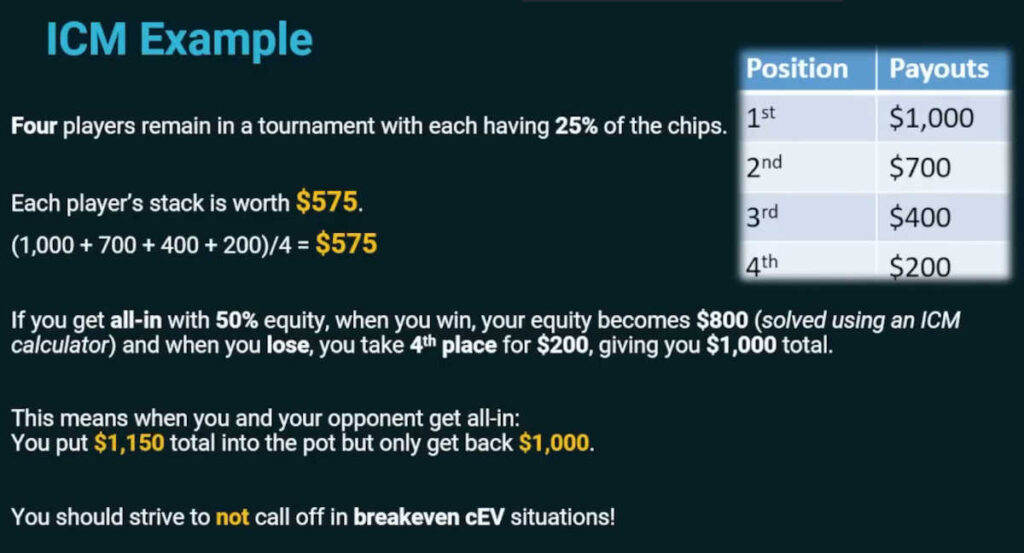
All situations differ, and ICM is hard. It is probably the hardest part of tournaments. Largest and most significant payout jumps often occur in weird spots.
For example, getting in the money, i.e., surviving the bubble, is usually quite important. But then, outlasting another third of the field might only get you from $1,700 to $2,000, so the difference isn’t all that important.
Then, ICM becomes very important once more late in the tournament, especially at the final table.
Also, it’s not just your stack that matters. It is a very different situation when everyone has 20 big blinds and when there are two players with just a couple of big blinds that you can outlast by just folding a few hands to secure a pay jump.
Finally, as payouts become more relevant, you should move away from the all-in or fold approach. Sometimes, you can raise – fold from a stack of 10 big blinds when you are highly incentivized not to go broke.
ICM is hard, and there is no magic bullet, and things can get further complicated in hybrid formats like progressive knockout tournaments, so this is one of those areas that you’ll simply have to work on constantly to stay on top of your game.