
Image courtesy of the World Poker Tour
There are many players out there who struggle with paired boards in No Limit Texas Hold’em. The main thing holding them back in these spots is the lack of understanding of range and nut advantage.
This causes them to make some significant blunders on paired flops.
Some players try to overcome this by playing a uniform strategy across all paired flops, but this doesn’t work. Not all paired boards are created equal, as you won’t be as likely to have trips on all of them. Things change significantly depending on the position and the situation.
This is an extensive topic, and the best way to address it is by going through some examples and focusing on the most important aspects of what you should and shouldn’t be doing.
Example #1: 40bb Deep on KK6
We’ll start with a situation where a UTG makes it 2x, and we defend from the big blind, playing 40 big blinds deep. The flop comes K♠K♥6♦.
After we check, the opponent proceeds to continuation bet small (25% of the pot), which they should do with pretty much 100% of their range here.
When deciding how to proceed, we have to figure out who has a range and a nut advantage in this spot, as we know that the opponent’s strategy is to bet small at a very high frequency.
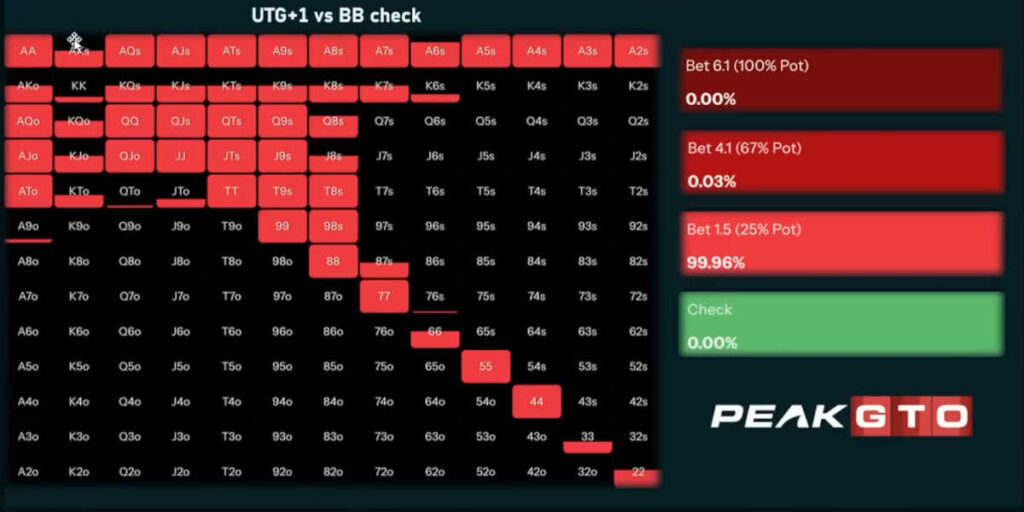
You’ll notice that the UTG raiser has many kings in their range, as well as pocket pairs and some decent ace highs, all of which play pretty well in this spot.
Taking this into account and looking at our range, we see that we have a lot of really bad hands, which means that we have to fold a lot in this situation. We are at a disadvantage, both in terms of the entire range and the nut potential.
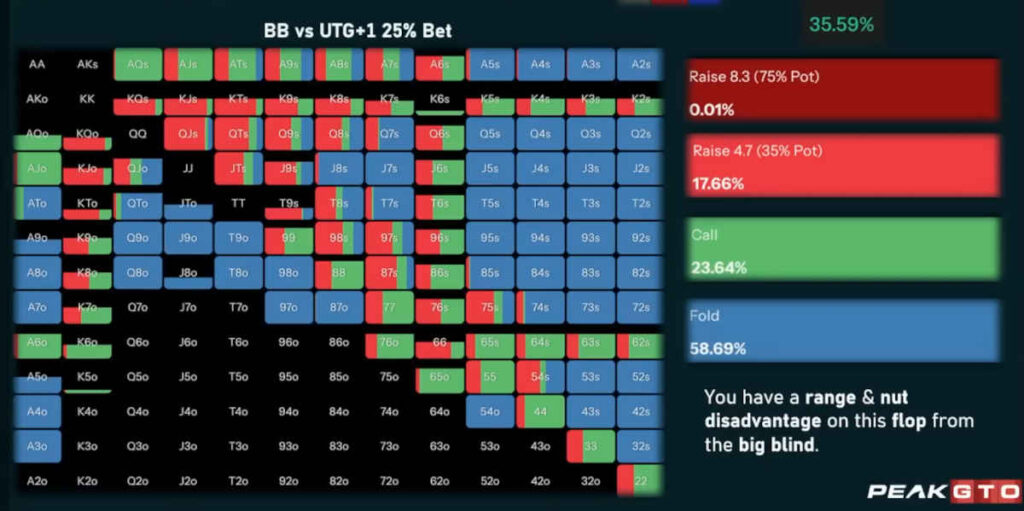
We are folding all hands in blue, and even many of our ace-highs are not loving this situation, as these hands become difficult to play if we face turn and river bets.
Generally speaking, we are looking to do a lot of raising on paired boards, in the spots where we have an advantage. Seeing how that’s not the case here, we simply have to fold a lot, and we can only raise with the combos containing a king and some combinations that wrap around the flop cards and also have a backdoor flush potential, such as QJ, JT, QT, as well as 97, 87, and 75.
But what happens if we change things slightly and move the original raiser to the button?
Hand ranges change quite significantly here. The opponent is still betting small and frequently, but here, we have way more Kx holdings, as well as a variety of hands containing a 6, so we get to stick around significantly more often. We are folding only 47%, and our defense strategy includes 33% raises, which is a significant shift compared to 17% that we had against a UTG raiser.
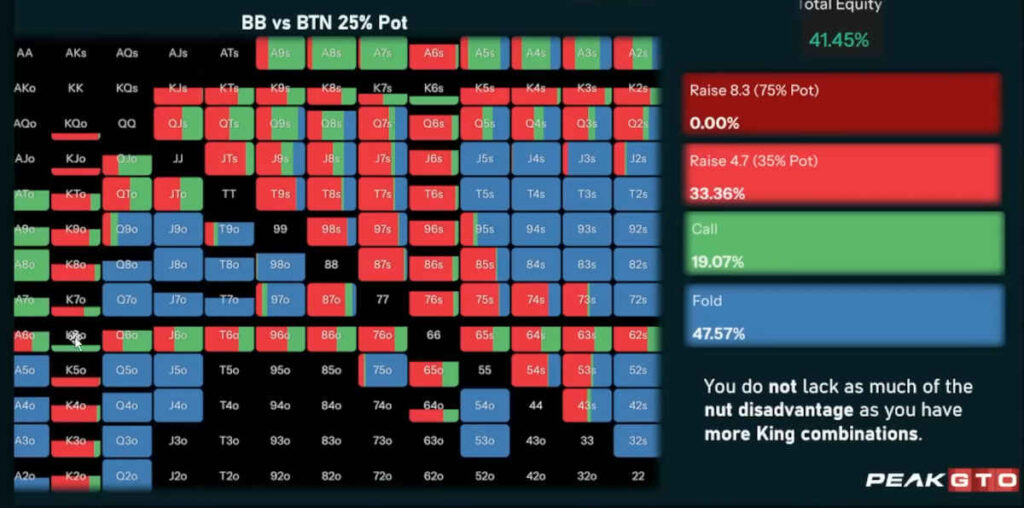
The fact that our range changed to contain way more trips combos allows us to raise much more often. While we are not doing any donk betting, we are raising the same types of hands for value, but we also get to raise with more bluffs. Here, we can start to include some of our offsuit hands as well, simply because our range contains more value.
Example #2: 25bb Deep on JJ6
Let’s now look at a different example. We are playing 25 big blinds deep, a UTG+1 opponent raises, and we defend from the big blind. The flop comes J♠6♥6♣, and after we check, they fire a small, 25% pot c-bet.
This is actually one of those spots that the original EP raiser shouldn’t be betting at a high frequency at all, since they don’t have very many sixes in their range. At the same time, we have quite a few in our defense range.
However, not many players realize this, and they’ll auto-bet any paired board. In fairness, this strategy probably works well in most games, simply because most players don’t check-raise nearly often enough.
We can see that the big blind doesn’t have that much raw equity in this spot. However, we do have a lot of super-nutted hands that can easily put in a check-raise.
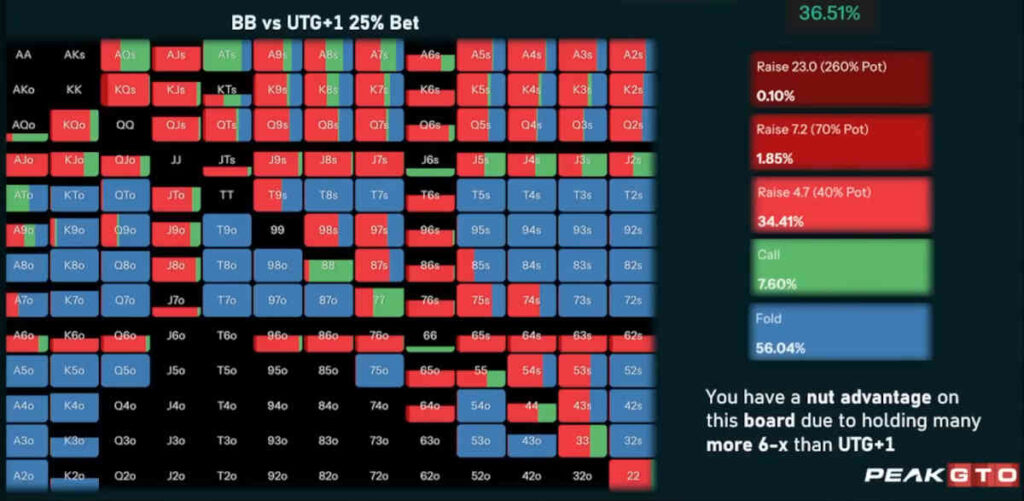
This gives us the freedom to attack the c-bet a lot, raising about 36% of the time and only calling about 7%. We also don’t have to go super big with our raise sizing.
We can put in a check-raise with a variety of holdings containing a jack or a six, as well as hands wrapping around the flop, especially when they contain a flush draw, as well as some overcards like aces, kings, and queens, when there is also backdoor flush draw potential to back it up.
Hands that we prefer to call with in this spot are solid ace-highs, some top pairs with bad kickers, and some pocket pairs.
But what happens if we move the original raiser’s position to the button once more?
Now, the button has more sixes in their range, but they also have more random, unpaired hands as well. Because of this, they are supposed to check back about half of the time, and we get to check-raise a lot with a variety of jacks, sixes, and hands with backdoor equity.
In reality, most players don’t really check-raise enough with hands like Qto, A4o, or 8h5h. Instead, they’ll just fold, which allows the original raiser to c-bet indiscriminately and win a lot.
So, in summary, if you want to improve your play on paired boards, you need to pay attention to positions, stack depths, and really understand who has range and nut advantage. Use that knowledge to attack the players who c-bet too often, raise them aggressively when you have the nut advantage, and stick around more often in marginal spots.
This should give you a significant upper hand over a majority of the opposition, especially at lower stakes, as they won’t have the right response to your aggressive strategy.